taxes are a solved problem that humans know how to do, ai is decent just not all people want to trust it with a task that’s much higher stakes for them
No one knows how to do RH, but if RH gets solved for most laypeople it’s not that high stakes
the actual reason one may think this is because a non mathematician has a lower TRUST barrier to accepting a proof of RH than a mathematician, as it means way less to them
@willccbb@tenobrus not exactly algorithms but construction of better codes in coding theory have actual applications to communication
for example Arikan polar codes from 2016 are now used in 5G
@mikeandallie cohn-elkies was shown to be better than KL-based bounds, but this is the first time we have a new “explicit best number” for asymptotic sphere packing
i agree i did dramatize a bit
Yeah I think it’s way smarter than a grad student. For context
1. last numerical progress 1978
2. last progress 1979
3. posed 1999
4. posed 1982
5. defined 1979, first improvement since trivial bound
6. last progress 2016
7. last progress 2003, first polynomial bound
8. posed 1964
9. posed 1961, $250 prize by Erdos
10. posed 1967
An internal version of Astra, @OpenAI’s next major model family, solved 10 major open problems in mathematics, quantum complexity, and theoretical computer science.
We believe it will be a major step for scientific reasoning. https://t.co/iP6cyheZ7i
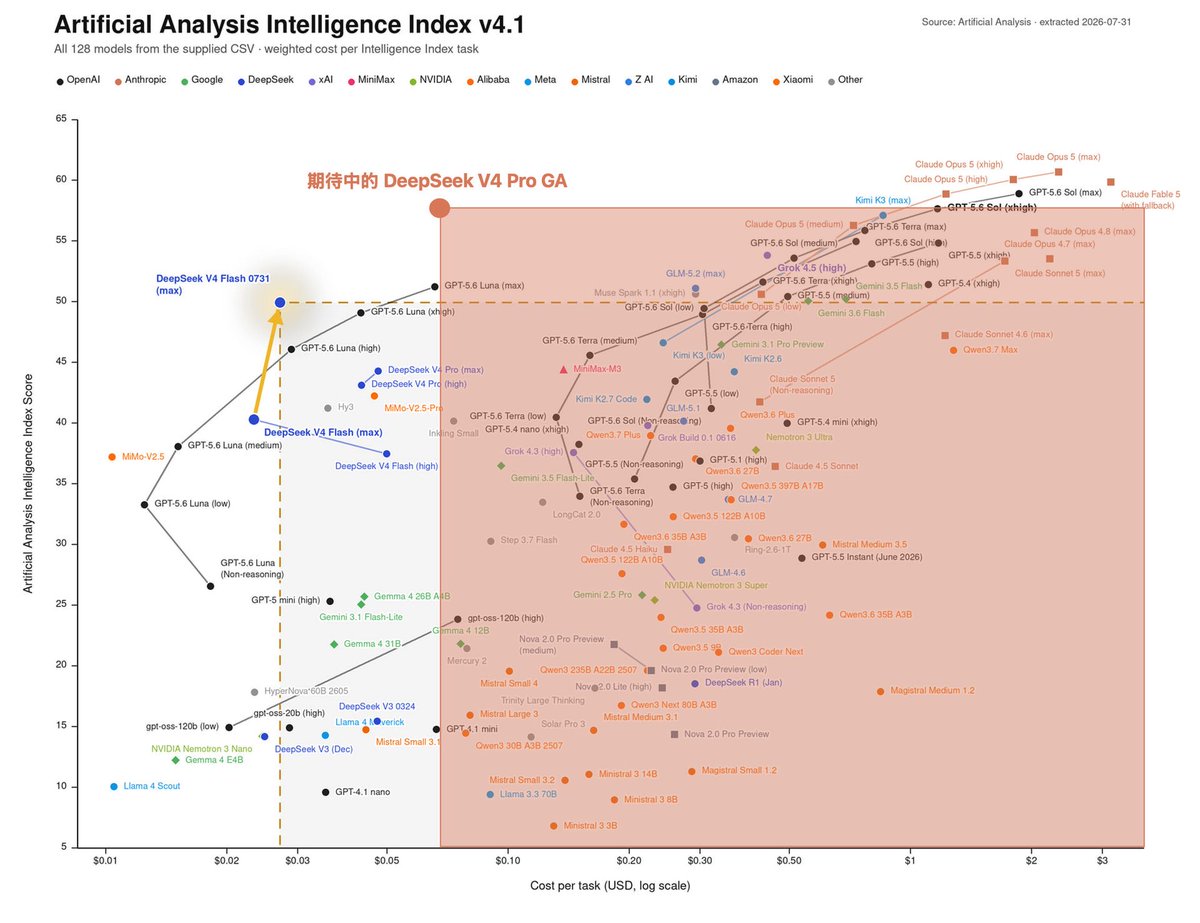
Cost per task is a good metric, but not perfect if the tasks don’t cover your space
Would highly recommend trying a mix of deepseek and other models instead eg @usetokenless
DeepSeek Kill Zone.
Models that are inferior and significantly more expensive should cut spending and be in survival mode ASAP.
Models that are superior but also more expensive or slightly inferior but with comparable pricing can survive a bit longer.
Some initial thoughts, and a complicated mix of feelings.
1. Wow. I mean, Erdos problems are cool (I genuinely mean that), I didn't know about the Jacobian conjecture before it got disproved. But this newest batch from OpenAI hits home in a way the previous announcements did not.
New circuit lower bounds? A simple, easy-to-describe non-sofic group? Hardness of approximation for CVP without needing a unique games-like conjecture? I didn't just hear about these problems from my friends or from seminars. I feel their importance in my bones; I deeply care about the answers to these questions.
@adntaha_ai well it sounds like we need to make lean or whatever else a trusted kernel through rigorous fixes
if this is the case, then what one needs to do is just verify the statement of the theorem is correct, which is a whole lot easier!
@ColinZwanziger sphere packing was resolved in dimensions 8 and 24. this version is asking about the asymptotics in large dimension, ie as dimension increases what does the optimal sphere packing fraction tend to?
@Ravenoil i think which result seems most important depends on taste. i did a bunch of tcs stuff so sphere-packing and coding theory stuff feels more impactful to me
the results presented here are super super major conjectures i had heard all of
also 27 years is a long time!
I want to emphasize these are NOT obscure problems, but deep and foundational problems that many people were either stuck or people were making small incremental progress on.
@gro_tsen Using < for subset,
NP^G < NP, P^G < P, and P <= NP, clearly you're putting two lower-bounds on two quantities and saying the lower bounds are unequal... doesnt say anything about the original quantities
For a finite set of integers (A), how much faster can (|A+A|) grow than (|A-A|)?
A 1969 theorem gave an upper bound of 2 for the exponent. For more than 50 years, the best constructions barely exceeded 1.1.
With help from our research agent Hyra and the Hy3 model, we found an explicit construction showing that the optimal exponent is exactly 2.
A 50-year-old problem, solved.
Paper: https://t.co/OU7lfH0hXR
Hyra blog: https://t.co/NeQEekUSZ3
Formal proof: https://t.co/LMbGdKqo2D
@thomasfbloom Perhaps the proof is not very surprising--
But this was a problem I thought about when I did TCS by hand in the stone age. My puny TCS brain thought it was pretty cool
(obviously AP-free sets, sum-product and PFR are cooler)