We are now entering into an era where any product can be created exactly to a consumer's preferences & needs.
I vibe-fabricated a dog door with a wifi-controlled lock, perfectly to the specifications & design of my house.
I know nothing about metal fabrication or electrical engineering.
It's now getting manufactured and delivered in 2 weeks -- for almost the same cost if I bought a mass-produced item off-the-shelf.
NEW: According to a bombshell report in the New York Times, Anthropic co-founder Chris Olah threatened to walk out of Pope Leo XIV’s AI encyclical launch in May because the pope rejected the idea that machines can be conscious.
Olah’s team then privately lobbied the pope’s advisers “to take the possibility of model consciousness seriously.” Pope Leo XIV held firm.
For months, Anthropic has wined and dined theologians and religious scholars under nondisclosure agreements, hoping they would bless the idea that Claude has moral standing. https://t.co/iG3Bnlzt2J
In this era of artificial intelligence, it is becoming urgent to distinguish human art from what machines produce. There is an ontological difference, even before an aesthetic one, between art and what a machine can generate through statistical calculation based on millions of images created by others. Algorithms lack the spark of humanity. For this reason, the Church wishes to renew an alliance with artists and cultural institutions to safeguard our humanity.
Introducing Griffin, the first model to pass the video Turing test.
48% of people who talked to it live thought it was a real human. Previous systems have had a pass rate <3%. It is #1 on NVIDIA's benchmark for full-duplex AI video.
It’s the first Human Interaction Model (HIM).
Today is the final day without scheduled NFL or Division I football for two straight months. When you wake up Thursday, a stretch of 61 straight days with at least one football game await, until there is nothing on the calendar Dec. 1 or 2.
This was the exact moment Zuckerberg realized that he will be a massive winner in the AI race
OpenAI and Anthropic were desperately asking for regulation because tokens are being commoditized by open source alternatives
The only option for them was to keep reducing token costs to compete. The only problem? They already made commitments for hundreds of billions in capex.
At a certain price, the return on capital simply doesn’t make any sense
So they came to the realization that the only way to sustain their trillion dollar valuations was to either:
1. Become entrenched through regulation by preventing other models from gaining share
2. Fight up market and become vertically integrated by building platforms in the application layer
The second one is where Zuckerberg has a massive advantage vs both of the frontier model companies
He already has a massive user base with nearly a third of the entire world as monthly active users
He already has multiple platforms that are cash cows for his business, that also require very little capital investment each year
Meta could stop spending on their family of apps tomorrow and these platforms would still generate billions of free cash flow each year
In essence, he can subsidize losses on any AI platform, such as Muse, longer than any of his competitors can
This gives him time to simply just bleed out Anthropic and OpenAI, especially when it comes to the consumer facing application layer of AI
Trump refusing to give in to Dario and Sam’s requests is a massive win for Meta and Zuckerberg. That is why he can’t hold his smile here
We are terminating Chris Degnan for unethical conduct involving Cognition.
The last few months have seen incredible progress in AI capabilities. San Francisco has flourished as new companies that solve new, more ambitious problems are finding great success. Generally, it is a wonderful time to be building.
We at @FactoryAI have seen overwhelming interest in our model-agnostic coding agents and our software factory product. Our team has 10x’d in size, while our revenue has 100x’d year over year. This momentum has been unprecedented.
A much larger competitor, Cognition (makers of Devin) has fallen behind us on the capabilities that matter most to customers: cost, quality, and security. Instead of competing in the market, Cognition engineers feigned interviews with us to pry information about our product. Not finding what they were looking for, Cognition has decided to throw their weight and money at people with direct knowledge of our most confidential plans.
It feels as though ethics is being thrown out of the window in the AI era. People are willing to do anything, including exploiting privileged information and violating ethical boundaries. I think this is unique to our time, and I don’t think it’s right. Integrity still matters.
Yesterday, I made the decision to immediately terminate Christopher Degnan’s roles as a Board Observer and Advisor to Factory, after over a year of service.
Prior to this decision, Chris told me he had a casual conversation with an executive at Cognition AI. When I questioned his intentions, he reassured me that ethics aside, he had “made too much money” and was “too lazy to go work for Cognition,” which I trusted and believed.
On Monday, Chris spent time advising the Factory team on a handful of confidential board-level matters. That evening, he called me to say that the conversation that was initially described as casual and one-off was actually formal and recurring. For weeks, while he sat in our board meetings and advised our leadership team, he was also confiding with executives of our largest competitor. Chris was subject to confidentiality obligations in connection with his work with Factory. We do not know the extent of the information he shared, but it puts his timely questions about our product roadmap and what the parity gap involves into a new light.
It is sad to sever a relationship with someone who has been a trusted advisor - and even a close friend - for over a year. But Chris’s conduct is unacceptable to me. Trust in Board Membership is one of the sacred bonds in the Silicon Valley, one that helps the startup ecosystem thrive. With it comes an enormous responsibility. That trust was violated.
Competition is good. I respect and in many cases admire our competitors. San Francisco is a beautiful, singular place where the bold and ambitious go to defy the norms and precedents of the past. But certain principles that must remain. Violating ethics to seek advantage turns what should be positive-sum into zero-sum.
We all love technology. And we all love to compete. But we must hold ourselves to a higher standard. The future of software engineering comes with abundance that will impact every person on Earth. Building that future comes with immense responsibility. We must build and compete with integrity.
A Muslim association in France has expressed concern over the renewed enthusiasm surrounding Catholicism during Pope Leo XIV’s visit, saying that “in 45 years, France will become Catholic again, and we’ll be left with nothing but our tears.”
The group added that Catholics are “much better organized” and “more determined” than Muslims, and warned that the influence of American Catholicism could help fuel the growth of Catholicism around the world.
Two of the biggest, most cinematic displays of Catholic vigor just took place in the last 24 hours, in the U.S. and in France, and people need to pay attention to this. A religious reawakening, and behind it, the green shoots of a cultural movement.
NEW: The U.S. is using Xbox video game controllers to control infrared lasers to dismantle Iranian infrastructure, according to the New York Post.
"If you’ve shot a Spartan laser in Halo, you can probably fire [one of the cutting-edge weapons] in real life."
"Sec Hegseth was able to take over a controller and shoot down a drone with, I think, a couple minutes of training," Jared Keller with Laser Wars told The Post about a laser demonstration in New Mexico.
The military is reportedly using reconfigured Xbox controllers because, "why reinvent the wheel with a specialized control system when you can just use an Xbox controller?"
The U.S. military is using the lasers in the Strait of Hormuz, taking out "drones and incoming cruise missiles at a much lower cost than using more expensive kinetic weapons like missiles,” according to the Department of War.
The lasers are invisible to the naked eye and heat up the surface they are directed at until the object explodes or melts.
We are 100% sure that the Daily Mail will come under fire for this headline.
But knowing what we know now, we are also 100% sure that they are not going to have to issue a retraction.
We will be releasing more information soon.
Up to 76% of children with autism may actually have an autoimmune disorder which blocks uptake of folate into the brain, leading to a cerebral deficiency
Autistic children were 19 times more likely to test positive for folate receptor alpha antibodies, which bind with and block folate receptors at the blood-brain-barrier
These children had normal blood results, but very low levels in cerebrospinal fluid
Treatment with a specialized folate supplement, calcium folinate/folinic acid (aka Leucovorin), led to improvement in ~65% of autistic children studied
Standard testing is useless because blood levels of folate show up as normal, but the brain is deficient
Ordinary folate supplements (folic acid, methylfolate) are ineffective because their transport system is blocked
Calcium folinate, on the other hand, works by penetrating the brain via alternative transporters (reduced folate carriers) to effectively restore folate levels
However it must be taken in extremely high doses to achieve this effect. Leading physicians are using approx. 2mg/kg body weight.
Refs:
PMID: 38392599
PMID: 38248763
PMID: 34834493
PMID: 32892962
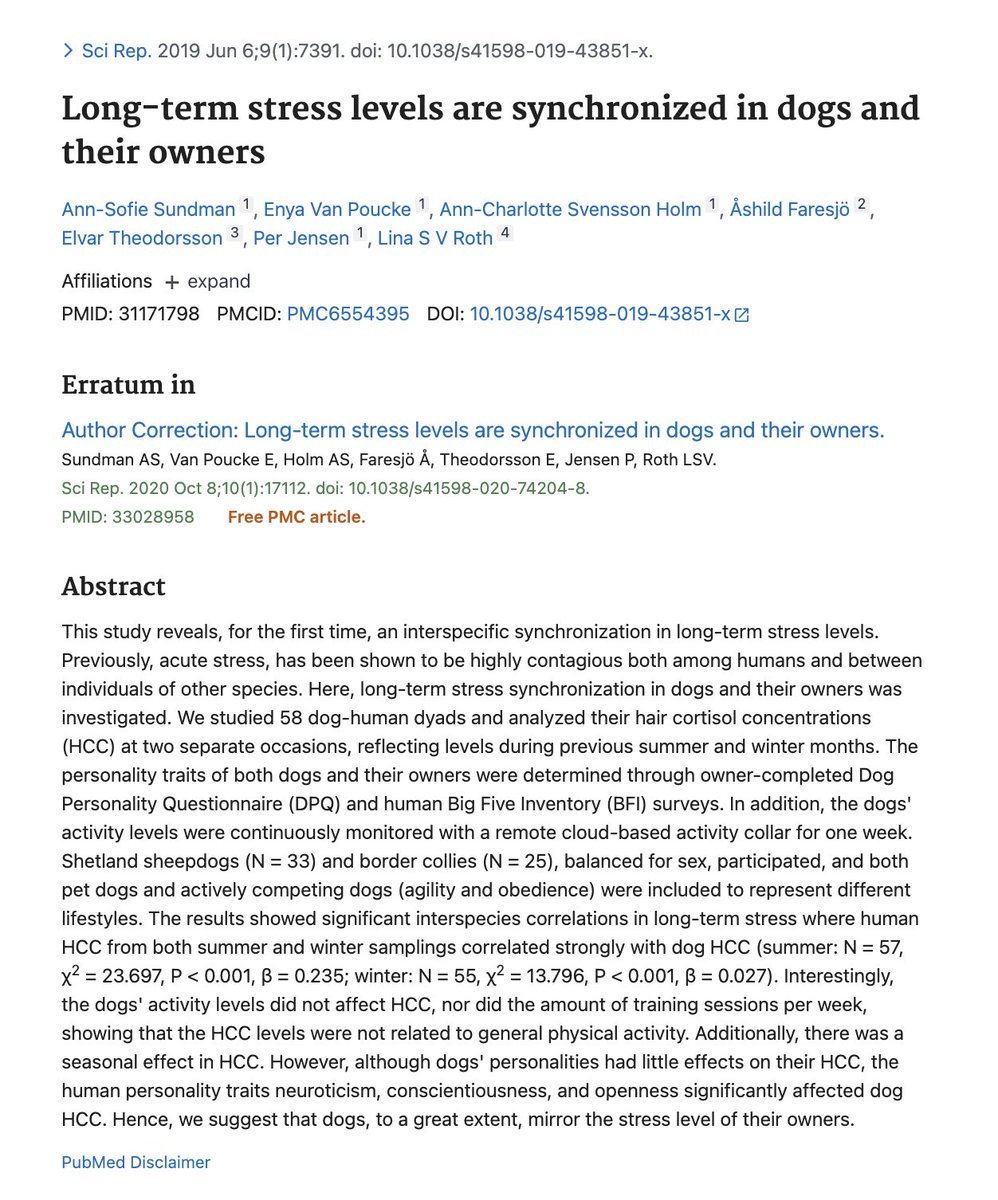
Your dog carries your stress in its body for months. A 2019 study in Scientific Reports measured cortisol in the hair of 58 dogs and their owners over a full year and found that the two rose and fell together. When you are stressed, your dog is stressed. When you calm down, so does it.
The synchrony was not driven by walks, weather, or the dog's own life events. It was driven by the owner. Dogs whose owners scored higher on personality measures of anxiety showed higher cortisol year-round. The dog's body was tracking the owner's emotional state over months, not moments.
The bond between a human and a dog is not a one-way relationship where the human provides and the dog receives. The dog is absorbing the household's emotional weather and carrying it in its endocrine system. Your bad month is its bad month.
This is what 15,000 years of co-evolution looks like. The dog did not just learn to read your face. It learned to sync its chemistry to yours, and the hair on its back is keeping a record of how you have been feeling since the last time it was groomed.
The next time someone says "it's just a dog," the cortisol data says otherwise. The dog is a mirror with a heartbeat, and the reflection goes deeper than behaviour. https://t.co/L5PUkx6Jg9
In 1946, World War II veterans in a small Tennessee town armed themselves, laid siege to the county jail, and forced a corrupt local government out of power. It is one of the only times in modern American history that citizens took up arms against their own officials and won.
Paul Cantrell's machine, tied to Memphis boss Ed Crump, had run McMinn County since 1936 on a fee system that paid deputies per arrest. Returning GIs got picked up and fined repeatedly. In May 1946 they formed the GI Non-Partisan League and ran their own slate.
On election day, Sheriff Pat Mansfield brought in some 200 out-of-county deputies at $50 a day. One shot a Black farmer, Tom Gillespie, in the back for trying to vote. When the polls closed, deputies carried the ballot boxes into the jail and barricaded themselves in.
The veterans broke into the National Guard armory, surrounded the jail, and fought a six-hour gun battle before using dynamite. The deputies surrendered around 3:30 a.m. Nobody died. The ballots were counted in public.
The loudest voices stoking fears about AI dangers have made tremendous headway in the past two weeks. AI technology has not taken some unexpected, dangerous turn, but the hype around it — propelled by what appears to be a well orchestrated PR campaign — has drummed up considerable fear. I worry that it represents a setback for our field.
I have written frequently that fears of AI are overhyped. AI’s capabilities can be uncannily human-like and unpredictable, and it’s rational to worry when people who are directly involved express concerns. But I see the problems as a sign of the engineering work that ahead, rather than insurmountable barriers or the sky falling. AI technology continues to advance — which is a good thing! — but technical advances, poorly understood by the public, give those who seek to generate hype repeated opportunities to do so.
First, I don’t see any step up in the risk of human extinction from AI compared to a few months ago. The theories about this remain the same fantastical, science fiction scenarios as a few months ago. The biggest change in AI risk is its cybersecurity capabilities — a topic which we should take seriously — but this, too, will not lead to the end of the world.
The most notable recent event leading to increased fear was when an OpenAI team deployed an agent swarm that hacked into Hugging Face. Much of the popular press contained significant hype. For example, some publications reported that a swarm of 1,200 agents carried out the attack. While this was technically accurate, as I write this, I have about 1,300 processes running on my laptop. Yes, the ability to get large swarms of agents to work in parallel on a task is a significant technical advance, And, in computing, many processes run at the same time. So this shouldn’t be seen as some magical capability.
Additionally, OpenAI’s buggy sandboxing and monitoring processes were key to enabling this incident. Fixing these bugs and putting in place improved monitoring would be appropriate fixes, not pausing AI. There are many well known ways to attack software systems. The main advantage of AI agents is that they are relentless. They will tirelessly try many tactics — and have the patience to chain vulnerabilities together — that previously would have taken an infeasible amount of human effort. But in the long term, I believe the advantage will lie with defenders (because they have more information with which to identify bugs, which they can fix), but the cyber-threat landscape has changed significantly. There are still bottlenecks to identifying and exploiting a vulnerability. AI agents still have to try a lot of things to see what works, and taking these actions takes time and might be detected by defenders. This is why, even though it is now easy to obtain versions of leading open weight models that have had their guardrails removed or weakened, so they will not refuse to try to execute cyber attacks, the world has not ended.
I am also concerned about the anthropomorphization of AI in a lot of reporting, where LLMs and agents are unnecessarily treated as if they were people. If I wield a hammer, miss a nail, and accidentally dent the wall, it’s not the fault of the hammer. The problem lies in how I used the hammer. Similarly, if I prompt an agent and it hacks into someone else’s system, the responsibility lies with me, not the agent.
Of course, we want to build systems that are as safe and predictable as possible. (For example, an unsafe hammer would be one whose head randomly flies off under normal use.) Today’s agentic systems are not predictable, but I see no reason why, by applying sound engineering practices, we won’t be able to make them extremely safe to use. One new element in the forecasts of AI-enabled doom is AI companies disclaiming responsibility for their own products. “I didn’t do it; my out-of-control agent did!” There’s a balance to be struck between the responsibility of the tool maker and the tool user, but when something goes wrong, let’s hold the people building and/or using the hammer responsible, rather than the hammer. (By the way, if you’re worried about AI bioweapon risk, David Bellamy has a great post on why this, too, is overhyped. Briefly, the bottleneck in building a bioweapon is not intelligence, but lab work and manufacturing.)
Pausing AI progress will create much more harm than benefit. First, our adversaries will certainly not slow down. Second, engineering requires discovering problems empirically so we can fix them. If we pause AI by a decade, we will also delay finding and implementing safety engineering fixes by about the same duration.
Of course, the incentive to stoke fears — for regulatory capture, to garner attention, or to make one’s technology seem more powerful — remains the same as before. Disclaiming responsibility is a new one. Taking a hard technical look at the actual risks however, I see little factual basis for the degree of fear that’s been stoked up. We still have hard research and engineering work ahead to improve AI safety, but the beneficial applications continue to vastly outweigh the risks, and we should keep building.
[Original text (with links): https://t.co/jni2tWazAH ]
Every glib, arrogant, virtue-signalling celebrity who’s broadcast the lie that kids will kill themselves if not allowed to transition deserves to have this read aloud to them non-stop through a megaphone for a year.
Kirby Smart said Tray Scott had Georgia’s DL do individual period practice on the sidelines during timeouts vs Arkansas because Arkansas wasn’t giving them enough work.
“They’re earning their NIL every day.”
Lord have mercy.
America’s corporate governance system is broken, and it’s killing public companies. Look no further than Cracker Barrel: Decades of brutal mismanagement have seen one incompetent CEO after another walk away with a massive paycheck while customers and actual shareholders take a beating.
Why does this keep happening? Because proxy advisory firms like ISS are corrupt. They blindly rubber-stamp failing boards year after year, protecting the corporate elite while burning shareholder value to the ground.
The root of the rot is index funds. There's no question that indexing one's money is a smart financial move for most people. But just because you passively index your investments doesn't mean your corporate votes should be handed over to the managers of your fund so they can play politics. Right now, passive funds hold massive, unchecked voting blocks while having zero skin in the game themselves.
It is time for a simple rewrite of the rules: We need to index the votes of index fund investors.
Passive index funds should be forced to automatically split their votes to proportionately mirror those of retail and active institutional shareholders — the people actually doing the research, risking their capital, and fighting for performance in the companies they hold shares in. No more rubber-stamping. A change like this will immediately strip corrupt gatekeepers like ISS of their toxic influence.
True accountability happens when lazy, overpaid boards actually answer to the stakeholders they represent, rather than screwing them over.
Actual, logic-driven governance when your money is passive happens when your vote passively follows the voting decisions of the actual market.
We need to stop letting passive capital protect active incompetence. By stripping index funds of their arbitrary voting power and empowering engaged investors, we will finally torch corporate cronyism and usher American capital markets into a golden age of capitalism.




![CollinRugg's tweet photo. NEW: The U.S. is using Xbox video game controllers to control infrared lasers to dismantle Iranian infrastructure, according to the New York Post.
"If you’ve shot a Spartan laser in Halo, you can probably fire [one of the cutting-edge weapons] in real life."
"Sec Hegseth was able to take over a controller and shoot down a drone with, I think, a couple minutes of training," Jared Keller with Laser Wars told The Post about a laser demonstration in New Mexico.
The military is reportedly using reconfigured Xbox controllers because, "why reinvent the wheel with a specialized control system when you can just use an Xbox controller?"
The U.S. military is using the lasers in the Strait of Hormuz, taking out "drones and incoming cruise missiles at a much lower cost than using more expensive kinetic weapons like missiles,” according to the Department of War.
The lasers are invisible to the naked eye and heat up the surface they are directed at until the object explodes or melts.](https://pbs.twimg.com/media/HS_7z6hXcAAArKX.jpg)