The reporting on OpenAI and Sam Altman that I've been working on for the past year and a half, for @NewYorker, with @andrewmarantz: https://t.co/HEPHN4E54P
This week, in Elon Musk's lawsuit against Sam Altman and OpenAI, the jury saw video of a sworn deposition from Mira Murati, OpenAI's former CTO. Elaborating on her comments in our latest @NewYorker story, she alleged that Altman was not always truthful, gave different executives conflicting information, and pitted them against each other. Texts between Murati and Altman were also entered as evidence.
Over the course of an 18-month investigation, we traced the yearslong history of these claims from Altman's colleagues, and looked at what this tells us about integrity in AI leadership, and how it affects all of us.
Here's some of what we found. And read the full story here: https://t.co/ZOusgFyA1H
Yesterday, a federal judge barred Elon Musk's lawyers from arguing that AI could threaten humanity in his lawsuit against OpenAI.
OpenAI was founded as a nonprofit focused on developing AI safely. But our recent @NewYorker investigation documented how some researchers at the company have raised concerns about safety being sidelined.
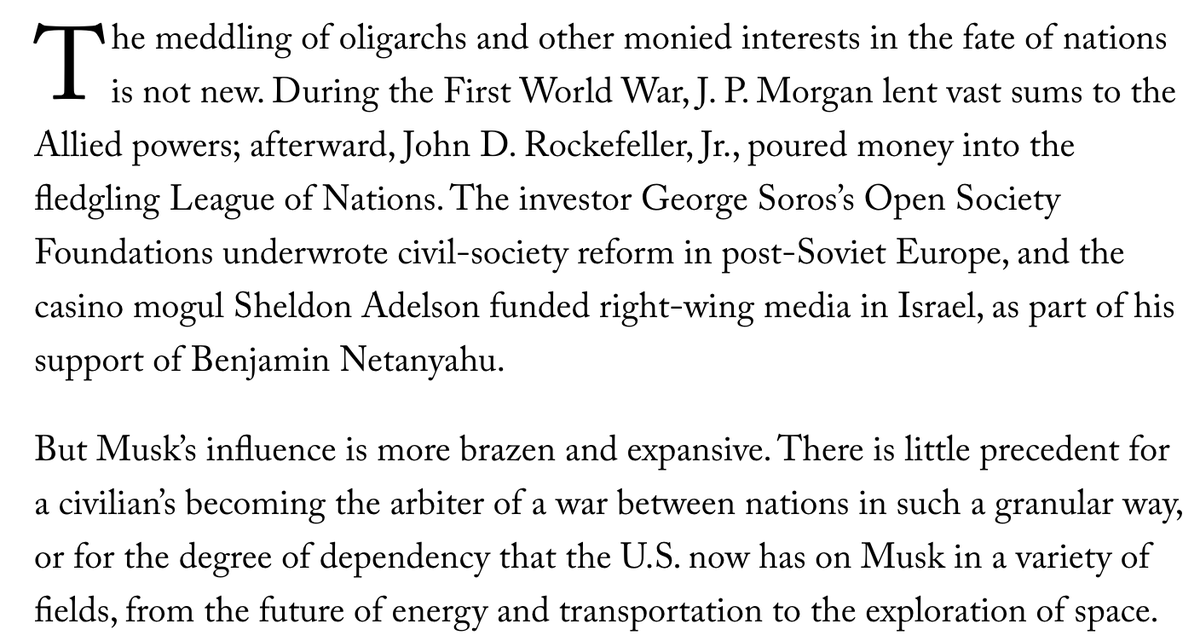
(🧵1/10) With renewed attention on my recent @NewYorker reporting about Sam Altman and OpenAI, it's worth revisiting a piece I wrote for the magazine about another tech billionaire who has accumulated unusual leverage over the US government—and whose hand many readers have lately seen at work in their feeds.
For that story, I spent months interviewing more than thirty of Elon Musk's current and former colleagues, along with current and former officials at NASA, the Department of Defense, the FAA, the Department of Transportation, and OSHA. Many of their observations have only grown more relevant since.
Read the full investigation here: https://t.co/5k5ciIS6ka
And a thread on a few of its findings below.
(🧵1/10) With renewed attention on my recent @NewYorker reporting about Sam Altman and OpenAI, it's worth revisiting a piece I wrote for the magazine about another tech billionaire who has accumulated unusual leverage over the US government—and whose hand many readers have lately seen at work in their feeds.
For that story, I spent months interviewing more than thirty of Elon Musk's current and former colleagues, along with current and former officials at NASA, the Department of Defense, the FAA, the Department of Transportation, and OSHA. Many of their observations have only grown more relevant since.
Read the full investigation here: https://t.co/5k5ciIS6ka
And a thread on a few of its findings below.
(10/10) Musk still controls everything the original piece described. He has since won shareholder approval for a pay package that could make him the world's first trillionaire; become the largest political donor in modern American history; spent months running a federal agency; and embedded his AI chatbot across federal agencies, including the Pentagon's classified networks.
When national security officials and other experts raise warnings about the dangers presented by the current generation of Silicon Valley tycoons, the point isn't just individual, it's structural. In some cases, political and economic structures can no longer meaningfully contain them.
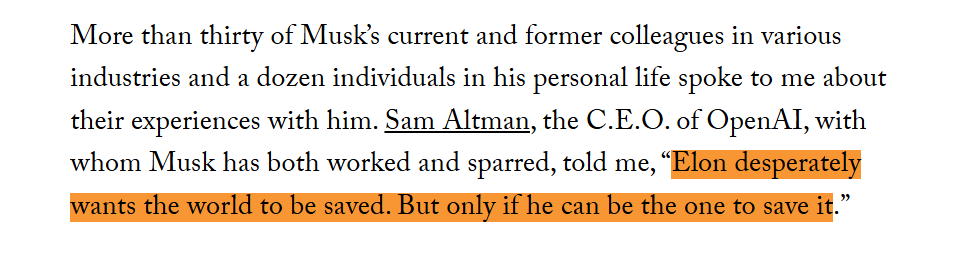
(9/10) Sam Altman, in an interview for that 2023 piece, told me: "Elon desperately wants the world to be saved. But only if he can be the one to save it."
In an open letter calling for a pause on advanced A.I. development, Musk and dozens of fellow tech leaders posed the question themselves: "Should we risk loss of control of our civilization? Such decisions must not be delegated to unelected tech leaders."