Decided to go the APEX Live path but retain the funded accounts with all the other prop firms
I'm content with the current set up for now with futures trading
The edge in Type 1 trading comes down to two things: discretion and discipline. After thousands of trades, the analysis stops feeling like analysis. It normalizes. Three questions replace everything else:
What is the market condition?
Is there a valid trade?
What is my position size?
That's the whole framework.
I think it's genuinely difficult, even for world-class traders, to fully define their edge in writing. Markets are dynamic. New information arrives continuously and alters the read at every step. Even a long-term position eventually demands reassessment. A risk event that strengthens or breaks the thesis, an exit level that needs revisiting. Most strategies are also composites, built from years of absorbing different styles and discarding what doesn't fit.
What I've noticed is consistent across every seasoned trader I've studied or traded alongside, anyone with 5+ years of actual profitability, is one thing: the ability to pull themselves back into their zone after a misread.
Misreads affect your mental state. Always. It might be subtle, it might get buried under the next trade, but it's there. The difference between a trader who compounds and one who doesn't isn't the misread. It's the recovery.
1/ Three strategies. Three different sources of edge. Zero correlation by design.
Type 1 is mechanical prop futures — $NQ, 9:30–11AM edge window, max 2 trades/day, 28x leverage on funded accounts. Nothing glamorous. But a highly scalable cash flow engine.
Type 2 is forward volatility. Algorithmic screening for a multi-decade backtested factor edge over a certain threshold (20%). Systematic, options-based (synthetically fixed volatility product), low frequency.
Type 3 is traditional L/S equity. Fundamental research, defined risk limits, high conviction names with asymmetric setups.
Three different timeframes. Three different risk profiles. One operating system.
What I'll do with this account is document running 3 uncorrelated strategies towards institutional scale and provide context on what I'm doing.
1) Prop futures
2) Forward volatility
3) Fundamental L/S
The intention is not to flash PnL screenshots. The goal is to systematically build a track record that speaks for itself over time and to demonstrate what's possible through calculated decisions.
Thread on three strategies:
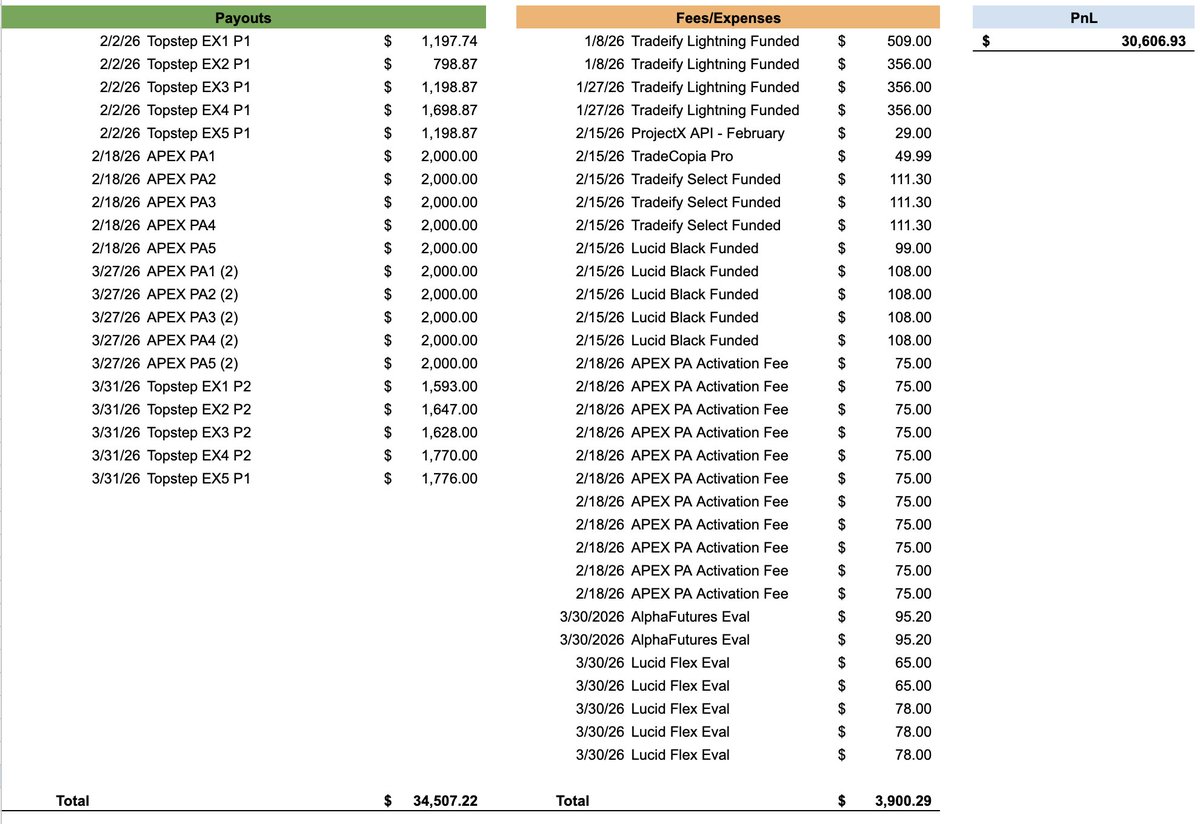
My YTD Prop Firm Payouts
🟢Payouts - $34,507.22
🔴Prop Firm Related Expenses - $3,900.29
Take Home PnL - $30,606.93
Here's a breakdown of my prop firm strategy -
Funded Accounts:
1) APEX (x20)
Bring account values above $4,000. Taking maximum payout of $2,000 still leaves me a $2,000 buffer
2) Topstep (x5)
Bring account values to $4,000-$7,000. A maximum payout of $5,000 leaves me a $2,000 buffer
3) Alpha Futures (x3)
Bring account values to $4,000-$7,000. A maximum payout of $5,000 leaves me a $2,000 buffer
Evaluation Accounts:
1) Alpha Futures (x2)
2) Lucid Trading (x5)
The goal is to aggressively pass these, risking up to 3x the size of funded accounts
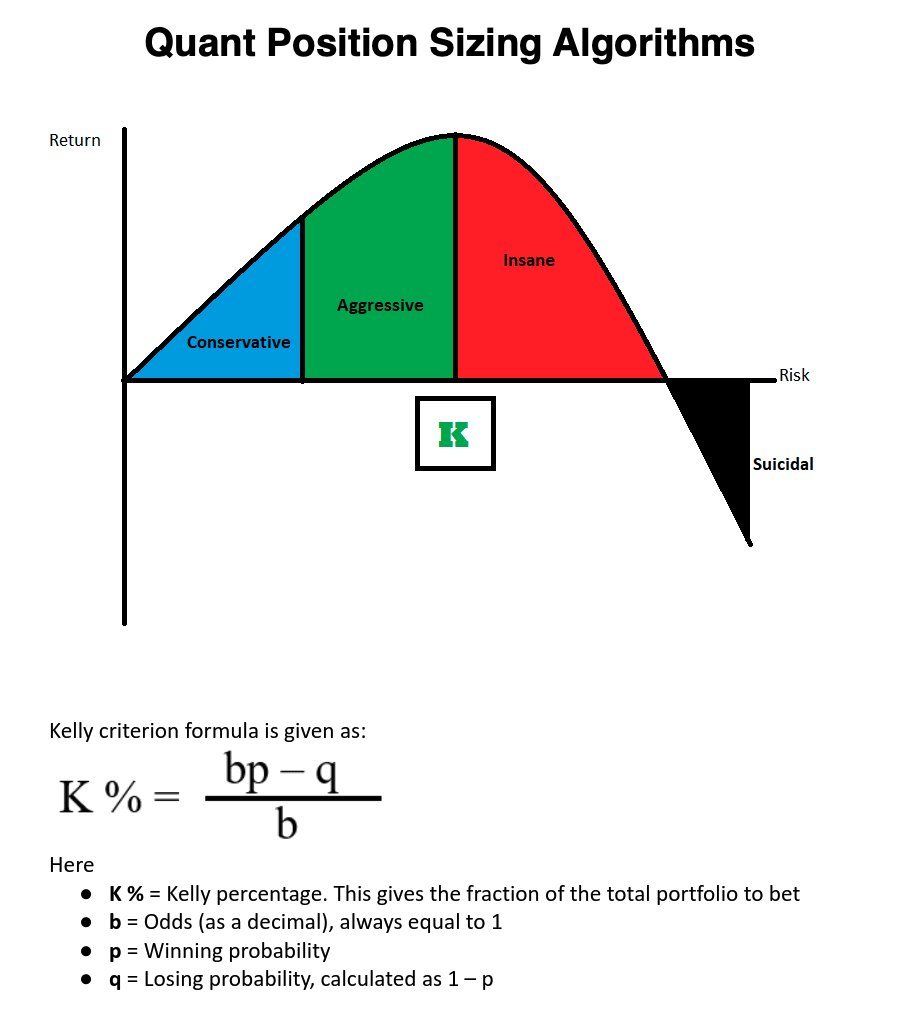
You can have the best strategy in the world.
Size too small and you leave most of the returns on the table.
Size too big and one bad run wipes you out.
Position sizing is where strategies survive or die.
Here's the complete progression:
I've been trading retail prop firms for roughly 3 years now
Currently running 28x $50ks ($1.4MM Notional Trade Value)
My current scaling plan for 2026:
- Increase retail prop account number to 50
- Raise capital from SEC-registered Broker-Dealer to trade up to $1MM live capital
I'm still weighing the options. If I go live with non-retail, I won't be able to trade any live capital with retail (APEX,Topstep), but I can keep funded accounts
Using this account as a fresh start. Not going to promote anything that I can't back up myself
I know what's possible in trading and I hope to help others achieve the same
I'll eventually start a personalized coaching program specifically for those in the breakeven stage