Anyone who actually cares about trust and the truth physically is unable to trust anyone by their word. If you disagree, thats evidence you are less trustworthy.
It doesn't matter what you say you value. What matters is observing what you buy without deliberating, what you do when the day is yours, and what you look at before you think to look away. The truth and trust can only live here, whether you know it or not, or whether you like it or not.
Across decades of research in behavioral economics, cognitive psychology, and neuroscience, one finding keeps surfacing: the correlation between what people say they value and what they actually do is shockingly low, often below r = .20. We are not hypocrites by nature. We simply don't have full conscious access to our own belief system. The brain's automatic, fast-moving System 1 drives the vast majority of moment-to-moment choices, while our conscious mind builds narratives afterward to explain them.
The signals that actually reveal what someone believes, aware or not, form a clear hierarchy. How you spend money without deliberating is nearly impossible to fake; it reflects real trade-offs against real constraints. How you allocate time, especially unstructured free time when no one is watching, is even purer because time can't be borrowed. Where your eyes move before your mind catches up (tracked in gaze research) predicts decisions before they're made. Your spontaneous behavior under time pressure bypasses conscious editing entirely. And your implicit associations, measured in milliseconds rather than self-reports, reveal automatic mental patterns shaped by years of experience that your stated beliefs often contradict.
The deeper finding is this: people who enact their values, not just state them, show measurably higher wellbeing. And people often feel the gap unconsciously. Perceived discrepancy between how you behave and how you believe you should behave produces measurable drops in positive affect. The truth isn't hidden from the world. It's hidden from you first.
The hierarchy of signals, most to least reliable:
1) Spontaneous spending (no deliberation)
2) Time allocation, especially free time
3) Unmonitored attention and gaze patterns
4) Behavior under time pressure
5) Implicit associations (IAT-type measures)
6) Repeated behavioral patterns over days and weeks
7) Stated intentions and values (least reliable)
Primary Sources:
Samuelson, P.A. (1938). "A Note on the Pure Theory of Consumer's Behaviour." Economica — foundational revealed preference theory
Greenwald, A.G., McGhee, D.E., & Schwartz, J.K.L. (1998). "Measuring individual differences in implicit cognition: The implicit association test." Journal of Personality and Social Psychology, 74(6), 1464–1480
Wilson, T.D. & Schooler, J.W. (1991). "Thinking too much: Introspection can reduce the quality of preferences and decisions." Journal of Personality and Social Psychology, 60(2), 181–192
Strack, F. & Deutsch, R. (2004). "Reflective and impulsive determinants of social behavior." Personality and Social Psychology Review, 8(3), 220–247
Maio, G.R. et al. (2009). "Changing, priming, and acting on values: Effects via motivational relations in a circular model." Journal of Personality and Social Psychology, 97(4), 699–715
Kahneman, D. (2011). Thinking, Fast and Slow. Farrar, Straus and Giroux
Laran, J. & Janiszewski, C. (2009). "Behavioral Consistency and Inconsistency in the Resolution of Goal Conflict." Journal of Consumer Research
Whillans, A.V., Dunn, E.W., et al. (2016). "Valuing time over money is associated with greater happiness." Social Psychological and Personality Science, 7(3), 213–222
Krajbich, I., Armel, C., & Rangel, A. (2010). "Visual fixations and the computation and comparison of value in simple choice." Nature Neuroscience, 13, 1292–1298
Hofmann, W., Baumeister, R.F., et al. (2012). "Everyday temptations: An experience sampling study of desire, conflict, and self-control." Journal of Personality and Social Psychology, 102(6), 1318–1335
The minister points, and the king sees what he always was, a pratyabhijñā arriving like a stick that is almost equal, the aitia that does not contain what it triggers. Ana- is the syllable that does the work: back, again, toward. The veils of māyā thin under dhikr the way sati calls the wholesome home, and what the Hebrew imperative zakhor commands across generations is not learning but the standing of the self at a sea that was always personally crossed. Vāsanā perfumes the air before the cup arrives. The slave boy draws the square he did not know he knew, and epistrophē turns the soul not outward but downstream of itself.
There is a durée in which nothing is lost, only descended; pure memory waits as virtual until a madeleine, a question, a syllable, an unequal stick calls it actual. Ubi te inveni, ut discerem te? Where did I find you, that I might learn you? The answer is in the prefix. Kashf is not addition; it is the lifting of what was always lit. You were not born too late or too early. Pratyabhijñā: you have only forgotten, in the most precise and ancient sense, that the pundit standing in front of you is already known by another name, and that name is yours.
We built machines that forget the way water forgets the shape of a cup. New weights overwrite old ones, the ālayavijñāna dissolved by gradient descent, every bīja in the store-consciousness scoured by a fresher loss. Replay buffers and sharp-wave ripples are the same prayer in different alphabets, a dhikr in silicon, the hippocampal zakhor of a network refusing to let the last task become māyā. Continual learning is the discipline of an epistrophē that does not erase its priors, a durée preserved against the catastrophe of the next minibatch. The square the slave boy drew is the square the model must still be able to draw tomorrow, after the new shapes arrive. The cup keeps its form not by holding water but by remembering, in some attractor still warm with the trace of itself, that it was once a cup.
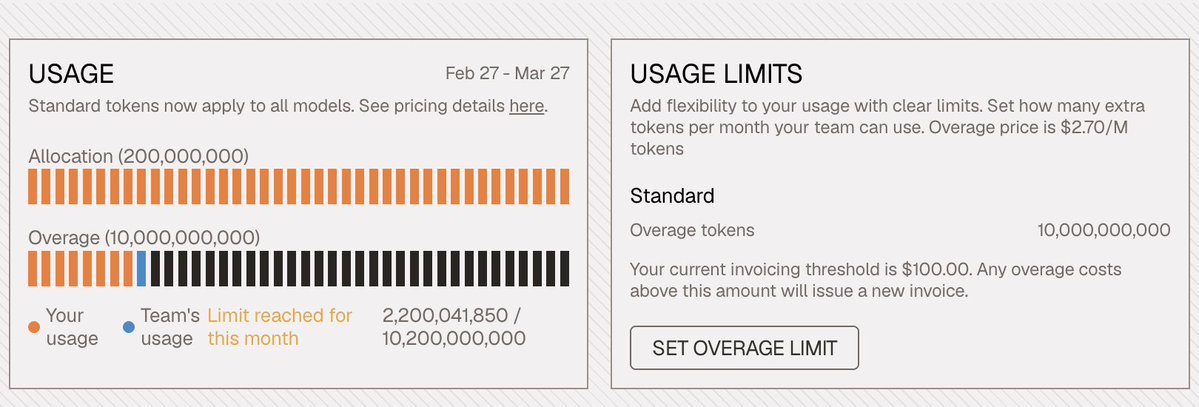
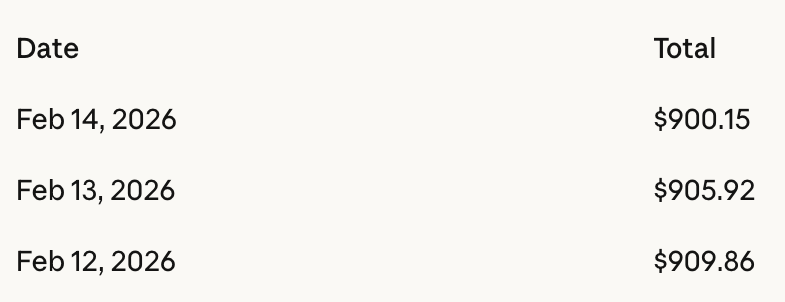
This must be the place 🚀I just accidentally spent $4k in 32 seconds and couldn't stop it until I physically turned hard turned off my local machine with my finger. I decided to go deep inside my machine that makes my machines and kicked off my classic meta-harness loop that autonomously self-optimizes and self-heals itself on my evals. My little homies were so chuffed that they spun up every single piece of juice on my new 128GB M5 MacBook Pro, that it maxed out my machine so hard, it wouldn't even respond to my manual raw terminal CLI command inputs. It was too focused on the more important runs than needing to listen to me. I couldn't be more excited for this moment LFG 💦
the boys fixed me up!!! hard limit removed. back to fuckin blastin thru tokens LFG @EnoReyes@matanSF@FactoryAI 💦💦
appreciate the two founders jumping in themselves within me tweeting this within 30 minutes and deploying fixes same day. this is bull signal for team/company and fuck with it.
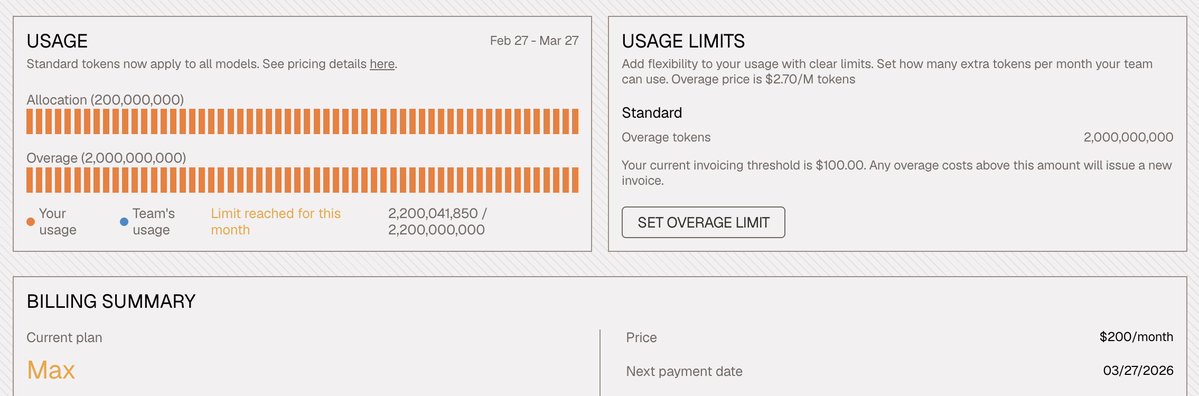
yo you guys fucked me. why did you hard cap me or allow for any of your clients to be hard capped on how much money they can spend with factory at 2.2B tokens??? @EnoReyes@FactoryAI@matanSF
extremely annoyed that my overnight autonomous mission run last night got forced stopped and cucked me this morning for my goals that I was counting on it finishing
was spending over $1k a day now going somewhere else and making whole new harness because I literally cant code rn and blocked and behind
yo you guys fucked me. why did you hard cap me or allow for any of your clients to be hard capped on how much money they can spend with factory at 2.2B tokens??? @EnoReyes@FactoryAI@matanSF
extremely annoyed that my overnight autonomous mission run last night got forced stopped and cucked me this morning for my goals that I was counting on it finishing
was spending over $1k a day now going somewhere else and making whole new harness because I literally cant code rn and blocked and behind
the machine that makes the machine that makes the machine. the metagame rn is fucking crazy. been building a scientific AI with autonomous labs to build, compile and deliver personalized medicine that creates casual cures (not symptoms) to an individual's unique disease.
way harder than the actual biology science is how many layers deep you have to go. every layer is a machine that makes the next machine. i think we are over hundreds and every day more gaps pop out.
recommendation is that this applies to every thing anyone is doing. doesn't matter the industry, company, product or your individual job. only thing that matters rn now is how many meta layers can you execute on and gain leverage on.
an oversimplified example of this project could be "10 categories" as example:
🌌 physics. the base layer os everything runs on
🧪 chemistry. atoms following those rules to form molecules and reactions
🧬 molecular biology. dna, rna, proteins. literally source code for living things
🫀 the human body. trillions of cells running that code together and we barely understand it
💊 medicine. reading the body well enough to fix it, for YOUR specific code not a population average
🔬 the research engine. ai that parses genomics and finds patterns faster than any human team
💻 the software. code that powers the research engine. someone has to write it right?
🤖 the ai agent. we're not writing it ourselves. ai reads specs, writes code, runs tests. but unsupervised it hallucinates and cuts corners
🔒 the harness. a machine that watches the agent while it codes. blocks bad moves, proves what happened, caps spend
🔄 the meta machine. checks on checks on checks on checks. conformance checks verify the harness follows its own rules and eventually the harness starts checking itself
context windows are better than before but still not great. i had one single verification check that cost about $5,000 to run. but if that test catches a foundational flaw before we build six more layers on top of it, it probably saves millions over the years. thats the math you start doing when you're building machines on machines on machines
goal is to keep going until this system can tests hypotheses while you sleep, catches its own mistakes before they ship, and turns every failure into a lesson it cannot forget. must be fully compounding, self correcting and accelerating.
and still then I won't fucking trust one thing and will always human self verify, but this helps my leverage and accelerate my human self verify is the point.
im spending ~$30k a month on just my own personal claude code usage. spending ~$500k a month across 3 of my startups with 5 people each. I think those 5 people prob doing more work than 500 in my previous companies.