In 2020 the United States paid out $888 billion in unemployment benefits.
To move money that fast, the identity checks were switched off. That wasn't a mistake. That was the policy.
a. Sources: US Dept of Labor OIG — testimony 19-23-004-03-315, 9 March 2023 GAO-23-106696, September 2023
b. House Ways & Means, Subcommittee on Work and Welfare — 16 March 2026 H.R.1156 · H.R.8873, 119th Congress
In 2020 the United States paid out $888 billion in unemployment benefits.
To move money that fast, the identity checks were switched off. That wasn't a mistake. That was the policy.
9. A second bill arrived in May. It extends the deadline to ten years, and specifies in its own text that it will not revive anything already expired.
Ten years. Starting after the part we lost.
8. A bill to extend the clock from five years to ten passed the House in March 2025, 295–127.
It went to the Senate, was read twice, and placed on the legislative calendar. Nothing has happened to it since.
7. And here is where it stops behaving like a fraud story.
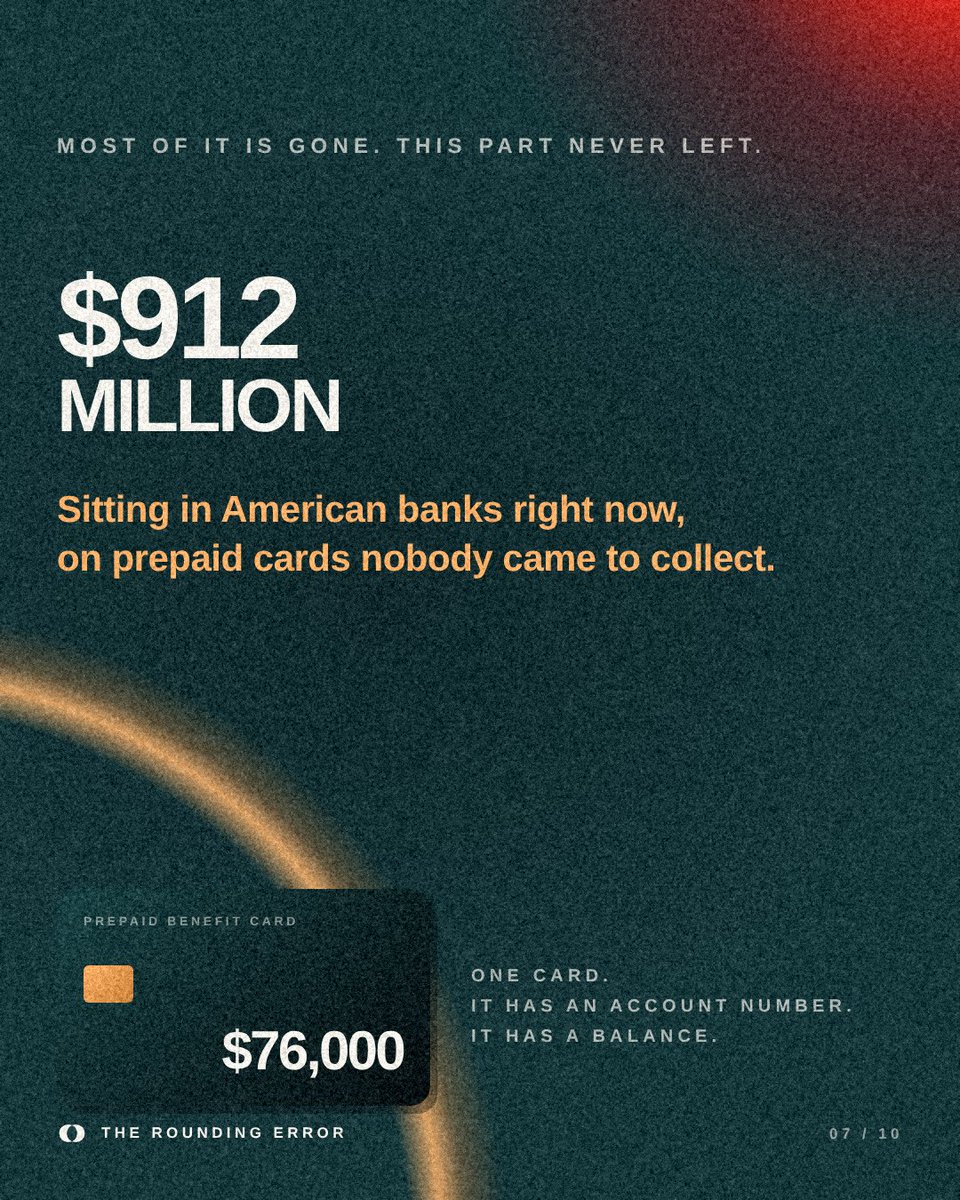
$912 million never left the cards. It's sitting inside American financial institutions right now, on prepaid cards nobody came to collect.
One of them has $76,000 on it.
6. Fraud against the federal government has a five-year statute of limitations, written long before anybody paid out $888bn in eighteen months.
The inspector general told Congress that some of the people involved are simply waiting for the clock to run out.
5. Over the same period the states waived $4.7 billion of it. Wrote it off.
Five times more than the investigations ever got back.
Recovering money, it turns out, is difficult. Forgiving it is a form.
2. The Labor Department's own inspector general went back and looked.
At least $191bn improperly paid — and he noted that figure excludes one programme entirely, so it's probably worse.
Over $76bn, he estimated, went to fraud.
Ninety-seven billion dollars of goods left China for India. Eighty-two billion arrived. Same ten months, same goods, two governments.
The report that found the gap was published by India’s own statistics office. It called its findings preliminary. That was December 2023.
#Data