Exciting news! 🧠👁️ Our latest paper, "Optic Nerve Degeneration Associated with Increased Inflammatory Response as a Potential Biomarker in Parkinson's Disease Patients", has been accepted for publication in npj Parkinson’s Disease.
Can Artificial Intelligence help us build safer cities? 🚀
The ROVIT research group (University of Alicante), driven by CENID, is mapping urban safety perception using AI, geolocation, and 360º footage to understand our streets better. 🌍🔍
Watch the project here:
A fantastic achievement for Félix and another important step forward for our group, reflecting the talent, dedication, and continued academic growth of our team.
Congratulations, Félix! 👏🎓
In less than a week, our research group is celebrating another major academic milestone! 🎉
Our colleague Félix Escalona has successfully completed the selection process for a tenured Associate Professor position.
🎉 Congratulations to Germán González Serrano, member of the Robotics, Vision and Intelligent Technologies Research Group, who last Thursday successfully passed the examination to become an Associate Professor.
A well-deserved achievement. Congratulations, Germán! 👏
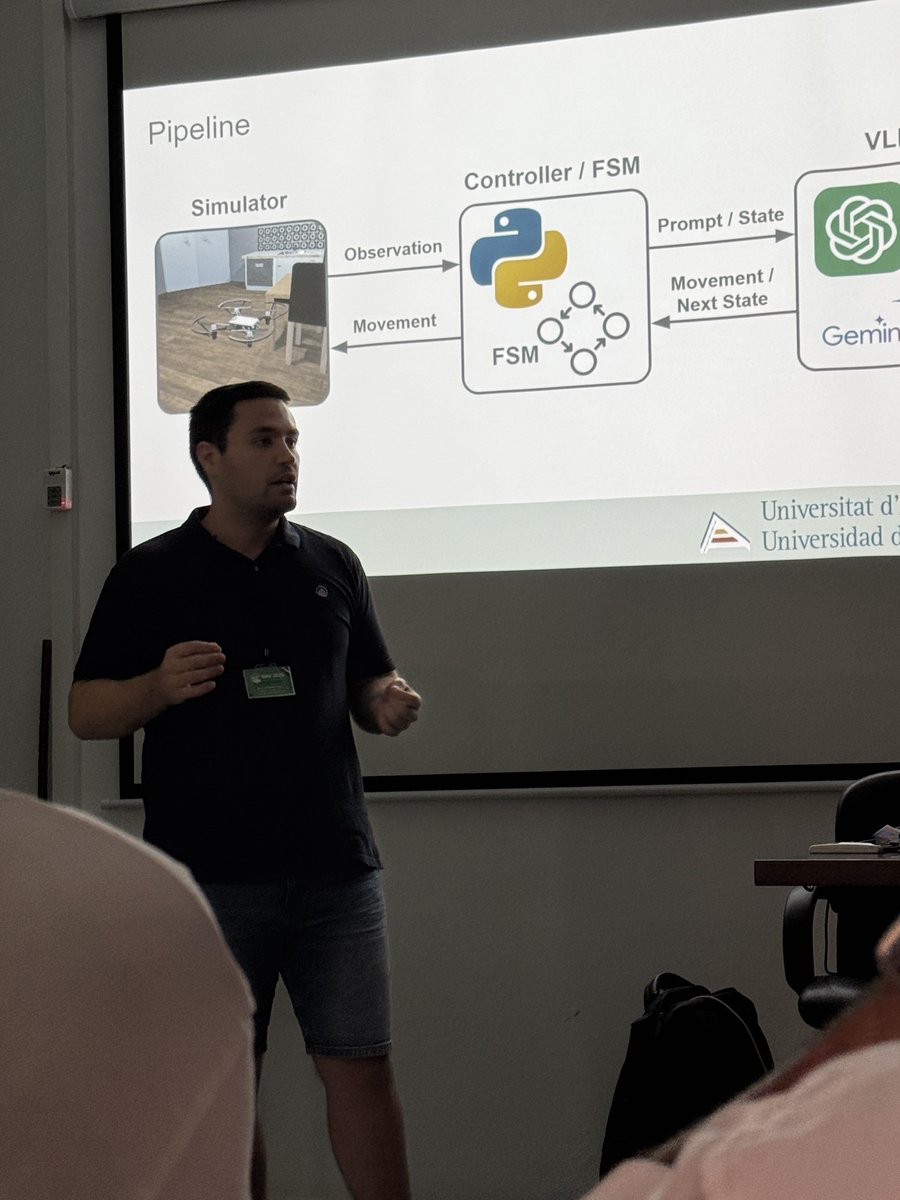
The work explores two key areas in next-generation robotics: real-time Digital Shadows for physical-to-virtual synchronization using ROS 2, computer vision and NVIDIA Isaac Sim , and VLN-Pilot, a framework that uses Vision-Language Models to autonomously navigate indoor
The results are encouraging:4/5 participants selected the highest enjoyment rating, and all 5 said they would like to use the system again.
There is still much to explore,especially with larger and longitudinal studies.
#VirtualReality#ArtificialIntelligence#GaussianSplatting
🎉 Thrilled to share that our paper “PICoS: Photorealistic Immersion for Cognitive Stimulation on Virtual Reality” has been accepted for publication in Virtual Reality!
A great milestone for a project bringing together #VR, #AI and cognitive stimulation.
We evaluated PICoS in a pilot study with children with different cognitive profiles, using two Go/No-Go-style activities focused on attention, turn-taking and response withholding.
The study was designed to assess technical feasibility and acceptability.
Led by Rosabel Roig-Vila and Miguel Cazorla at the University of Alicante, TEACH-AI will deliver open-source tools, FAIR datasets and a validated prototype for teacher training, educational planning and inclusive decision-making.
#AI#EdTech#Education
We are delighted to announce that TEACH-AI has been funded by the Generalitat Valenciana through the Prometeo Programme for Research Groups of Excellence. The project will explore how AI can support more inclusive, evidence-based education. 🧵
At its core, the project will use multi-agent simulations and skill graphs to model teachers, students, competencies and learning pathways—including diverse and neurodivergent profiles such as ASD and ADHD.
Excited to share the publication of our paper “FAKES FOR ALL: A Demographically Inclusive Face-Swapped Video Dataset for Fair Deepfake Detection”!
In this work, we introduce a new deepfake video dataset designed to support more fair, robust, and representative deepfake detection.
Our experiments show that many current detection models experience a significant performance drop on FFA, especially when analyzed across demographic subgroups. This highlights the need for benchmarks that evaluate not only accuracy, but also generalization and fairness.