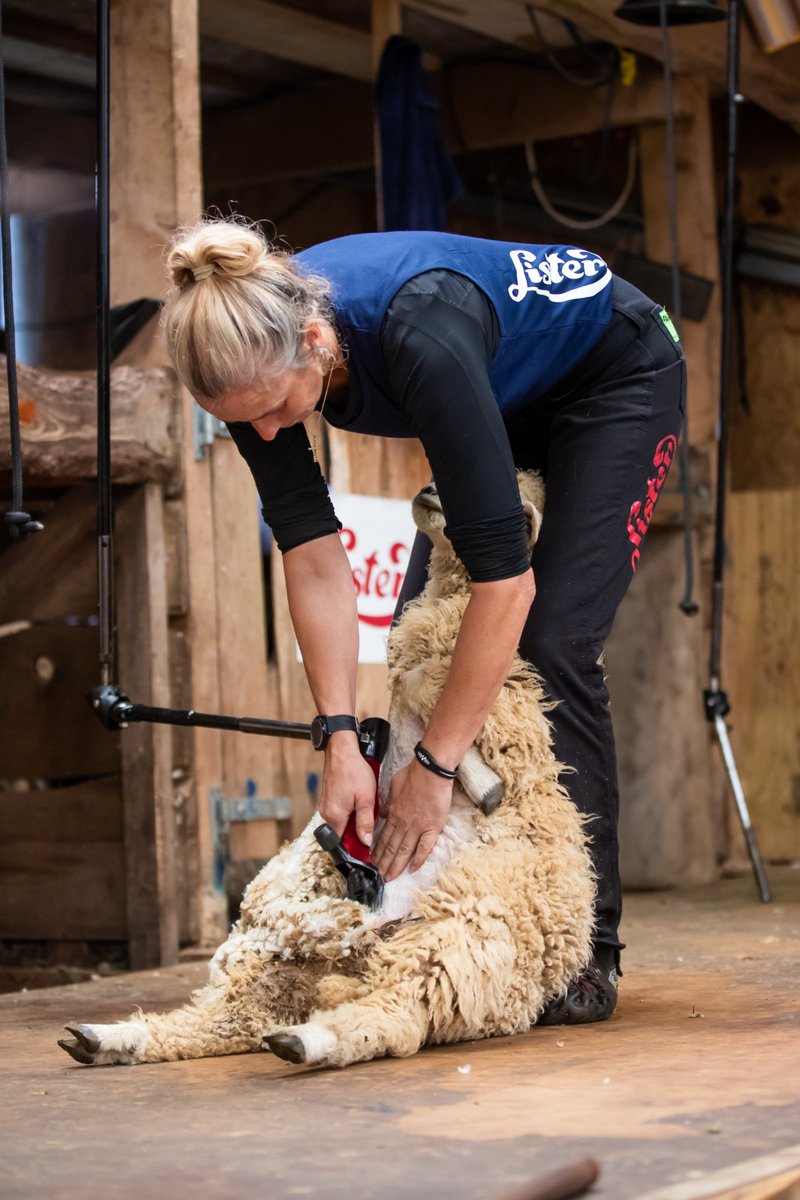
The obvious answer to losing our foreign shearers is to simply train our own. Britain already does. Training was never the problem, and here is what actually is.
The country has fourteen million breeding ewes and about three months to shear them, because the fleece has to come off in a short warm window or the animal suffers. A mountain of work crammed into one season, then nothing for nine months.
So think like someone weighing up the trade. You spend years mastering one of the hardest physical skills in farming, shearing hundreds a day with calm hands and no harm to the animal, and the reward is twelve brutal weeks in summer and three quarters of a year with no work and no money. Nobody builds a life on that. So they don't, and who could blame them.
The shearers who fly in have solved the one problem Britain cannot. A top shearer works four countries a year, New Zealand, America, Britain, Australia, three months in each, chasing the season round the planet until twelve weeks becomes fifty. That is what makes it a career instead of a summer job, and no single country can recreate it, because no single country has more than one season.
There used to be British gangs on this circuit. Contractors who travelled, who trained the next lot, who knew every shed in the dale. That world thinned as the wool stopped paying and the young went to jobs that ran all year, and the gap was filled by the shearers who fly in, who now teach the British newcomers coming up, because the knowledge had nowhere else to live. Cut them off and you do not force Britain to train its own. You remove the last people still doing the teaching.
And this is what makes it so hard to stomach. Seventy-five people, in for twelve weeks, gone the day the job is done, costing the taxpayer nothing and leaving the flock shorn. If any arrival on earth is the useful kind, it is this one. A government serious about who comes and goes would fling the door open to exactly these people and spend its energy on the arrivals it genuinely cannot account for.
It has done the precise reverse. A hard No for the seventy-five it could see, needed and time-limit, while the numbers it cannot explain carry on untouched.
They looked at a skills chain held together by seasonal workers and decided the workers were the problem. They were the only reason it still existed.
The obvious answer to losing our foreign shearers is to simply train our own. Britain already does. Training was never the problem, and here is what actually is.
The country has fourteen million breeding ewes and about three months to shear them, because the fleece has to come off in a short warm window or the animal suffers. A mountain of work crammed into one season, then nothing for nine months.
So think like someone weighing up the trade. You spend years mastering one of the hardest physical skills in farming, shearing hundreds a day with calm hands and no harm to the animal, and the reward is twelve brutal weeks in summer and three quarters of a year with no work and no money. Nobody builds a life on that. So they don't, and who could blame them.
The shearers who fly in have solved the one problem Britain cannot. A top shearer works four countries a year, New Zealand, America, Britain, Australia, three months in each, chasing the season round the planet until twelve weeks becomes fifty. That is what makes it a career instead of a summer job, and no single country can recreate it, because no single country has more than one season.
There used to be British gangs on this circuit. Contractors who travelled, who trained the next lot, who knew every shed in the dale. That world thinned as the wool stopped paying and the young went to jobs that ran all year, and the gap was filled by the shearers who fly in, who now teach the British newcomers coming up, because the knowledge had nowhere else to live. Cut them off and you do not force Britain to train its own. You remove the last people still doing the teaching.
And this is what makes it so hard to stomach. Seventy-five people, in for twelve weeks, gone the day the job is done, costing the taxpayer nothing and leaving the flock shorn. If any arrival on earth is the useful kind, it is this one. A government serious about who comes and goes would fling the door open to exactly these people and spend its energy on the arrivals it genuinely cannot account for.
It has done the precise reverse. A hard No for the seventy-five it could see, needed and time-limit, while the numbers it cannot explain carry on untouched.
They looked at a skills chain held together by seasonal workers and decided the workers were the problem. They were the only reason it still existed.
@PokemonGoApp I am really struggling to get support after a raid issue. I use the in-app support links, but each time I try to attach a screenshot of the issue, the app crashes. I don't get help as I can't continue. This has happened repeatedly
@susie_dent@hayfestival I always thought that Penelope (heard as Pen-ell-oh-pay) and Pen-eh-lope (how I read it in my head when I saw it on the page) were two different names!
Yesterday 25 girls had a "Grand Day Out" at 'Play Like a Girl' at St Giles Cripplegate. It included contributions from Patron Anna Lapwood, Abigail Balfour-Rowley, Daniel Moult, Giuliana Tritto, Imogen Morgan and Anna Steppler. There was also chance to play at St Lawrence Jewry.
@RosemaryGemmell Quince jelly or poached quince (either just in sugar syrup or with red wine and cinnamon) are my 'go-to' options. When I'm making the jelly, I reserve the strained pulp afterwards and use it for things like quince meringue pie or quince and sultana loaf.
We’re delighted to share this year’s NYCB concert @SaffronHallSW! Featuring Lisa Nelsen as soloist in the #worldpremiere of Bill Connor’s Flute Concerto “La Chasse Galerie” and a new orchestration of “Sisters in Arms” by Issie Barrett @NYJC https://t.co/AZXJj43WaE
Another nice 5-star review: 'Dismore writes a fascinating biography of this little known explorer. The book is carefully researched, but like Lady Dorothy Mills herself, never dull.' Thank you! #History#women#Biography@TheHistoryPress
Hubby witnessed a collision on the A1(M) this morning, when a car was shunted into the oncoming traffic at Trotters Bottom. He's got dashcam footage of it happening... but it's next to impossible to share it with @HertsPolice as he wasn't directly involved in the incident.
Passing Places (1973) https://t.co/Hmf3efu81C via @YouTube
Great little film. A young Bill Paterson singing!
"𝑌𝑜𝑢 𝑓𝑒𝑒𝑙 𝑠𝑜 𝑔𝑜𝑜𝑑 𝑡ℎ𝑎𝑡 𝑦𝑜𝑢 ����𝑙𝑜𝑤 𝑑𝑜𝑤𝑛, 𝑡ℎ𝑒 𝑓��𝑟𝑡ℎ𝑒𝑟 𝑡ℎ𝑎𝑡 𝑦𝑜𝑢 𝑔𝑖𝑡 𝑓𝑟𝑜𝑚 𝑡𝑜𝑤𝑛..." - what's the next line?
Ears please?