I love life, meeting people and helping out. I am go getter, an achiever and believe there is nothing impossible for me to do. Am passionate about God.
Most people make success look more complicated than it really is. They spend years searching for shortcuts, hacks, secrets, and hidden formulas.
But in truth, success often comes down to three simple things: the courage to look foolish when you are starting, the humility to admit you do not know everything, and the stubbornness to keep going when the pain becomes heavy.
The real barrier to entry is not always money, connections, or opportunity. More often than not, it is character. Because success does not first test your resources. It tests your discipline, your patience, your resilience, and your willingness to keep showing up when quitting feels easier.
"I have a boyfriend" doesn't stop them.
"I’m married" doesn't stop them.
However, “I love luxury and expensive things"
that one clears the room every time.
I think one of the healthiest things a person can do is become easy to delight. To still stop for weird clouds and dogs wearing bandanas and the smell of garlic cooking somewhere down the street. The world already has enough cynicism. Be the person who still points at the moon.
Major cheat code in life: Master the graceful exit. From conversations. From parties. From opportunities. "This has been wonderful, but I need to go." No elaborate excuses. No fake emergencies. Just clear, kind departure. Most people don't know how to leave. They stay too long or leave badly. Master the exit.
Highly recommend letting people know you're capable of madness from time to time. Especially if you're a quiet, soft spoken person. Disrespect sometimes needs to be met with disrespect.. let mfers know you can go from 0-100 real quick.
Nobody talks about how God’s love is not transactional. It doesn’t increase when you’re faithful and decrease when you’re not. It doesn’t reward your good seasons and withhold in your bad ones. It’s the same yesterday, today, and forever. 🥹🥹🥹🥹🥹🥹🥹
The Japanese eat very little fat and suffer fewer heart attacks than the British or Americans...
The French eat a lot of fat and also suffer fewer heart attacks than the British or Americans.
The Japanese drink very little red wine and suffer fewer heart attacks than the British or Americans.
The Italians drink excessive amounts of red wine and also suffer fewer heart attacks than the British or Americans.
The Germans drink a lot of beers and eat lots of sausages and fats and suffer fewer heart attacks than the British or Americans.
Conclusion:
Eat and drink what you like.
Speaking English is apparently what kills you.
guess what? you can be a deeply serious person with a silly little heart. you can care about the world, grieve what’s broken, and still be delighted by clouds, snacks, and fuzzy socks.
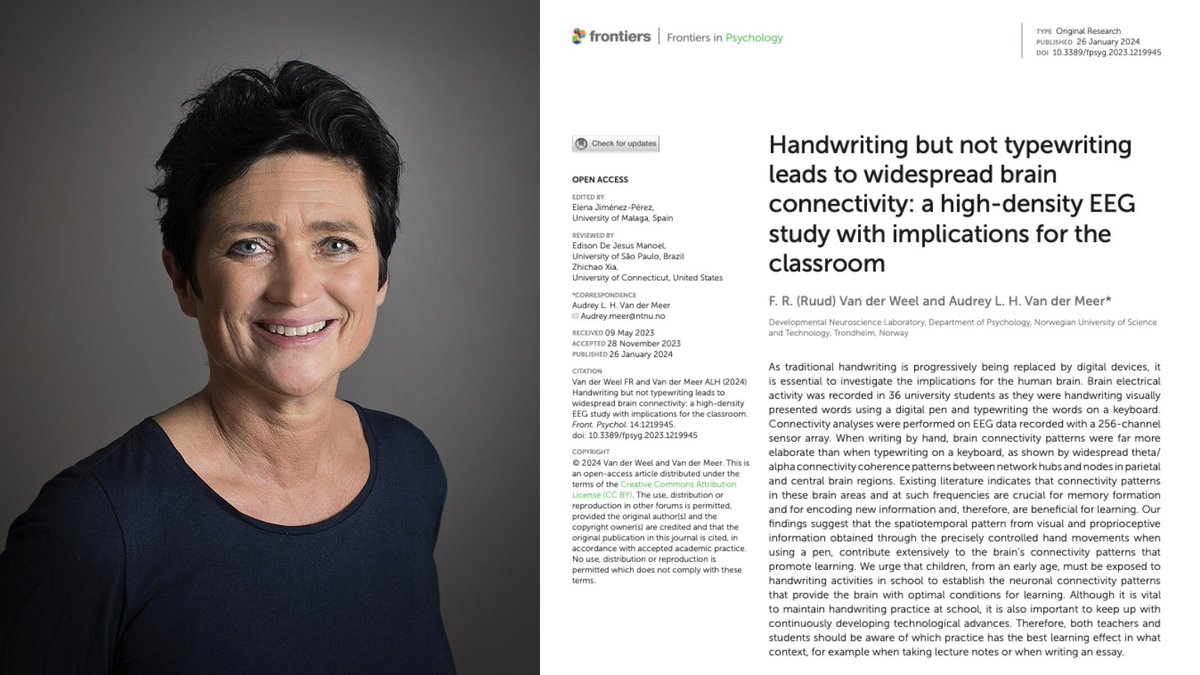
A Norwegian neuroscientist spent 20 years proving that the act of writing by hand changes the human brain in ways typing physically cannot, and almost nobody outside her field has read the paper.
Her name is Audrey van der Meer.
She runs a brain research lab in Trondheim, and the paper that closed the argument was published in 2024 in a journal called Frontiers in Psychology. The finding is brutal enough that it should have changed every classroom on Earth.
The experiment was simple. She recruited 36 university students and put each one in a cap with 256 sensors pressed against their scalp to record brain activity. Words flashed on a screen one at a time.
Sometimes the students wrote the word by hand on a touchscreen using a digital pen, and sometimes they typed the same word on a keyboard. Every neural response was recorded for the full five seconds the word stayed on screen.
Then her team looked at the part of the data most researchers had ignored for years, which is how different parts of the brain were communicating with each other during the task.
When the students wrote by hand, the brain lit up everywhere at once.
The regions responsible for memory, sensory integration, and the encoding of new information were all firing together in a coordinated pattern that spread across the entire cortex. The whole network was awake and connected.
When the same students typed the same word, that pattern collapsed almost completely.
Most of the brain went quiet, and the connections between regions that had been alive seconds earlier were nowhere to be found on the EEG.
Same word, same brain, same person, and two completely different neurological events.
The reason turned out to be something nobody had really paid attention to before her work. Writing by hand is not one motion but a sequence of thousands of tiny micro-movements coordinated with your eyes in real time, where each letter is a different shape that requires the brain to solve a slightly different spatial problem.
Your fingers, wrist, vision, and the parts of your brain that track position in space are all working together to produce one letter, then the next, then the next.
Typing throws all of that away. Every key on a keyboard requires the exact same finger motion regardless of which letter you are pressing, which means the brain has almost nothing to integrate and almost no problem to solve.
Van der Meer said it plainly in her interviews.
Pressing the same key with the same finger over and over does not stimulate the brain in any meaningful way, and she pointed out something that should scare every parent who handed their kid an iPad.
Children who learn to read and write on tablets often cannot tell letters like b and d apart, because they have never physically felt with their bodies what it takes to actually produce those letters on a page.
A decade before her, two researchers at Princeton ran the same fight using a completely different method and ended up at the same answer. Pam Mueller and Daniel Oppenheimer tested 327 students across three experiments, where half took notes on laptops with the internet disabled and half took notes by hand, before testing everyone on what they actually understood from the lectures they had watched.
The handwriting group won by a wide margin on every question that required real understanding rather than surface recall.
The reason was hiding in the transcripts of what the two groups had actually written down.
The laptop students typed almost word for word, capturing more total content but processing almost none of it as they went, while the handwriting students physically could not write fast enough to transcribe a lecture in real time, which forced them to listen carefully, decide what actually mattered, and put it in their own words on the page.
That single act of choosing what to keep was the learning itself, and the keyboard had quietly skipped the choosing and skipped the learning along with it.
Two studies. Two countries. Same answer.
Handwriting makes the brain work. Typing lets it coast.
Every note you have ever typed instead of written went into your brain through a thinner pipe. Every meeting, every book highlight, every idea you captured on your phone instead of on paper was processed at half depth.
You did not forget those things because your memory is bad. You forgot them because typing never woke the part of the brain that would have made them stick.
The fix is the thing your grandmother already knew.
Pick up a pen. Write the thing down. The slower road is the faster one.
Sometimes you'll get exactly what you prayed for and it will scare you, because once you have it in your hands, it's under your control, and that level of responsibility can be overwhelming. So in all your prayers, pray for wisdom too, so you know how to handle your blessings.
Adult friendships require a lot of grace. People are busy. People are healing. People are growing. People are taking time for selfcare just like you. Don’t mistake less communication for less love. Check in, not out. 🩶
i saw a girl on tiktok who said "accountability is so important to me. nobody's perfect, but don't try to flip the script and make my reaction the issue when your actions lit the match" i felt this to the core.
My dad learned to use WhatsApp status two months ago. Like he posts on his status every single day now like it's his personal broadcast channel. I don't think he fully understands that we can all see it. Last week he posted five times in one day.
Status 1: (photo of his breakfast) Good morning. Eat well today.
Me: (sees it)
Me: (says nothing)
Status 2: (photo of the sky outside his window) God is good. Look at this sky.
Me: (sees it)
Me: (says nothing)
Status 3: (blurry photo of the TV) Good match today. Football is back.
Me: (sees it)
Me: (smiling now)
Status 4: (photo of his dinner) Your mother cooked today. She still has it.
Me: (texts mum) Did you see dad's status?
Mum: Which one? He's been posting since morning.
Me: The one about your cooking.
Mum: (pause)
Mum: He didn't tell me he posted that.
Me: He posted it for everyone.
Mum: (long pause)
Mum: He finished the whole pot.
Status 5: (selfie, slightly too close to the camera, one eye slightly cut off) Good night everyone. Sleep well. Tomorrow is another day. God bless.
Me: (calls dad)
Dad: You saw my status?
Me: All five of them.
Dad: I'm documenting my day.
Me: I can see that.
Dad: Your mother says I post too much.
Me: You posted five times today.
Dad: Five is not too much. Some people post twenty.
Me: Those are teenagers.
Dad: Expression has no age limit.
Me: (pause)
Me: Dad the selfie. You need to hold the phone further away.
Dad: It captures more detail this way.
Me: It captures your pores this way.
Dad: (pause)
Dad: I thought it looked professional.
Me: Further away next time.
Dad: (posts another status while we're on the phone)
Me: Did you just post while I was talking to you.
Dad: The sunset was happening. These things don't wait.