This is more than a conversation, it concerns every Nigerian.
Food security is non-negotiable. How do we reduce food prices, make agriculture more profitable for farmers, and attract more young people into the sector?
Join the conversation as we explore practical solutions.
Meet Our Speaker: Fahad Husaini Adamu
Joining us on this X Space is @royalhusain , an agribusiness and development professional with extensive experience in agricultural value chain development.
📅 June 26, 2026
🕗 8:00 PM WAT
https://t.co/3wKWVdkQS0
Join us for an insightful X Space as we explore the realities behind food inflation.
Guests: @royalhusain@humanitarian_bs
Host: @_preciousdavies
📅 Date: 26 June 2026
🕗 Time: 8:00 PM WAT
📍 Venue: https://t.co/VDcGQ4jnug
Matias Galarza
Rossie
Turkey
ELIMINATED
Meet Our Speaker: Fahad Husaini Adamu
Joining us on this X Space is @royalhusain , an agribusiness and development professional with extensive experience in agricultural value chain development.
📅 June 26, 2026
🕗 8:00 PM WAT
https://t.co/3wKWVdkQS0
There was a time in Abuja when transportation looked like it was finally being treated as a serious part of urban development, not merely an afterthought patched together by chaos and suffering. During the era of Malam Nasir @elrufai as FCT Minister, there was a deliberate attempt to create a structured transport system within the capital city. Bus terminals were introduced. Urban transit planning began to take shape. There was at least a visible understanding that a modern capital cannot survive on disorder, roadside struggles, and commercial transport anarchy.
In fact, between 2003 and 2007, El-Rufai’s administration took one of the boldest transport decisions Abuja had seen at the time. In 2005, his government established a mass transit system specifically aimed at reducing the dangerous and chaotic dependence on illegal “Okada” motorcycle transport within the city. Over 192 high-capacity buses were purchased under the Abuja Urban Mass Transport Company (AUMTCO). Those buses quickly became known among residents as the famous “El-Rufai buses.” For many workers, students, and low-income residents, they brought relief, order, affordability, and a sense that Abuja was gradually moving towards becoming a truly modern capital city.
The idea was simple: Abuja was meant to grow into a functional capital where movement would be predictable, affordable, safe, and dignified for ordinary residents. Workers were not supposed to spend hours stranded under the sun searching for transport before getting to offices already exhausted. Residents were not meant to battle daily exploitation from transport operators who increase fares arbitrarily at the slightest excuse. The city was supposed to evolve into a modern African capital with a transport structure that reflected planning and competence.
Sadly, what we have today is the painful burial of that vision.
Most of the transport structure that once gave hope has gradually disappeared into neglect, abandonment, and policy laziness. The terminals that were meant to become hubs of organized movement now wear the face of decay. The once-celebrated AUMTCO buses have largely vanished from relevance. Public buses are grossly insufficient. In many areas, the system has virtually collapsed into survival of the fittest. Workers leave homes before dawn not because Abuja is impossibly large, but because transportation has become unreliable and humiliating. Residents queue endlessly in confusion. Students trek. Families budget heavily just to move from one district to another. A city designed to represent the pride of Nigeria now punishes its people daily through transportation failure.
The embarrassment becomes even clearer when one compares Abuja with countries that took public transportation seriously as a national priority rather than political propaganda.
Speaking about somewhere I lived, Malaysia, transportation is treated as an economic backbone. From Kuala Lumpur’s rail systems to interconnected buses and clean terminals, the government understands that productivity depends heavily on how efficiently citizens move. Workers can predict their travel time. Students move with ease. Visitors experience order. Public transport is not seen as a punishment for the poor but as a reliable system for everyone.
Then look at Singapore — a country that transformed itself from limited land and scarce resources into one of the most efficient societies on earth largely through discipline, planning, and long-term infrastructure investment. Their buses arrive on schedule. Their train systems are integrated. Their transport cards work seamlessly across systems. The ordinary citizen is respected through efficiency. Government there understands a simple truth: when transportation fails, the economy suffers, families suffer, and national dignity suffers.
When Allah has already accepted your dua, He first places you in the perfect moment to make it.
The sudden urge in your heart, the tears in tahajjud, finding yourself in sujood with that exact need on your tongue, these aren't random. They're signs of His mercy already in motion
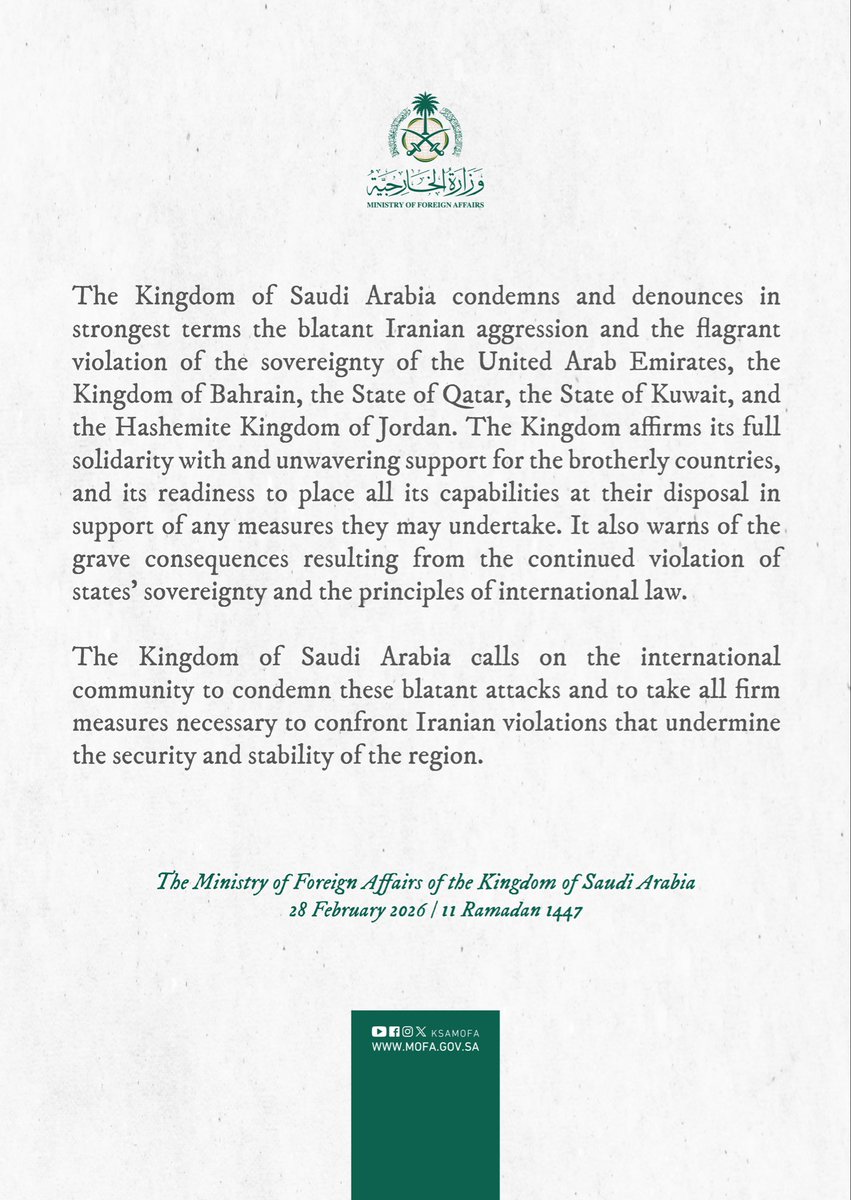
#Statement | The Kingdom of Saudi Arabia condemns and denounces in strongest terms the blatant Iranian aggression and the flagrant violation of the sovereignty of the UAE, Bahrain, Qatar, Kuwait, and Jordan. The Kingdom affirms its full solidarity with and unwavering support for the brotherly countries, and its readiness to place all its capabilities at their disposal in support of any measures they may undertake. It also warns of the grave consequences resulting from the continued violation of states’ sovereignty and the principles of international law.
#Statement | The Kingdom of Saudi Arabia condemns and denounces in strongest terms the blatant Iranian aggression and the flagrant violation of the sovereignty of the UAE, Bahrain, Qatar, Kuwait, and Jordan. The Kingdom affirms its full solidarity with and unwavering support for the brotherly countries, and its readiness to place all its capabilities at their disposal in support of any measures they may undertake. It also warns of the grave consequences resulting from the continued violation of states’ sovereignty and the principles of international law.
No, not true.
Saudi Arabia condemned Iran's retaliatory strikes on UAE, Bahrain, Qatar, Kuwait, Jordan (and its own territory, which it repelled). It vowed full solidarity and "all resources" to help those Arab states defend themselves—but announced no offensive military role, strikes on Iran, or joining US/Israel operations.
This is defensive support for neighbors, not "joining the war." The claim misleads; image is an old Trump-MBS photo. Confirmed across Reuters, NYT, BBC, Al Arabiya.
Should Governor Abba Kabir's commitment to the defection be genuine, the Red Cap's removal is imperative. Otherwise, this appears to be a mere political spectacle.
Truly impressed with Dr. Jumoke Oduwole's work as Minister of Industry, Trade & Investment! The recent UAE CEPA deal and real reforms. This might be the first time Nigeria has truly gotten it right here. Massive kudos!