Nothing is more important than the welfare and future of our youth!
We have decided to set up fast-track courts to ensure swift and stringent punishment for those involved in paper leaks. Have directed the concerned authorities and officials to take all necessary steps in this regard. This continues our series of steps for safeguarding the interests of students.
Those who try to harm the future of our youth will not be spared.
देश के युवाओं का हित और उनका भविष्य हमारी सर्वोच्च प्राथमिकता है।
पेपर लीक के सभी मामलों में दोषियों को जल्द से जल्द कठोर दंड देने के लिए, केस के त्वरित निस्तारण के लिए फास्ट ट्रैक कोर्ट्स का गठन किया जाएगा। इस संबंध में निर्देश दे दिए गए हैं कि संबंधित विभाग आवश्यक कार्रवाई सुनिश्चित करें।
विद्यार्थियों के हितों को सुरक्षित करने के लिए, सरकार द्वारा लिए जा रहे निर्णयों की श्रृंखला में ये एक महत्वपूर्ण कदम है।
युवाओं के भविष्य के साथ खिलवाड़ करने वाले किसी भी व्यक्ति को बख्शा नहीं जाएगा।
Senior backend interview in 2026.
How many of these can you explain clearly:
Event sourcing
Saga pattern
Bulkhead isolation
Token bucket vs leaky bucket
Consistent hashing
Write-ahead logging
Backpressure
Tombstone records
Bloom filters
Vector clocks
Gossip protocol
Idempotency keys
Read-your-writes consistency
If it's less than 8, you're not ready.
One of my friends got rejected in a Spring Boot Microservices interview, not because he didn’t know concepts,
but because he couldn’t answer real production issues.
That’s when we realized, interviews are no longer about theory — they’re about real-world problem solving.
Here are 15 real production scenario-based questions:
1. Your Spring Boot service CPU suddenly spikes to 90% in production. How will you investigate and fix it?
2. After deployment, your service starts throwing intermittent 500 errors. How will you debug this issue?
3. One microservice goes down and causes a chain failure in other services. How will you prevent this in future?
4. Your API response time increased from 200ms to 3 seconds after a new release. How will you identify the root cause?
5. Database connections are getting exhausted under load. What steps will you take to fix this?
6. A third-party service you depend on is timing out frequently. How will you handle this in your system?
7. You observe duplicate transactions happening in your system. How will you prevent this?
8. Logs are too large and distributed, making debugging difficult. How will you improve observability?
9. Memory usage keeps increasing and your service crashes after some time. How will you detect and fix memory leaks?
10. Your microservice works fine locally but fails in production. How will you approach debugging?
11. A new deployment breaks one feature but works for others. How will you safely roll back?
12. Traffic suddenly spikes 5x during peak hours and your service becomes slow. How will you scale?
13. Inter-service communication is failing due to network latency. How will you optimize it?
14. You need to trace a single request across multiple services during a failure. How will you implement tracing?
15. A bug in one service causes inconsistent data across multiple services. How will you handle data consistency?
If you can answer these with real solutions, you are already at production-level understanding.
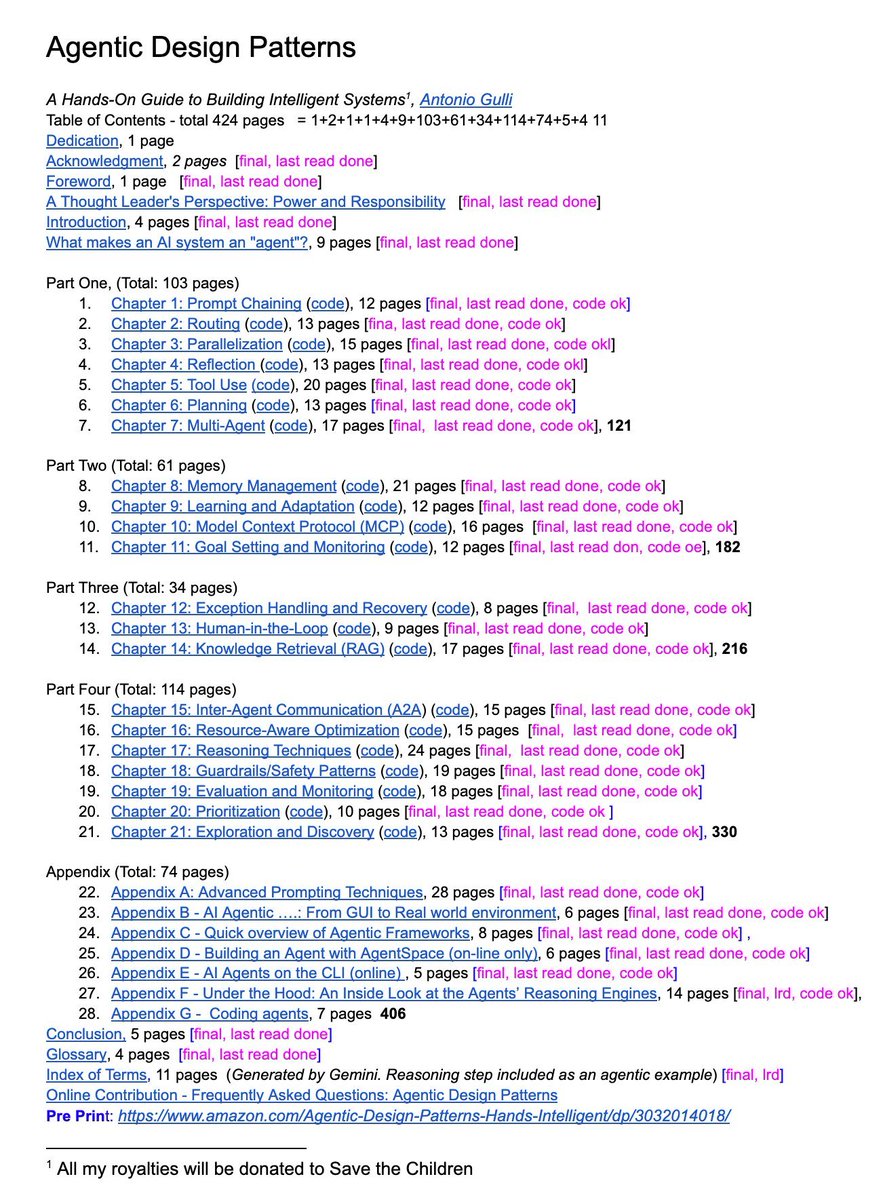
A senior Google engineer just dropped a 421-page doc called Agentic Design Patterns.
Every chapter is code-backed and covers the frontier of AI systems:
→ Prompt chaining, routing, memory
→ MCP & multi-agent coordination
→ Guardrails, reasoning, planning
This isn’t a blog post. It’s a curriculum. And it’s free.
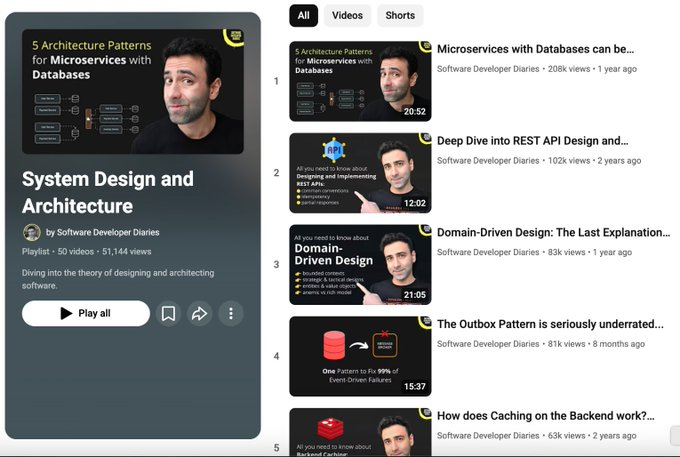
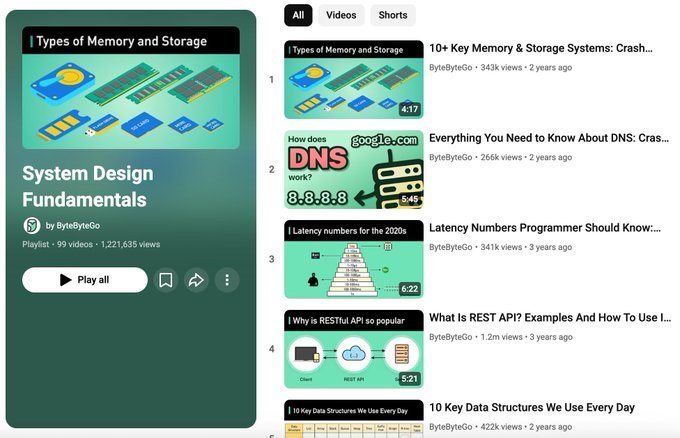
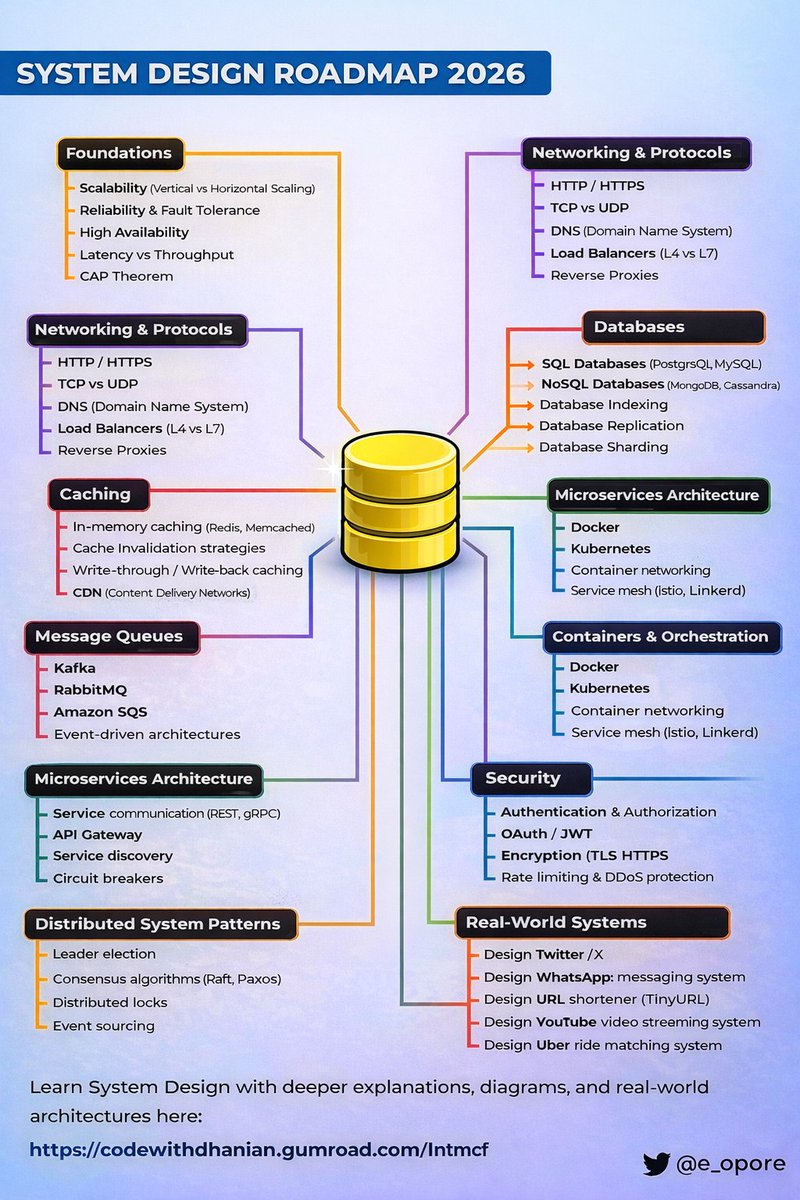
50 System Design Topics – Simple to Complex
Perfect Learning Roadmap for 2026. Save this list.
1. Design a Rate Limiter
2. Design a URL Shortener
3. Design Pastebin
4. Design a Unique ID Generator
5. Design Consistent Hashing
6. Design a Load Balancer
7. Design an API Gateway
8. Design a Basic Key-Value Store
9. Design a Caching System (e.g., LRU Cache)
10. Design a Notification System
11. Design a Typeahead/Autocomplete System
12. Design a Web Crawler
13. Design a Message Queue
14. Design a 1:1 Chat System
15. Design a Group Chat System
16. Design a News Feed System
17. Design a Proximity Service (e.g., nearby friends)
18. Design Instagram (photo/video sharing + feed)
19. Design Twitter/X (timeline + posts)
20. Design WhatsApp (real-time messaging)
21. Design Dropbox (file storage & sync)
22. Design a Ticket Booking System
23. Design an E-commerce Platform (catalog + checkout)
24. Design a Recommendation System
25. Design a Distributed Cache
26. Design Uber (ride-sharing + matching)
27. Design Netflix (video streaming platform)
28. Design YouTube (video upload + streaming)
29. Design TikTok (short-video platform)
30. Design Facebook-like Social Network News Feed
31. Design Google Docs (real-time collaborative editing)
32. Design a Content Delivery Network (CDN)
33. Design a Search Engine (indexing + querying)
34. Design Google Maps (routing + location services)
35. Design a Distributed Database
36. Design a Real-time Analytics System
37. Design an Ad Serving & Tracking System
38. Design a Fraud Detection System
39. Design a Stock Trading/Exchange System
40. Design a Distributed Job Scheduler
41. Design Event Sourcing + CQRS Architecture
42. Design a Multi-tenant SaaS Platform
43. Design Live Video Streaming at Scale
44. Design a Highly Scalable NoSQL Database
45. Design a Real-time Multiplayer Game Backend
46. Design Machine Learning Model Serving Infrastructure
47. Design a Geo-distributed Low-Latency System
48. Design a Strongly Consistent Global Database
49. Design a High-Frequency Trading Platform
50. Design a Planet-Scale Distributed System (billions of users, multi-region HA)
Want to add anything in this list?
Best YouTube Channels To Learn in 2026
1. Cybersecurity – John Hammond
2. Artificial Intelligence – Andrej Karpathy
3. AI Research Breakdown – Yannic Kilcher
4. Web Development – The Net Ninja
5. Python Programming – Corey Schafer
6. DevOps – TechWorld with Nana
7. Cloud Computing – AWS re:Invent
8. Data Analytics – Luke Barousse
9. System Design – Gaurav Sen
10. Databases – Hussein Nasser
11. Low-Level Programming – The Cherno
12. Linux – Learn Linux TV
13. Networking – David Bombal
14. Math for ML – 3Blue1Brown
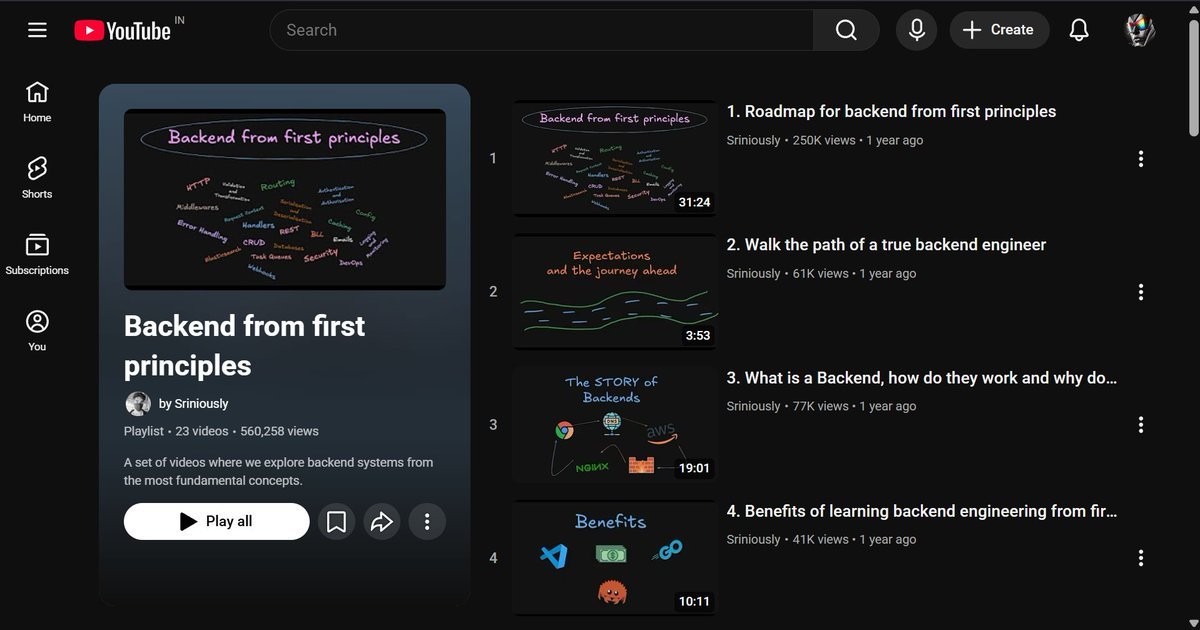
Most devs learn backend by copying tutorials.
They can build. But they can't explain "why anything works".
That's the difference nobody talks about.
"Backend from First Principles" by Sriniously fixes exactly that.
23 videos. Free on YouTube.
It covers everything underneath the surface:
• HTTP & Routing - what actually happens before your handler even runs
• Middlewares - why order matters more than you think
• Auth & Security - not just "add JWT" but why it works
• Task Queues & Webhooks - how real systems handle async without breaking
• Caching & Databases - the decisions that make or break performance at scale
This isn't another "build a REST API" tutorial.
This is backend "the way seniors actually think about it".
Most of your competition hasn't found this yet.
Save it before you write another endpoint you don't fully understand.
As a Backend engineer, learn below to move beyond CRUD APIs:
→Security
a. Authentication & Authorization
b. Cryptography
c. Encryption Algorithms
d. OWASP Top 10
e. SIEM, IDS, IPS, etc.
f. misc: OAuth 2.0, JWT, etc.
g. CORS
h. Security headers(CSP, HSTS etc.)
i. Input validation
→Performance
a. Caching strategies
b. Rate-limiting & Throttling
c. Load balancing
d. Chaos Engineering
e. Fault Tolerance
→Database Engineering
a. Query optimization
b. Indexing
c. Database trade-offs
d. Database transactions and isolation levels
e. Sharding and partitioning
→API Design
a. OpenAPI 3.0 standards
b. Restful & GraphQL API principles
c. Status codes, versioning, and pagination strategies
→Architecture & Paradigms
a. Monolith
b. Modular monolith
c. Microservices
d. Serverless vs. Native
e. Concurrency & parallelism
f. Multithreading
g. Optimistic and pessimistic locking
→Distributed systems
a. Microservices patterns
b. Event-driven approach
c. Serverless vs native approach
d. gRPC & Protobuf
e. Kafka/RabbitMQ
→ DevOps
a. CI/CD
b. Containerization
c. Understanding of SLAs
d. Incident Management
→Observability
a. Logging, monitoring, and tracing
b. Profiling & optimization
c. Alerting
→Miscellaneous Microservices topics
a. API Gateway
b. Reverse proxy
c. Circuit breaker Pattern
d. Retry/back off patterns
e. Background jobs/Scheduling
These will help you make outstanding backend systems that are secured, meet SLAs, and are highly tolerant.
As a developer,
Please slap yourself if you can't explain at least 10 of these :
API Gateway
Load Balancer
Reverse Proxy
Rate Limiting
Throttling
Pagination
Cache stampede
Idempotency
GraphQL
gRPC
Webhooks
JWT
OAuth
Cache invalidation
Composite index
Query optimization
CAP THEOREM
ACID
Sharding
Circuit breaker
Livelock
CSRF
Backpressure
False sharing
mTLS
Everyone is learning Next.js and AI tools.
Almost no one is learning how databases actually work at scale.
CMU Advanced Database Systems (Full 22-lecture playlist)
Master these rare skills:
• How real query execution & optimization engines work
• Columnar storage, vectorized execution & modern OLAP
• Why Snowflake, Redshift & DuckDB changed everything
• Distributed database failures & the “one DB to rule them all” myth