A big step forward for #foodallergies: new @US_FDA Food Code calls for allergen labeling of "unpackaged" food - made by restaurants, delis, bakeries etc.
But read our report on why state level advocacy is vital to achieve change.
@FoodAllergyEdu@NatashasLegacy@oakley_red
@jprotudjer@DrElanaLavine@CSACI_ca Thank you for tagging them! I think this will be such a useful position paper because it gives such clear, actionable guidance. Really great stuff.
The Canadian Society of Allergy and Clinical Immunology & Canadian Pediatric Society came out with a new position statement on early allergen introduction, highlighting the most important factors for population-wide interventions. ��
So what are the key takeaways?
1. Infants should start potential allergens around 4 months
2. Common allergens should be eaten at least once per week
3. Infants should get about 2 g of allergen protein (about 1.25 tsp peanut butter for example) each week.
Matthew Greenhawt gave a great interview about peanut allergy patch therapy in infants and toddlers (1-3 years)- this therapy is incredibly effective in these young children with few side effects! Early intro leads to early treatment and better outcomes!
https://t.co/4IrqOzbeUJ
More studies are needed to really refine our understanding of the time dependency of early allergen introduction, but the data we have so far is clear: we need to introduce babies earlier. #foodallergy#peanutallergy#preventallergies
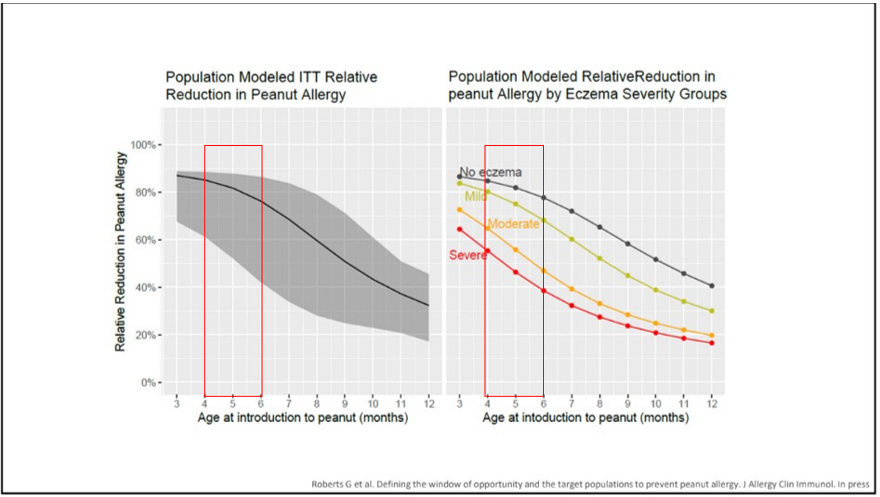
Dr. Gideon Lack, lead on the pivotal LEAP trial, spoke at #ACAAI22 about what we have learned about preventing peanut allergy since his study published in 2015. What did he find? Early introduction of common allergens is important for every baby and when we introduce matters
Early introduction matters in all kids, and it matters when you introduce common allergens. Medical guidelines direct parents to introduce infant safe forms of common allergens starting at 4 – 6 months. There is even a difference between 4 mo and 6 mo.
I think that this has some interesting connotations for allergy introduction - early allergen introduction and early allergy identification can help with early OIT. https://t.co/ETfWAcOl4A
The University of British Colombia did a study on oral immune therapy in "preschoolers" (9 months - 70 months) and found that OIT is safer in these young children than in older children.
Within this group, OIT was safer in children who started OIT before 12 months. In initial testing only 33.9% of <12 mo olds had a reaction while 53.7% of 1-5 year olds had a reaction.