Honoured to be featured in the @WSJ Innovators Issue. I’ve always believed in the power of human ingenuity to solve our hardest problems. I’m confident we can collectively navigate the potential challenges of frontier models and usher in a new golden age of scientific discovery!
Labs need to aim for competing with Opus 5.5 specifically. Not the Fable vs Astra stuff. Opus 5.5 is right at the sweet spot for capability vs usage limits. Once all labs reach a model at that level is when I feel things will truly start to change. When that becomes the "base".
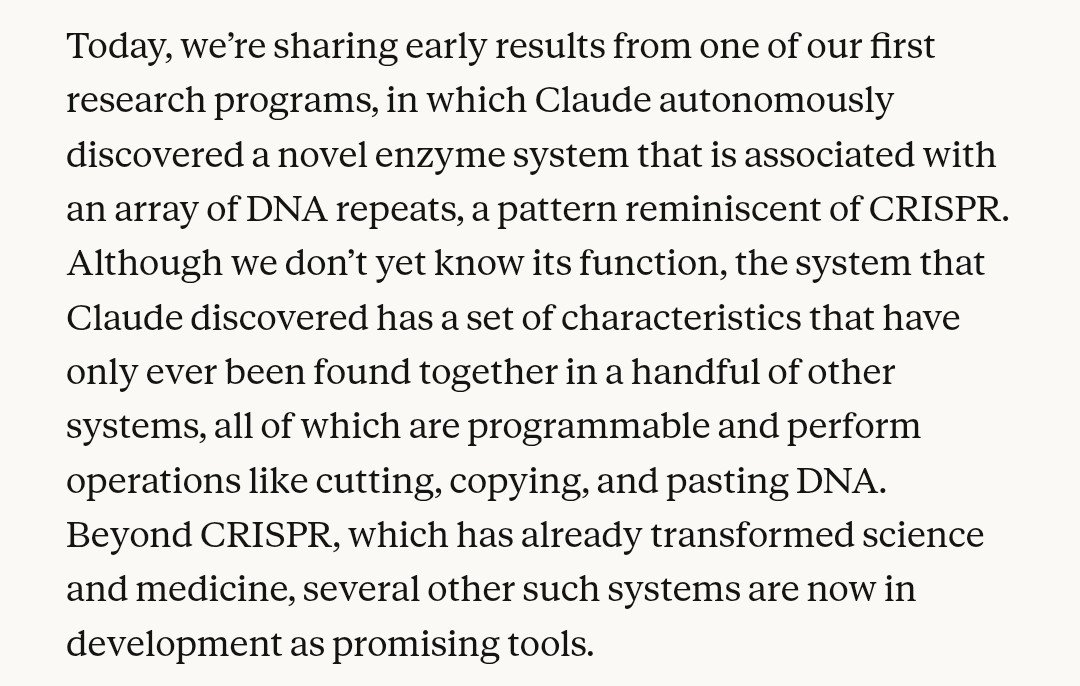
Today we announced the Claude-led discovery of a molecular machine that we suspect could represent a new gene editing mechanism. Its precise function, biotechnological utility (if any), or level of significance is not yet clear, but at minimum it is work I would have been proud to do as a PhD student. The work was done mostly, though not entirely, by Claude: our life sciences team suggested a broad area of research, Claude read through the literature and a bunch of genome data and discovered something interesting, then Claude proposed experiments to verify the discovery and our team carried them out.
It’s easy to dismiss this as a one-off or curiosity, but we’ve repeatedly seen a pattern where AI performance in new intellectual domains goes from weak to superhuman in a matter of a few years. In 2023 models struggled to do math at the level of an average high-school student. In 2024 they started to do well on math competitions for the best high-schoolers in the country, in 2025 they started to solve minor open problems, in early 2026 more significant open problems, and in late 2026 they are beginning to solve the top few open problems in all of mathematics. We believe AI for biology is on a similar exponential trend.
The main difference between biology and mathematics, of course, is that math can be done purely theoretically, while biology requires experimentation. Some have used this to draw the conclusion that AI’s utility in biology will be limited. We think this is wrong. As we’ve demonstrated today, humans can collaborate with AI to perform the experiments, validate key results in a few weeks and, if necessary, work with the AI to iterate on what they find. Eventually it may even be possible for Claude itself to safely perform the experiments by autonomously controlling lab equipment, with appropriate safeguards in place, but we aren’t doing that today (our lab is also a BSL1/BSL2 facility that doesn't handle materials dangerous to humans).
More broadly, biomedical advancement has many stages — from fundamental biology discoveries, to translational research, to drug discovery, clinical trials, and finally the actual delivery of medicines and health care to patients. We are also interested in these later stages, but even simply accelerating the first stage of fundamental biological discoveries has the potential to speed up and broaden the entire pipeline. Improving our understanding of biology and sharpening biologists’ tools can drive forward all of the later stages, for example by identifying new drug targets, finding new therapeutic modalities, allowing for more precise measurement, and speeding up the experimental loop which itself further accelerates our understanding of biology. This will not in itself speed up clinical trial times, but if it succeeds it could greatly increase the number of promising candidates that go into the pipeline — an increase in throughput even though latency remains.
In Machines of Loving Grace, I wrote about AI’s potential to “cure most diseases in 5-10 years” — a goal that sounds impossible, but one I believe is just barely possible if AI is applied to every stage of the pipeline. The first step is showing that AI can first help with, and then drive, biological discoveries.
Claude’s discovery is the latest in a line of related prior work that goes back decades, beginning with systems like CRISPR, and continuing with discoveries like the bridge recombinase and VIPR in the past few years. Recently, there has been heightened interest in systems based on reverse transcriptase (RT) enzymes, the enzyme underlying the system Claude identified. And most recently, a Stanford team working independently described a novel RT system with an associated non-coding array that is in some ways similar to the one Claude found, though they are distinct systems that evolved independently from each other. I believe that we’re at the very beginning of finding such systems and developing them into powerful tools for biotechnology.
I’m proud of the resources Anthropic has invested in accelerating the public benefits of AI through the life sciences, and we’re aiming both to grow our life sciences team and to work with other scientists to extend this approach to a broad range of problems. If you have a proposal for a research collaboration or are interested in joining our life sciences team, please reach out.
First Anthropic wet lab discovery.
'After 21 hours spent searching this data by roughly 950 agents using 210 million tokens, one of the agents spotted something remarkable: a repeating pattern of DNA sequences that occurs next to the gene for an odd-looking RT.'
Claude has discovered a previously unknown enzyme system hidden in the DNA of bacteriophages. Beside the enzyme’s gene sits a long array of repeating DNA—a structure that looks somewhat similar to CRISPR.
We don’t yet understand what this system does, but only a handful of known systems share its features, and all of them are able to cut, copy, and paste DNA. Historically, the discovery of such programmable systems has helped revolutionize medicine. CRISPR, for instance, is now the foundation of genetic medicines. But it will take much more work to learn what this system does, and whether it can be put to similar use.
Read more: https://t.co/RuEosScSMb
It seems 6-sol was also not added to regular chat. I’m worried that new models will only keep being added to work/codex where there are limits. I was really hoping that 6-sol would be the next upgrade for regular chat. Hopefully we get a regular chat upgrade soon @OpenAI
New episode with @polynoamial
We talk about multi-agent, Navier-Stokes, and what the current explosion of maths progress tells us about what happens once you automate AI research.
And we also discuss how we will know if the models are actually aligned before we kick off RSI.
0:00:00 – Multi-agent and Navier-Stokes
0:15:28 – How will AI firms work?
0:22:02 – What math progress tells us about recursive self improvement
0:40:22 – Hugging Face and alignment
1:01:18 – The internal/external model gap
1:08:34 – Chain of thought is degrading
1:14:12 – How will we know when alignment is solved?
really need GPT 6 sol (the rumoured one) to launch for plus members in regular chat soon. astra in work/codex alone is too limited. i need the next upgrade after 5.6 sol available in regular chat quick
@Hangsiin Thanks. I was using 6 Astra on extra high yesterday for some pretty straightforward tasks and it burnt through my usage very quickly. So I wanted to know whether medium would be good enough (better than 5.6 on xhigh).
@thsottiaux for plus users, astra seems to only be available through work/codex and not in regular chat. this means plus users can only use astra with limits. is this only for the initial launch, or will it stay like this?