Subscribe to my newsletter for free to receive clear critical posts on European news, politics and challenges shaping the future of our continent
https://t.co/B5L6ACno0a
Maybe if Germany´s 'establishment' and mainstream parties hadn´t spent over a decade ignoring the concerns of the majority of voters, they wouldn´t have to think about how they will 'contain' (read: obstruct through state mechanisms) a party polling at over 42% of the vote
https://t.co/AalW4k885f
In Germany, almost 9000 deportations of rejected asylum-seekers have failed in this year so far. Those who were set to be removed from Germany used the ‘warning time’ they had to hide from authorities. In Berlin, 3158 out of 5027 planned deportations failed. The states of Niedersachsen, Bremen and Brandenbug had the lowest levels of returns of those who were ordered to leave the country at just 5,8%, 2,5% and 2,1%
A state that knows that tens of thousands of people are living within its borders, including thousands who pose a security risk, yet cannot monitor or deport them, is itself part of the problem. As I wrote in this previous post: https://t.co/LOjOZo1RH0
I wrote a post about the different ways in which Spain’s Pedro Sánchez undermines the rest of the EU, from migration policy, China policy to the COVID recovery fund. And why the criticism from media and the EU remains so mute compared to Orbán
https://t.co/3j29ULUuNo
De kranten staan vol met wat er mis loopt in Amerika; over wat er mis loopt in Brussel wordt in verhouding amper wat gezegd.
Hoe kan hier nu ooit nog iets verbeteren, als mensen niet eens weten wat er op het spel staat? Het graf van Europa wordt gedolven door de klassieke media.
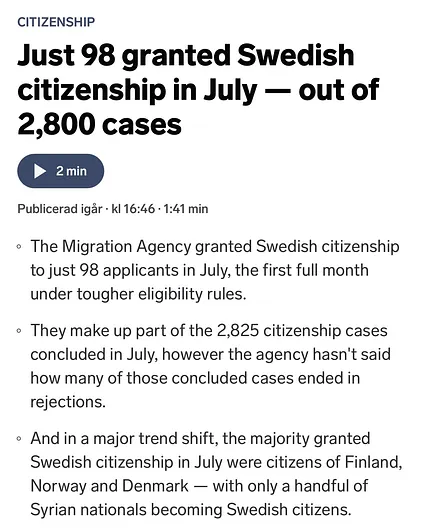
Under the stricter rules for Swedish citizenship, just 98 applicants have received citizenship in July, the first month under new rules and out of the 2825 concluded cases. The majority granted citizenship were from Finland, Norway and Denmark.
Essential Europe is a reader-supported newsletter that brings you clear analyses of news, politics and challenges that Europe faces. From political decisions, economic trends to EU policies. Have a look at: https://t.co/Vio3KlZujI
“If two Arab boys need to be taken care of, I’m not sending two girls in.” “As soon as certain surnames come up, we bring in the police.”
An emergency nurse in Germany told German newspaper Die Welt about the enormous precautions hospitals need to take while treating clan members. People shouldn't have to live like this in what was once one of the highest trust societies in the world.
“It usually doesn't take long for 20, 30, 40 family members to show up in front of the hospital. They have special Telegram groups where they alert each other, and they want to make their presence felt in a way that's often aggressive: 'We're here; we stand by our people—and you can expect trouble if anything happens to them.' In these circles, it's common for the mothers and women to scream loudly and in high drama. This high noise level is a stress factor for the staff and also for the patients."
Subscribe to my newsletter for free to receive clear critical posts on European news, politics and challenges shaping the future of our continent
https://t.co/B5L6ACno0a
If the European Convention on Human Rights undermines the rights and security of Europeans, and protects those non-Europeans who have no right being here and are a threat to our security, maybe it’s time to change the bloody thing
@ALSpeyerbach
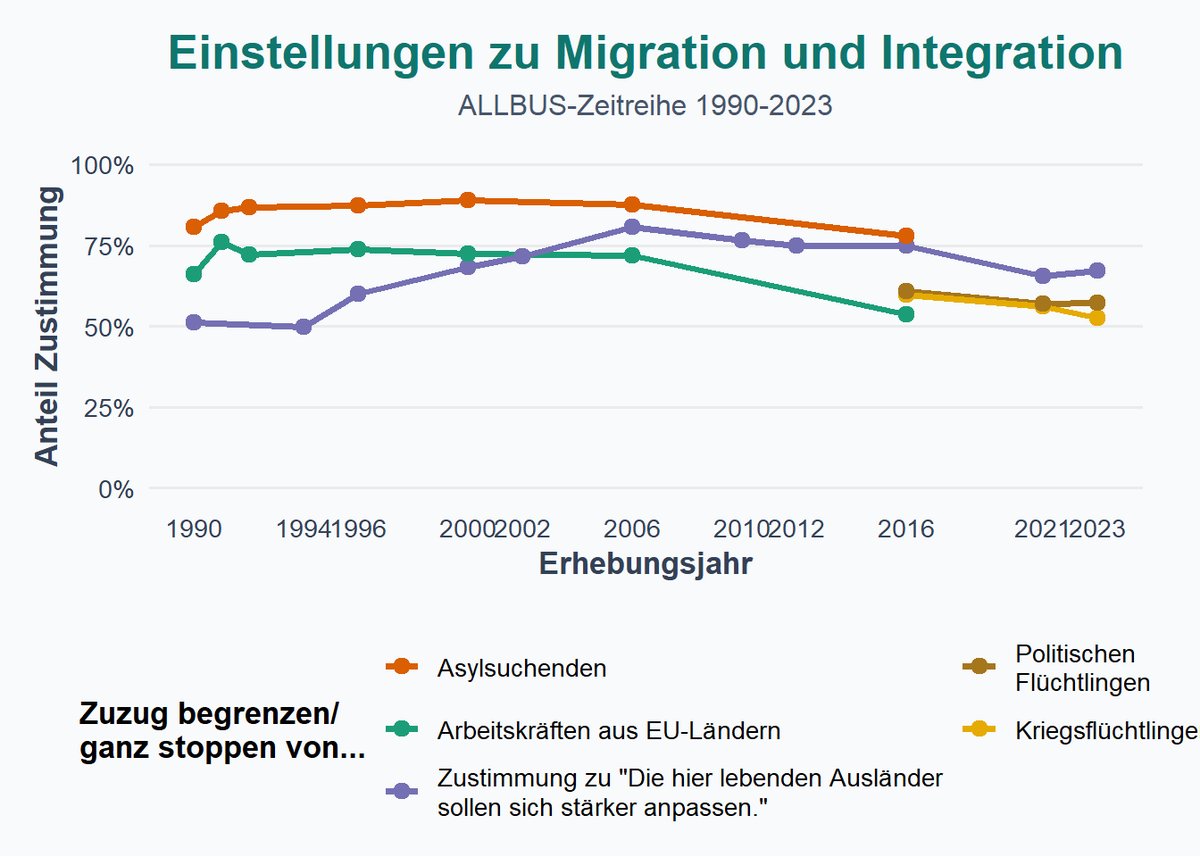
In contrast to all the talk about 'far-right radicalisation' on migration, German citizens have been thinking about migration and integration in roughly the same way for decades. Since 1990, more than 75 percent of Germans have wanted asylum migration to Germany to be reduced or even stopped altogether. In fact, in almost every Western European country, a majority of citizens wants far less migration, or even “no migration at all and recent migrants sent back.”
I wrote about this in more detail here:
https://t.co/X51IyrEnwn
Angela Merkel’s former fixer Peter Altmaier is now warning for a ‘state crisis, for the first time in the history of the German Federal Republic since 1949’. Altmaier argues that in the past, whenever a government was unpopular, an alternative coalition was always possible. Today, that is no longer the case. At least: not without the AfD. The newest history books still have to be written, but Germany has taken its historic place again: as a warning to the rest of Europe.
https://t.co/r6iN33kuwj
Merz’s clownish performance abroad and his faltering coalition at home have political consequences. While Merz’s CDU/CSU and the SPD keep muddling through, the far-right AfD keeps surging in the polls. According to INSA, the AfD would now be the largest party in the Bundestag elections, with 28% of the vote, 7 points more than in the February 2025 election. In September, voters in Sachsen-Anhalt and Mecklenburg-Vorpommern will go to the polls. In both states, the AfD has repeatedly been above 40% over the past year.