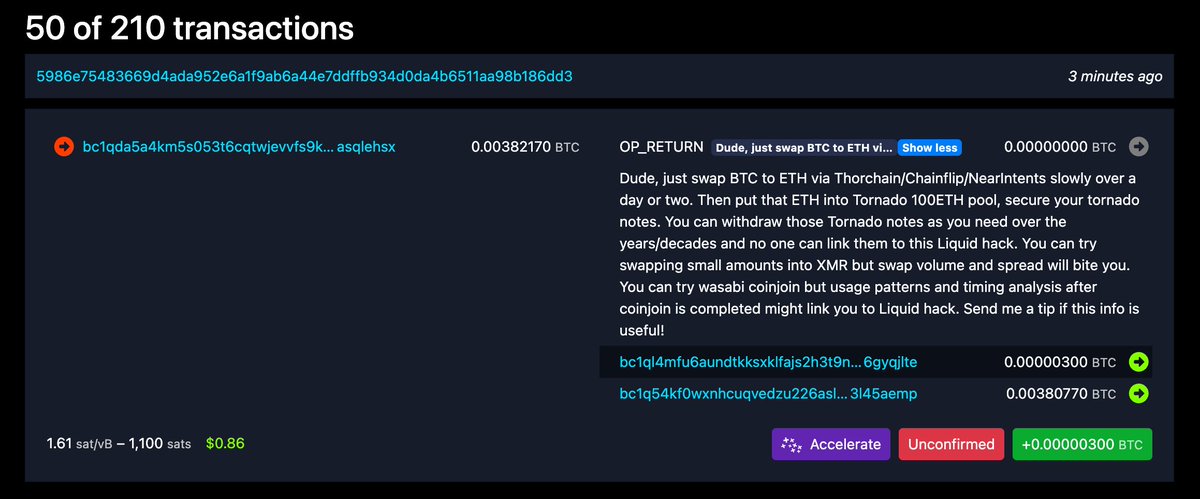
so some "good" news - the malicious (i.e. the current ui deployment steals notes) tornado[.]cash domain is now finally on "clientHold" status; in simple terms the registrar (TLD Registrar Solutions Ltd.) has told the registry (Binky Moon, LLC) _not_ to publish/activate the domain's dns. so i sincerely hope this will prevent further losses and my personal wish is that the domain can be returned eventually to Roman (after expiration).
Scandal in mathematics: OpenAI asked an NYU professor to cut his coauthor from the paper because the coauthor works at Anthropic.
Tristan Buckmaster, professor at NYU's Courant Institute and a Clay Research Award winner, published a statement on September 8. What follows is his account of events.
For a year, he and Levent Alpöge pushed the Córdoba / Martínez-Zoroa program toward smooth forcing. August 15: blowup for Boussinesq and 3D Euler. August 22: verified in Lean.
They paid OpenAI out of pocket for compute. And they kept every draft of the project inside private Codex sessions. On OpenAI's servers.
The program is obscure. Almost nobody else in the world was working on it. This was not "paste the Clay problem into a chatbot."
Then this.
Thursday, September 3. Rumors are spreading. Buckmaster emails OpenAI himself trying to stop a mess, not start one. The reply comes the same day: send us details so we can "avoid competing." Also, want some free compute?
Sunday. They suddenly need a call "at any point today." Sébastien Bubeck, who runs OpenAI's math team, gets on the line. Alpöge is not invited.
Buckmaster is told an internal model has produced a roughly 100-page proof of finite-time blowup for forced Navier–Stokes. Fefferman's options c and d. The exact route he and Alpöge had quietly chosen a year earlier.
He's shown a prompt and told the model was "simply given the problem statement." Very little human input.
That falls apart on the same call. An entire team had been on it. "An insane amount of compute." The model had been warmed up on easier equations first including Euler. And the prompt he was shown had itself been written by prompting Codex.
He asks when the first prompt went out.
They stall. Then: the past few days. After word of his work reached OpenAI.
He asks whether the model had access to the private Codex sessions holding every draft of the project.
The answer: the model does not look up user data.
He asks again about training.
No answer.
And here the story stops being about science.
Option one: you post Euler, we post Navier–Stokes the next day.
Option two: you post Euler, then you alone write up Navier–Stokes, credit our model and we cut Alpöge.
Bubeck, per Buckmaster, pushes twice to remove Alpöge from authorship. The reason: he works at Anthropic.
Buckmaster declines both. And says that if they release it that way, he goes public.
There was no scientific objection. There was:
"Why would you ruin your career?"
And after he answered that he's an academic:
"If you don't want me to be nice, then I don't have to be nice."
Later, Alpöge gets a text proposing a one-on-one: "I don't know if Tristan is being fully rational right now."
That is not how you talk to a collaborator. That is how you split one.
So here's what we have, if even half of it holds. A lab learns two academics are about to close out a path almost nobody was on. It spins up a team on that exact path. It dodges the question about their unpublished drafts sitting inside its own product. It tries to dictate the announcement order. It tries to remove a coauthor over his employer. And when that fails, someone reaches for a career threat.
Bubeck has publicly called the allegations "false and inflammatory" and promised a fuller response. So this is one side but a side that put a timeline, names, and direct quotes on the record under his own name and his own reputation.
What the hell is happening.
Ostium hacker lost 5100 ETH.
Coldcard hacker (footprint E) lost 1010 ETH.
Both 1 month apart. Both to a phishing tornado site tornado[.]cash. Dude made $15m in one month from those hackers. 😭
The clearly-not-whitehat hacker kept almost 600 of the 4000 bitcoin they stole. Fun fact: engaging in a random exchange creates a cascade of new, even more serious criminal charges than if the hacker just kept it all, and law enforcement pursues it just as aggressively regardless