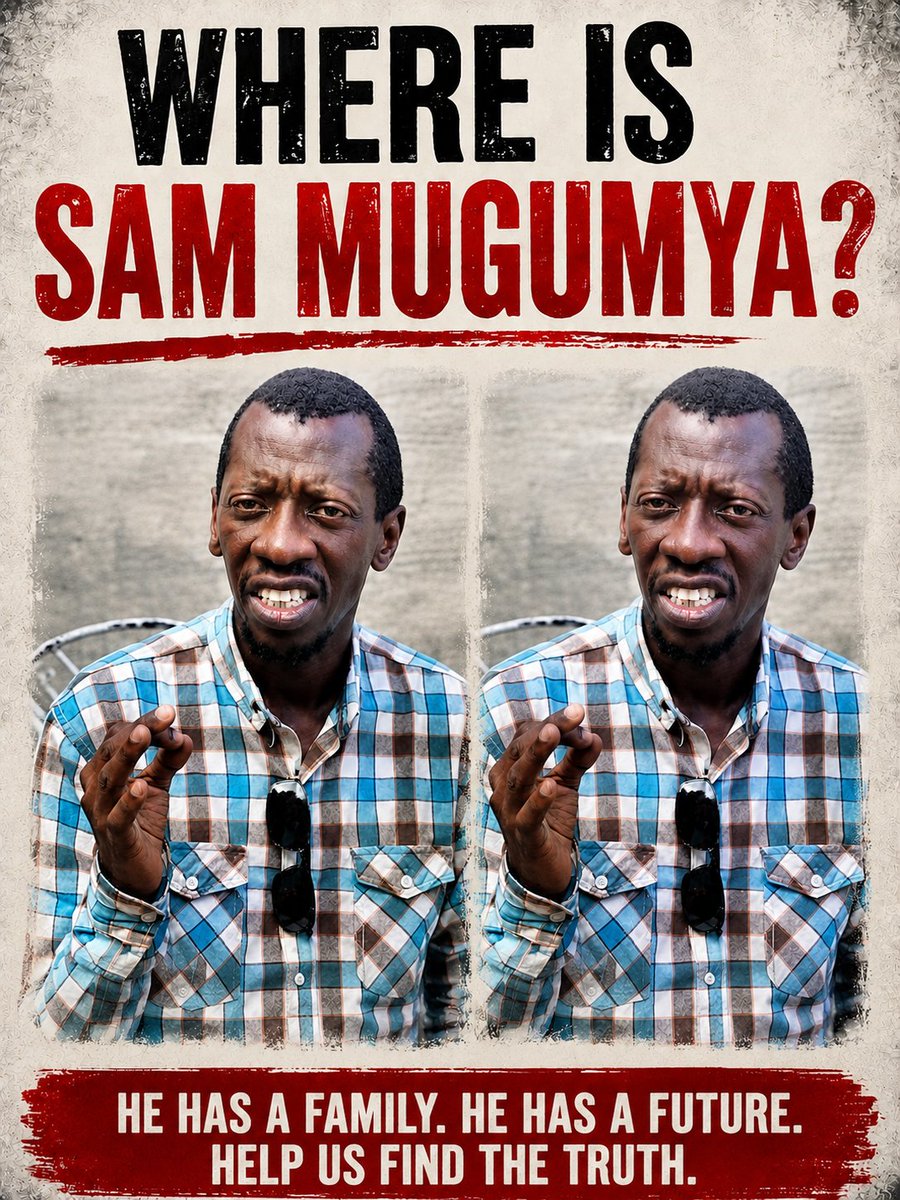
Sam Mugumya was abducted on 26th August 2025. Thats 240 days since he was abducted. The state has refused to produce him. The two Kenyans who were kept in an SFC facility said they left him there.
Where is Sam Mugumya?
#Weknowourheroes#FreeSamMugumya
In 2018, together with others we petitioned the constitutional court over the passage of the constitutional amendment bill that removed age limit to enable @KagutaMuseveni die in office. Our lawyers led by @EriasLukwago asked court to summon then CDF Gen David Muhoozi. This was in relation to military invasion of Parliament and the violence. He was summoned and he came to Mbale where the case was heard and he testified from the dock. @mkainerugaba simply thinks Uganda is his father's estate and he is above the law. This is what we must fight. Muhoozi like his father must be vigirously taught that they are servernts and not masters. That is our collective duty as citizens.
Our +254 people, I don’t purport to direct your existent, unbowed revolutionary agenda, but just to say: hold onto those term limits and the rule of law. Hold on with everything! Perhaps for us all.
Thank UOX for the solidarity in demanding for Tabz . Kindly let's keep the momentum .
No one is safe till all of us are safe.
Where is SAM MUGUMYA ?
#FreeSam
His eyes tell half of the story. Tabz human rights have been grossly violated by his captors for over 6 days.
We cannot continue to look on as this inhumane behavior by @MODVA_UPDF is normalized by the entire justice system of uganda.
Time to Rise and say enough is enough
#FreeUgandaNow
#freeTabznow
Sovereignty Without Law: When Power in Uganda Can No Longer Justify Itself
Sovereignty is not merely the possession of power; it is the legitimate exercise of authority within a legal order. In constitutional democracies, sovereignty is expressed through adherence to the law, not its suspension. When those in power act outside the law, sovereignty is not strengthened; it is hollowed out. Law is the language through which sovereign authority explains, restrains, and justifies itself. Where the state cannot account for its actions in law, it ceases to act as a sovereign governed by consent and becomes a coercive apparatus sustained by fear.
The Constitution vests sovereignty in the people, exercised through institutions established by law. The protection and faithful implementation of laws is therefore not a technical obligation; it is the core mechanism through which sovereignty is preserved. Persistent lawlessness by state actors amounts to an abdication of sovereign responsibility and a rupture in the social contract.
Article 99 of the Constitution of the Republic of Uganda vests executive authority in the President, to be exercised in accordance with the Constitution and the laws of Uganda. This provision does not grant unfettered power; it constitutionalizes restraint. Presidential authority is derivative, not absolute, it flows from the Constitution and is bounded by it. Critically, Article 99 does not authorize parallel command structures, informal security units, or actions outside established legal framework. Illegal and extra judicial acts represent executive action divorced from constitutional legitimacy, reducing presidential authority from lawful command to raw coercion.
Since 2020, Uganda has witnessed a disturbing pattern of military abductions, illegal detentions and torture: These practices violate multiple constitutional guarantees, including the right to personal liberty, the right to a fair hearing, and the absolute prohibition against torture.
What makes this crisis particularly grave is not only the frequency of violations, but the state’s inability or refusal to justify them within the law. Courts have repeatedly ordered the production of detainees; security agencies have ignored these orders with impunity. This systematic disregard for judicial authority signals a breakdown of constitutional governance and the emergence of a security state operating outside the law.
Under international law, torture is not merely an abuse of power; it is one of the gravest international crimes. When committed as part of a widespread or systematic attack against a civilian population, torture constitutes a crime against humanity under the International Criminal Court framework and the Rome Statute. By tolerating or normalizing torture, a state exposes its officials to international criminal liability and erodes its standing in the community of nations.
True sovereignty depends on the state’s ability to govern through law. When law is replaced by force, sovereignty is not defended, it is cannibalized. A state that terrorizes its own citizens loses moral authority, institutional coherence, and international credibility. In Uganda’s case, continued abductions and torture weaken the very sovereignty the state purports to protect, transforming constitutional authority into discretionary violence.
Possible remedies lie in the following actions: immediate end to illegal detentions; reasserting judicial authority; independent investigations and prosecutions of perpetrators and leadership recommitment to constitutionalism.
Sovereignty cannot survive where power is exercised without legal justification. The persistence of abductions and torture reflects not strength, but constitutional decay. Restoring sovereignty requires a return to lawful authority, where every exercise of power can be explained, defended, and constrained by law. Anything less is not sovereignty, but lawlessness clothed in the language of the state.
Nonviolent revolutions are systemic, society-altering movements that achieve political and social transformation through civil disobedience, mass protests, strikes, and institutional boycotts rather than armed conflict.
#TheRevolutionIsOn
🚨 FREE ALL POLITICAL PRISONERS🇺🇬
No one should be imprisoned for their beliefs or political opinions. We call for justice, due process, and the release of all those arbitrarily detained.
🧵 A thread of names:
#FreePoliticalPrisonersInUganda#HumanRights#FreeUgandaNow