A movement to create fair markets for the farmers who grow our food, while rebuilding the towns, schools, and hospitals that hold rural America together.
Smithfield is walking out of the hog barn and keeping the bacon, and that single move explains the whole pork business.
Last month Smithfield reported hog production profit down 61%.
Fresh pork lost 89 million dollars.
Packaged meats, the bacon and the hot dogs, made 230 million. Fifth straight year over a billion.
So they agreed to sell about 40,000 North Carolina sows to Vision Ag, a long-time Smithfield contract grower.
Smithfield still owns 90% of that company.
They are leasing the barns back for about a million dollars a year.
They are financing the deal on a 30-month note.
They still sell the feed. They still truck the pigs. They still buy every hog back under a long-term contract.
900,000 fewer hogs a year on Smithfield's balance sheet.
They raised 17.5 million hogs in 2019. Last year it was 11 million.
The CEO said getting below 10 million hogs has been a big goal of ours.
Barn Talk broke the mechanics of it down this week, and the mechanics are the story. The live animal carries the loss, the label carries the margin.
Own the barn and you carry the weather, the feed bill, the death loss and the note. Own the brand and you keep the 230 million.
Every farmer in this country is told to get bigger, borrow deeper and chase efficiency. The biggest player in pork just chose fewer hogs and more bacon.
I would rather own the animal and sell the meat to the family eating it.
Your rancher,
Jason Hanley | 208-714-0478
Senator @JohnBoozman is urging the 119th Congress to pass "Farm Bill 2.0".
Any final farm bill must explicitly omit the Save Our Bacon Act.
Outgoing members: as you conclude your service, your final votes will cement your legacy. We urge you to uphold core American principles: federalism, common sense, and compassion. Do not let your departure be marked by compromise or catering to special interests. Leave a legacy of clear moral leadership.
Some great news for factory-farmed pigs last night.
In Iowa and Kansas, voters rejected the lead sponsors of the Save Our Bacon Act in both the House and Senate: Rep. Ashley Hinson and Sen. Roger Marshall.
These were the politicians who did the pork lobby’s bidding and tried to wipe out every state ban on selling pork from crated pigs.
Yet even in two of the most pro-agriculture states in the country, it cost them more votes than it won them.
The politicians who follow the factory farming lobby aren’t as safe as they thought.
ICYMI, Joe Maxwell of @FarmActionFund told Out of State that if Democrats want to retain any rural farm voters after today, they need to switch up their approach to politics and policy.
They must "shift back to economic issues and call out corporate power that’s extracting opportunity from rural communities," he said.
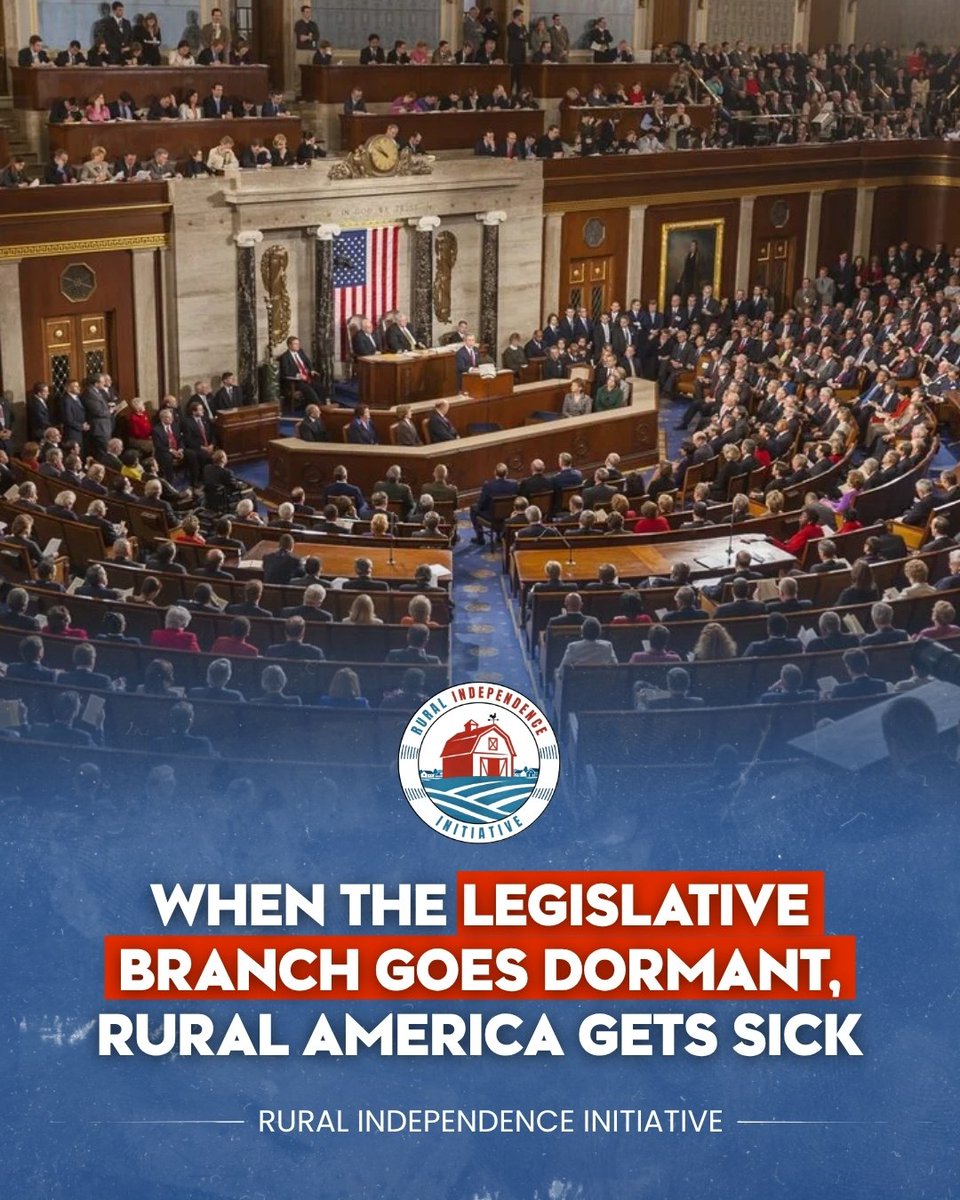
The Constitution gives Congress three big powers.
The power to set tariffs.
The power to declare war.
The power to decide how your tax dollars are spent.
Over the past two years, the President has taken all three. When he did, Congress hid under a desk.
Tariffs. The President slapped sweeping tariffs on nearly every country using an emergency law. Congress could have asserted its constitutional authority over duties and foreign commerce. It didn’t.
War. The war with Iran started in February. Congress had the power to stop it. It didn’t.
Spending. Congress writes the budget. But the administration refused to spend money Congress approved. Congress had the power to enforce the law. It didn’t.
Corruption. Congress had the power to hold hearings, issue subpoenas and put the scoundrels under oath.
Both the House and the Senate adjourned early and went home to campaign.
Every one of these hit rural America. The tariffs cost farmers their markets. The war pushed diesel past six dollars a gallon. Help for rural America was left unspent, and the crooked are still slopping at the trough.
The Founders built three branches so no one person could control the country alone.
Members of Congress who refuse to exercise their constitutional duties are failing the oath they took to the Constitution.
Those who don’t have the moxie to stand up to power have no business being in Congress.
We are the Rural Independence Initiative.
We are fighting for change in Washington, for a Congress that remembers it works for the people, not for the President.
Join Us - https://t.co/J1WabIUnOo
Donate - https://t.co/pj1ZqEif2c
Joe Maxwell, President
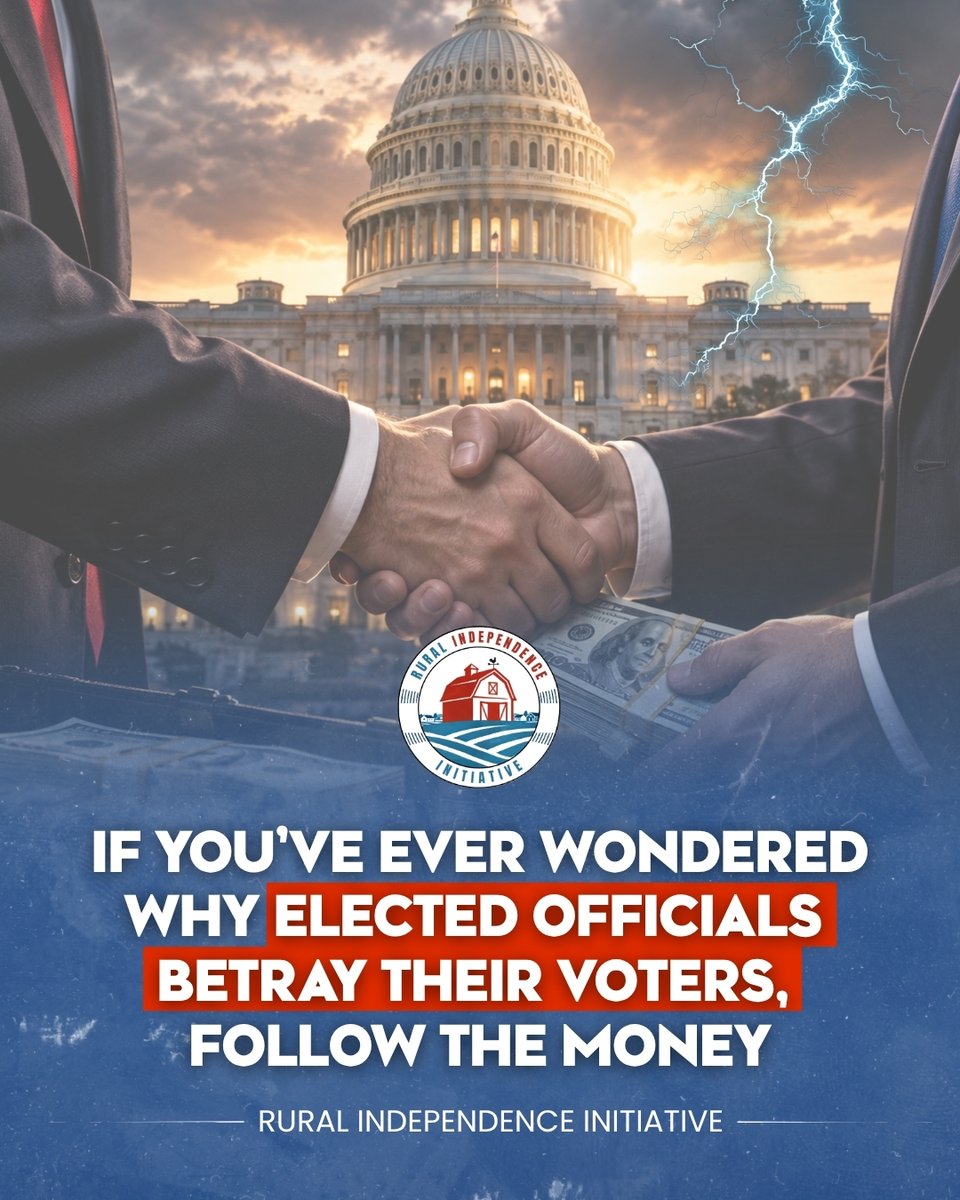
Ever wonder why the people you send to Washington end up voting against you?
Follow the money.
This year, 172 billionaire families have poured a record 1.7 billion dollars into the midterm elections.
One man, Elon Musk, has spent about 445 million dollars by himself. His company, SpaceX, holds billions of dollars in federal contracts.
The crypto industry has poured 189 million dollars into this election. That makes it the biggest corporate spender in American politics. It wants Congress to write the rules for cryptocurrency on its terms.
Big Tech and the AI industry built their own super PAC, with tens of millions of dollars ready to back candidates who promise lighter rules on AI. That's the same industry looking to build data centers in rural communities.
The companies squeezing farmers are writing checks too.
And oil and gas companies spent 219 million dollars in the last election to help elect the people now in power. Diesel is over six dollars a gallon.
The single biggest donation to the President’s inauguration, five million dollars, came from Pilgrim’s Pride. It’s owned by JBS, one of the four meatpackers that control 85 percent of the beef market.
Bayer, the company behind Roundup and one of the two biggest seed sellers in America, spent 9.2 million dollars lobbying Washington last year. It gave another one million dollars to the inauguration. It wants Congress to shield it from tens of thousands of Roundup cancer lawsuits.
Koch Industries owns one of the country’s biggest nitrogen fertilizer makers. It has given 30 million dollars to the Koch network’s super PAC this election.
None of that money is being spent for the good of rural America.
It's being spent to buy access. To protect government contracts. To lock in tax breaks and friendly rules.
Farmers can't write checks like that. Neither can rural hospitals, small-town schools, or the family running the hardware store on Main Street.
But we have something they can't buy.
Votes.
We are the Rural Independence Initiative.
We are fighting for change in Washington, for a government that answers to the voters who elect it, not the donors who fund it.
Join Us - https://t.co/J1WabIUnOo
Donate - https://t.co/pj1ZqEif2c
Joe Maxwell, President
Independent hog farmers have found viable markets thanks to Prop 12. The Save Our Bacon Act is only being promoted by China owned Smithfield to fuel more consolidation. We appreciate FAF endorsed Josh Turek @turek4iowa for standing with us against Big Pork
Democratic U.S. Senate candidate Josh Turek visited a farm Thursday to discuss his plans to support Iowa farmers if elected to Congress — a plan he said will not include the “Save Our Bacon” act proposed by Republican Ashley Hinson, @robinlopsahl reports. https://t.co/MV0nE7XfQe
In the late 1800s, American farmers were getting squeezed.
Railroads charged whatever they wanted to haul grain. Banks charged whatever they wanted to lend. And both parties in Washington looked the other way.
So farmers organized.
First came the Grange. Then the Farmers' Alliance. In 1892, they formed their own party, the People's Party, and wrote a platform in Omaha.
The establishment called them cranks and radicals.
Here's what those "radicals" asked for.
Let voters, rather than rather than state legislators, elect their U.S. Senators.
A graduated income tax, so the wealthiest paid their fair share.
A secret ballot, so nobody could see how you voted.
Postal savings banks for families the big banks wouldn't serve.
Real rules for the railroads.
Within a generation, almost all of it was the law of the land.
And the fight kept going.
In 1921, Congress passed the Packers and Stockyards Act to rein in the meatpackers. In 1922, Congress passed the Capper-Volstead Act, protecting the right of farmers to form cooperatives.
North Dakota farmers, tired of out-of-state grain companies and banks, built their own state bank and a state-owned mill. Both are still running today.
In the 1930s, rural electric cooperatives brought power to farms the big utilities refused to serve.
Every one of those wins started on the prairie, with farmers who were told to sit down and be quiet.
They didn't.
Look at farm country today.
Four companies control 85 percent of the beef market. Four control 67 percent of pork.
Two companies sell the seed planted on 72 percent of America’s corn acres.
Four companies own about 70 percent of the country’s nitrogen fertilizer capacity. Four sell virtually all of its potash and phosphate.
Different century. Same fight.
We are the Rural Independence Initiative.
Fighting for a new generation of farmers and rural Americans doing what their great-grandparents did a century ago.
Join Us - https://t.co/J1WabIUnOo
Donate - https://t.co/pj1ZqEif2c
Joe Maxwell, President
Eight billion dollars.
That's what the President promised farmers at a rally in Kansas on Monday, October 19, to help cover the cost of diesel.
Diesel is running about six dollars and thirty cents a gallon. A year ago, it was about three dollars and sixty cents.
Fuel costs on the farm are expected to jump nearly 30 percent this year. For a rice farmer, higher fuel alone added fifty-two dollars an acre.
But the check isn't in the mail.
Payment rates won't even be announced until November. The money, if it ever comes, will come too late.
Harvest is happening right now.
And notice what nobody in Washington explained: why diesel costs so much in the first place.
A war with Iran choked off the oil coming out of the Persian Gulf. Fertilizer, which tracks fuel prices, went up right along with it.
This is the second farm bailout in less than a year. Last December, it was twelve billion dollars to cover losses from the trade war. Now it's eight billion more for the fuel crisis.
Twenty billion dollars in emergency checks. And the problems that caused them are still here.
That's a Band-Aid on a ruptured aorta.
Farmers don't want a bailout every time Washington breaks something.
They want Washington to stop breaking things.
We are the Rural Independence Initiative.
We are fighting for change in Washington, for farm policy that lets farmers earn a living from the market, not wait on the next emergency check.
Join Us - https://t.co/J1WabIUnOo
Donate - https://t.co/pj1ZqEif2c
Joe Maxwell, President
Listen closely.
That rumble you hear this year is coming from rural America.
Here's why.
Since 2010, 206 rural hospitals have closed or stopped offering inpatient care. Another 417 are at risk of closing.
Fifty years ago, rural America had the lowest cancer death rates in the country. Today, it has the highest.
Small-town schools are closing and consolidating.
Farmers are getting squeezed from both ends. Sixty-three farmers will go out of business today.
Foreign markets are drying up. America's share of global soybean trade has fallen to a record-low 23 percent.
Costs keep climbing. Diesel is over six dollars a gallon. Anhydrous fertilizer is up 20 percent from a year ago.
The USDA expects farm income to fall this year while the cost of producing a crop goes up.
Rural America has been patient.
They've been told to wait for the next farm bill. The next trade deal. The next emergency check.
We’re tired of waiting. Tired of broken promises. Tired of being taken for granted.
We are the Rural Independence Initiative.
We are fighting for change in Washington, because rural communities are tired of being ignored and ready to be heard.
Join Us - https://t.co/J1WabIUnOo
Donate - https://t.co/pj1ZqEif2c
Joe Maxwell, President