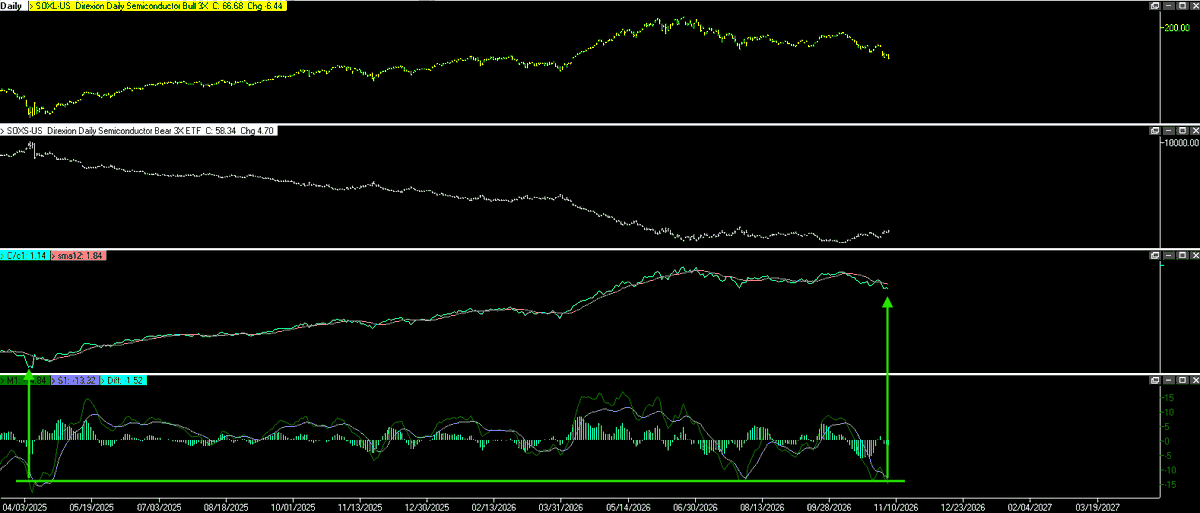
The SOXL/SOXS ratio hit a momentum extreme today, a sign that leverage has become severely dislocated.
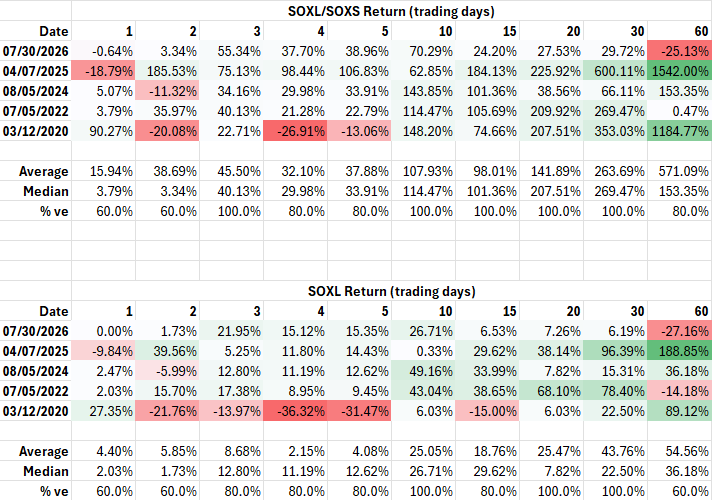
Similar setups have been rare, but the historical outcomes have been remarkable. Across prior occurrences, the SOXL/SOXS ratio gained an average of 108% over 10 trading days, 142% over 20 days, and 571% over 60 days.
What's particularly interesting is that some of these ratio rebounds occurred even when SOXL itself was flat or negative. In other words, the ratio improved not because semiconductors were rallying aggressively, but because SOXS was deteriorating even faster through leverage decay.
That's an important distinction. This signal is not simply identifying oversold conditions, but periods where bearish leveraged exposure has become so crowded that the mechanics of leveraged ETFs begin working against the bears. History suggests those conditions tend to emerge near major momentum washouts.
We're seeing an extreme in leverage, positioning, and bearish conviction. Historically, those have been fertile conditions for powerful reversals.
On days like today, it's important to zoom out.
No, the AI Revolution is not "over," and the market is not "going to zero."
In fact, the Nasdaq 100 is up +11% YTD and nearly +70% since its April 2025 low.
Meanwhile, the S&P 500 is currently set to post a blended earnings +30.2% growth rate for Q3 2026.
This puts us on track for the third-straight quarter of earnings growth above 25%.
And, even after the biggest hack in crypto history, Bitcoin is down less than -5% this week.
Disruptive technologies like AI will inevitably bring heightened volatility, polarized positioning, and extreme swings in market sentiment.
However, do not let short-term volatility overshadow the broader picture.
We are in the midst of the biggest technological revolution in history.
Technical corrections are healthy, necessary, and an inevitable part of every bull market.
Do not lose sight of the bigger picture.
Today is another reminder of just how fast things can change.
Just 9 months ago, markets were pricing in 3 rate cuts in 2026 and we had $60 oil prices.
Today, a new Fed rate hike cycle has begun, oil prices are above $100, and diesel prices are at record highs.
The market and the Fed are in agreement, lower rates are not coming as long as the current energy crisis continues.
There simply is no scenario where rate cuts are warranted with $100+ oil prices and 3.5%+ inflation, aside from an economic depression.
Luckily, we are also in the midst of the biggest technological revolution in history, and the AI boom continues to provide substantial support for the S&P 500.
Without the AI Revolution, markets would be in a much darker position right now.
On the flip side, a resolution to the current energy crisis opens for the S&P 500 to rise well above 8,000.
For now, a long and bumpy road appears to be ahead as the Fed continues its 60-straight-month battle against inflation.
"Higher for longer" has returned.
Will Warsh Break the Hall of Mirrors?
Kevin Warsh has criticized the Federal Reserve’s forward guidance and its resulting “hall of mirrors,” where markets anticipate the Fed, the Fed watches markets, and policy becomes a validation of financial-market expectations rather than independent judgment.
Wall Street pundits have it wrong. CPI is above the Fed’s 2% target, the Bernanke handcuffs. So what? The relevant question is whether a supply shock is generating clear second- and third-order effects, a self-sustaining spread into domestic prices, wages, expectations, and excessive demand.
The data say no. Breakevens confirm.
The clearest market signal came after the CPI release. Two-year and five-year inflation breakevens declined. The bond market’s forward-looking measure of expected inflation did not validate the claim that the report revealed a durable inflation breakout. Instead, it marked down expected inflation even as rate-hike odds rose.
That contradiction is the hall of mirrors. A backward-looking supply shock lifts CPI. Pundits demand a hike. Markets price a hike. Policymakers see the repricing and feel obliged to deliver it, even though the market’s own inflation expectations are declining.
A supply shock is already a tax on growth. Higher energy, freight, food, tariff, or input costs reduce real household income, compress business margins, and weaken spending and investment before the Fed moves.
Rate hikes do not pump more oil. They do not produce more diesel, lower tariffs, clear shipping bottlenecks, or add productive capacity. They add a second tax on growth through mortgages, business credit, capital investment, consumer durables, and housing construction.
Sound economic theory says the Fed should be still unless the supply shock is clearly spreading into persistent domestic inflation. Before hiking, it should be able to show broad domestic-services inflation, wages persistently outpacing productivity, rising medium- and long-term expectations, and robust real demand, credit, housing, and investment.
It cannot.
If the Warsh Fed yields to the hall-of-mirrors crowd, Warsh’s credibility is shot.
A supply shock lifts CPI, pundits demand a hike, markets price it, the Fed complies, and ordinary Americans absorb the costs through weaker housing, investment, credit, and employment.
That is not credibility. It is reflex.
BREAKING: The US and Iran have reportedly agreed to extend their 60-day ceasefire which was set to expire today, per Al Arabiya.
Details include:
1. Under the "Memorandum of Understanding" brokered by Pakistan, today marks the final day of the Iran War ceasefire
2. President Trump says that a "backchannel" is in place with Iran’s Revolutionary Guard officials
3. Despite the supposed extension, there remains no indication of an imminent deal
Today marks day 170 of the Iran War.
China's CXMT Plays Hardball — Strengthening Samsung and SK's DRAM Bargaining Power
Apple, which had recently been evaluating China's Changxin Memory Technologies (CXMT) as a new supply-chain source in a bid to cut costs, is understood to be struggling in negotiations to secure further price reductions. Paradoxically, with the cheap-Chinese-component workaround now blocked, Samsung Electronics and SK hynix have been relieved of the burden of shipping commodity DRAM and are concentrating their production lines on high-value AI memory such as high-bandwidth memory (HBM) — creating a market dynamic in which they now hold complete control over global memory pricing power.
◆ "More expensive than Samsung" — CXMT rebuffs Apple as DRAM market leadership flips
According to semiconductor industry sources on the 5th, Apple recently negotiated with CXMT over supply pricing for mobile DRAM including LPDDR5X, seeking to ease manufacturing cost pressure on its next iPhone and smart-device lineups, but was reportedly refused a price cut. CXMT instead held firm at prices equal to or higher than those quoted by Samsung Electronics and SK hynix. In effect, Apple — long a byword for buying power in the finished-goods market — has been stonewalled by a component supplier's hardball pricing.
Behind CXMT's willingness to flatly reject Apple's demands is the wholesale volume sweep by Chinese IT giants such as Huawei and Xiaomi. With Washington's semiconductor sanctions on China still in force, Chinese device makers pursuing domestic self-sufficiency have locked up CXMT's DRAM output in advance through high-priced long-term contracts — leaving CXMT with no reason to bend to an Apple that demands both exacting quality qualification and lower prices. Analysts say the solid captive demand of China's domestic market is providing CXMT with a powerful pricing shield.
The "cross-diversification into cheap Chinese components" playbook favored by Apple and other global device giants for beating down component prices has been rendered useless amid the commodity DRAM shortage. Finished-goods divisions have historically deliberately dangled Chinese panels or memory as bait to pressure affiliates and incumbent suppliers, thereby seizing the upper hand in annual pricing contracts. But as the supply-demand imbalance across the memory market accelerates, the balance of power is seen as having shifted decisively from set makers to memory manufacturers.
◆ Big Tech's cheap workaround closes — the shortage spreads to commodity DRAM
This phenomenon is read as a knock-on effect of the sharp drop in absolute capacity for commodity DRAM (DDR5, LPDDR5X) caused by the buildout of HBM-dedicated production lines throughout the first half. As major memory makers cut wafer input for commodity DRAM and concentrated on HBM packaging processes to meet demand from next-generation AI servers and accelerators, even commodity DRAM prices have surged, entrenching the "memflation" phenomenon. With Chinese memory makers — once viewed as the alternative — now demanding full price as well, Big Tech has lost its detour around rising costs.
The market's read is that this episode is feeding a virtuous cycle delivering record practical windfalls to Korean semiconductor giants Samsung Electronics and SK hynix. Because CXMT is absorbing large volumes of China-focused commodity DRAM, Korean firms have been fully freed from the shipment pressure of clearing low-priced commodity volume and from the associated price-decline risk.
Into the space vacated by commodity DRAM oversupply fears, Samsung Electronics and SK hynix are aggressively pushing forward ultra-high-value AI memory lineups such as HBM4, LPCAMM2 and eSSD. Having reengineered their product mix toward high-value products, the two now hold unrivaled pricing power heading into second-half long-term pricing negotiations with global Big Tech.
"An unusual situation has emerged in which CXMT is holding the price floor and thereby firmly underpinning commodity DRAM pricing as well," one industry official said. "With the commodity DRAM floor intact and Samsung and SK hynix monopolizing leadership in high-value AI memory like HBM4, operating margins and global market control for Korea's semiconductor camp should rise all the more steeply in the second half."
THIS HAS TO BE THE STORY OF 2026
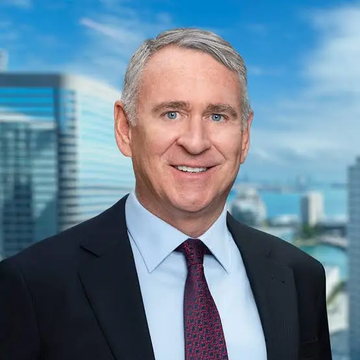
Ken Griffin’s Citadel was pushing surprise-rate-hike fears just days before the AI trade collapsed and forced 4x-levered Leopold Aschenbrenner's Situational Awareness to unload its book near the lows.
Citadel then reportedly bought most of those assets at significantly lower prices knowing that if sentiment deteriorated enough the fund could be forced to sell which makes the entire sequence look absolutely ruthless.
This is why the stock market is the greatest game on Earth.
Trump still hasn't figured out that soaring memory prices are one of the biggest drivers of core inflation. But with iPhone prices about to jump $300, he will very soon