Exciting News! We're offering a free four-day training on Universal Design for Learning through the California Coalition for Inclusive Learning (CCIL). Sign up today. https://t.co/7Nk8nyHONm
@caahayes A6 Our article just came out in @sciencescope that focuses on how teachers can support their multilingual students in the science classroom. The article includes many strategies that teachers can use right away! You can read it here: https://t.co/hMc10SlBDe
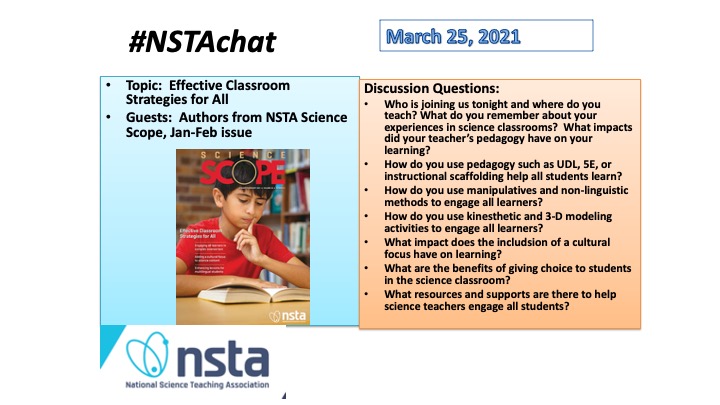
#NSTAchat
@caahayes A5 Giving students choice in the science classroom shows them that their choices, their ideas, and their curiosities matter. By positioning students as capable decision-makers in the classroom, we create a learning environment that promotes students’ sense of agency. #NSTAchat
@caahayes A4 cont...There are MANY ways of knowing in science, from those practiced in what we think of as “western” science to those practices valued by cultures around the world. It is important to recognize and elevate these ways of knowing! (2/2) #NSTAchat
@caahayes A4: By taking a more expansive view of what it means to do science (and who does science), we can position students as knowers and doers of science whose ideas and ways of knowing are both generative and valuable. (1/2) #NSTAchat
@caahayes A2 cont.. Not only does this sort of embodied (kinesthetic) learning allow teachers to see students’ thinking in real-time, it ensures that all students are actively engaged! Plus, students love to move! #NSTAchat
@caahayes A3: Students can use their bodies to model scientific processes, to explain what they think is happening with a phenomenon, or to make predictions. For example, students can "be plants" and show what they think would happen if there was more or less sunlight. #NSTAchat
@caahayes A2: Not only can teachers better see how students’ science ideas are evolving, but students’ ideas play a central role in the learning taking place in the classroom. (3/3) #NSTAchat
@caahayes A2: Models, for example, are very powerful for making students thinking visible. Students can create an initial model to explain or predict phenomena and then can come back to these models over time to revise them (2/3) #NSTAchat
@caahayes so it is incredibly important for teachers to not only encourage students to use their many meaning-making resources, but also to value these resources (3/3) #NSTAchat
@caahayes Multilingual students bring with them so many different linguistic (speaking, listening, reading, writing across languages and registers) and non-linguistic resources (gesture, symbols, charts, graphs, models, drawings, etc.) for making sense of science ideas... (2/3) #NSTAchat
@caahayes Hello! Sage Andersen, here from UT Austin. Former middle school science teacher, longtime teacher educator, and current PhD student. #NSTAchat