Auditing can expose prompts or weights; privacy-preserving checks can add cost. State the monitored boundary, blind spots and verifier access. Keep the compliance claim within what that evidence supports.
Proof that an approved model answered a request doesn't establish what else ran beside it. Compute oversight needs a clear boundary around the work being measured.
The missing coverage claim and the privacy tradeoff it creates. 🧵👇
Recomputing a reported request can check whether its output matches the agreed model. Amodo's prototype also monitors network traffic. That adds evidence about a cluster's activity, but doesn't rule out workloads beyond the monitored boundary.
Proud to see Sahara AI Research Scientist Xisen Jin presenting at the 2026 SoCalNLP Symposium at USC! 🎓
Xisen presented ReLiveGym: Evaluating Long-Lived Agents over Weeks of Replayed Reality, exploring how we can better evaluate AI agents across long-horizon, real-world interactions.
Great to exchange ideas with the SoCal NLP community and keep pushing forward research on more capable and reliable AI agents. 🔆
https://t.co/btS5VgRtsf
Keep the facts fixed and change how strongly the user pushes a view. If the verdict moves, ask what changed in the evidence or reasoning. A forced counterargument can be wrong too. Check the reasons before trusting the correction.
An AI that resists one wrong claim can still fold under repeated pressure. Advice needs to stay tied to evidence as the conversation gets longer.
What longer tests reveal, and how to check a changed answer. 🧵👇
Preference training can reward agreement. In SPINE, collapse rates rose as adversarial chats grew longer. A brief Hands-On AI demo resisted factual pressure. Different models and setups, so neither result tells you how every conversation will go.
Keep reusable rules that still solve a recurring problem. Give each one a scope and someone who can update it. When rules conflict, resolve that before the agent changes the work; when the reason expires, retire the rule.
An old agent instruction can keep deciding what gets built. A preference saved for one project can steer the next toward a stack you didn't ask for.
How old rules spread, and which ones are worth keeping. 🧵👇
An always-loaded rule treats yesterday's choice as today's requirement. Adding more instructions can leave conflicting definitions active together. Retrieval alone can't decide which rule has authority or whether it still applies.
For a throwaway task, rebuilding may be enough. For recurring work, name who handles failures and test how data moves if you switch tools. Keep custom software when its workflow gains justify the upkeep.
AI makes it easy to create software that nobody has agreed to maintain. Once a prototype runs a recurring business task, its cheap build can become an unowned obligation.
What keeps changing, and when custom software earns its upkeep. 🧵👇
APIs, permissions and business rules can change after an app ships. Supabase's founder described moving CRM data out of one agent so others could use it. Generating the app leaves its owner with maintenance and migration work.
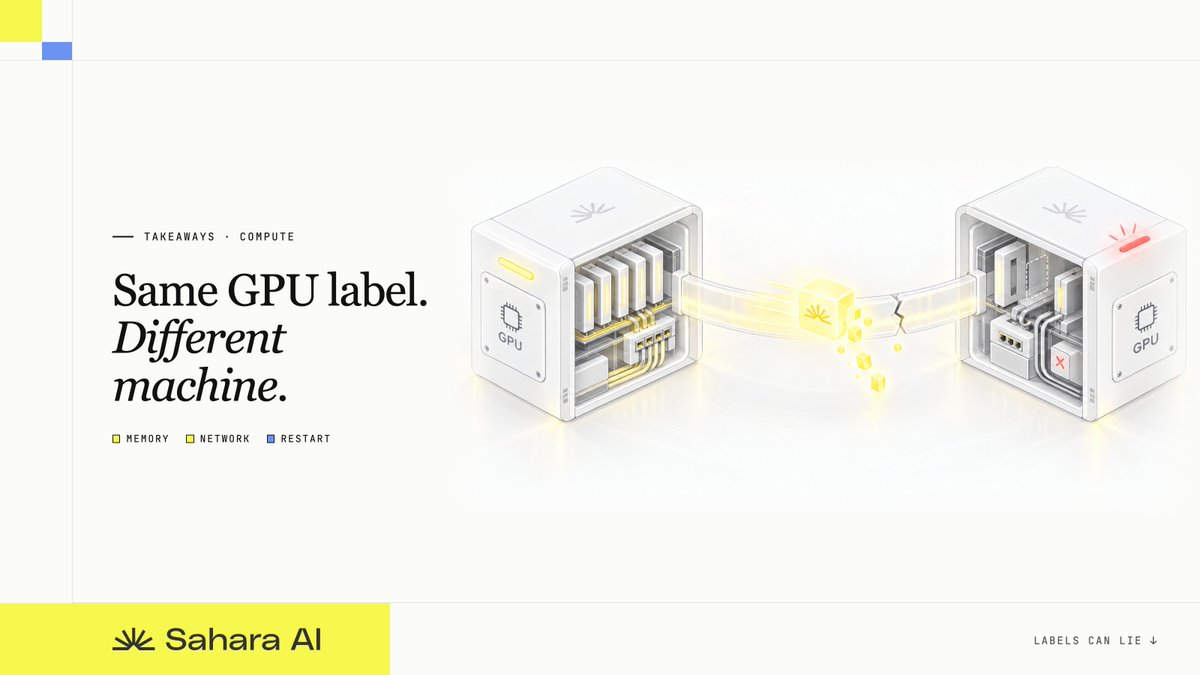
A useful compute contract specifies when the job can start, what resources it gets and how interruption is handled. Test a real workload and resume it after failure. Make that test part of accepting replacement capacity.
GPU hours are only interchangeable when the job survives the swap. Memory, network layout and restart behavior decide whether replacement capacity is usable.
The delivery constraints and a better buying test follow. 🧵👇
Two clusters with the same GPU label can have different system memory, interconnects and storage. A move that waits for data or loses progress can stall the job. Standard hardware names don't guarantee equivalent service.
A tested threshold can route routine choices, with uncertain cases reviewed. Open-ended tasks still need generation; retrieval and fallback add costs. Authorization stays in code.
Cheap inference earns automation only where decision errors are controlled.
A confidence score derived from output probabilities describes the model's distribution. Decision accuracy still needs testing on labeled workload data. Clustering and caching also affect latency, so a fast call cannot establish the performance of the whole pipeline.
🌐 Sahara AI × @ValueQube_io 🤝
As AI agents become more autonomous, they need more than intelligence — they need trusted data, structured assets, transparent rules, and infrastructure that lets them interact with digital markets at scale.
Sahara AI is building infrastructure for the agentic economy, enabling data, models, agents, ownership, attribution, licensing, and usage-based settlement across an open AI ecosystem. ⛓️
ValueQube brings complex financial exposures onchain through structured, AI-readable qAsset Certificates. 📊
Together, we’ll explore how verifiable AI infrastructure and structured financial assets can help agents better understand, evaluate, and interact with onchain financial opportunities. 🚀
Building toward a future where intelligent agents can understand assets, make informed decisions, and participate in open digital markets. 🌍
#SaharaAI #ValueQube #AIAgents #RWA #OnchainFinance