Epilogue
The fate of the missing diary pages is unclear. Sakowicz may have hidden them separatelly from the rest, and they were neer found. It is also possible that they were concealed with the other pages but destroyed by Lithuanian or Soviet elements.
Epilogue
It is less likely that he was intentionally shot by Lithuanian collaborators, as his wife claimed. The Lithuanians were in headlong flight, and it si unlikely that they had time to think about setting an ambush for Sakowicz.
Epilogue
The Red Army was approaching the city, which it occupied on July 13. The city and its environs were a battlefield, so it seems likely that Sakowicz was accidentally shot during an encounter between Soviet forward elements or partisans and German forces.
Epilogue
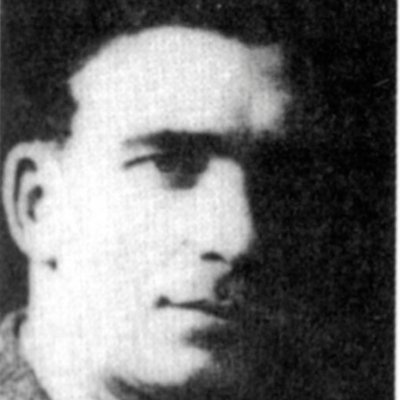
According to his family, Sakowicz continued to keep his diary until the day he was shot and mortally wounded while riding his bicycle from Wilnow to his home in Ponary on July 5, 1944. He was buried in Wilno on July 16. It is not clear who shot him.
That's all the diaries. It's taken me five years to Tweet everything he wrote. The last entry is dated November 6th 1943 although it is almost certain he continued after this date. He was killed on July 5th 1944.
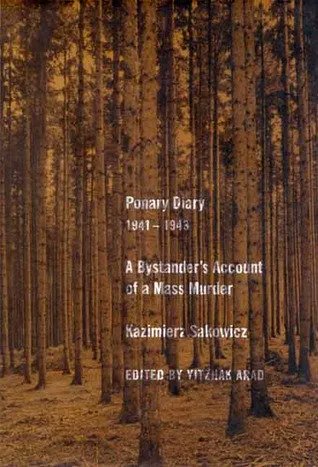
I started Tweeting Ponary Diary almost precisely five years ago on March 20th 2018 and today I reach the end of the diary itself. There is some more information to come. After that I start work on converting it into a new book.
Nov 6 1943
I forgot: at Wierhonowicz's on October 2, two wagons were loaded. One of the Jews told Wierhonowiecz that the cow would be taken another time (he pointed to her in the pigsty); until then the cow should be fattened. Wierhonowicz is feeding the cow better now.
Nov 6 1943
How did they know that? Very simple: their guides were the Jews who were sawing in the forest. Now they went together openly. Six horses returned later.
Nov 6 1943
After which they named, among other things, small items, such as wristwatches, and when the farmer would try to explain that he didn't have any, he was asked, "The where is that [high quality] Cyma silver watch"?
Nov 6 1943
It is interesting that the Bolsheviks, who that night appeared at the farms, declared at the beginning that "by the order of the Soviet authorities they demand that the following be furnished immediately, etc."
Nov 6 1943
Practically all of Gob, and actually all the richer farmers in Gob, wer thoroughly robbed last night. Six wagons, loaded with locally slaughtered pigs, lambs, and, in addition, clothes, shoes, and the like, left in the direction of the forest.
Nov 4 1943
It turns out that the policemen guarding the bases have concealed goods to sell. At a late hour two policemen come from the side of the base and on the stairs at teh Rudzinskis' they have laid out men and women's underwear, some dresses, children's clothing.
Nov 4 1943
The railway hut is full: there is Kulaskis, the great comrade of the Shaulists, Sienkiewicz from Chazbijewicze whose father was executed by these Shaulists at the beginning of the executions, and others.
Nov 3 1943
Near the pit a barrel with chloride stands now. Now the barrel always stands ready. The badly wounded, pretending to be killed, have chlorine poured on them. The Lithuanians say that the Jews often begin to jump up when the chlornine is shovelled on them.
Nov 3 1943
After a lont intermission again a truck full of Jews, mainly children and women. They were shot in the pit near Rudzinski's. The victims had already undressed in the truck and were naked -- to the pit. The Lithuanians shot them from above, as if at pheasants.
Oct 28/29 1943
On October 28, at night, a band robbed the farmer Wiernakowicz from Gob; three pigs were taken, seven lambs, clothing, linen, flour, kitchen utensils, shoes etc. Who did it? The Jews who sawed wood in the forest in Gob?