In crypto, it is easy to grab attention with hype. What's much harder is delivering month after month.
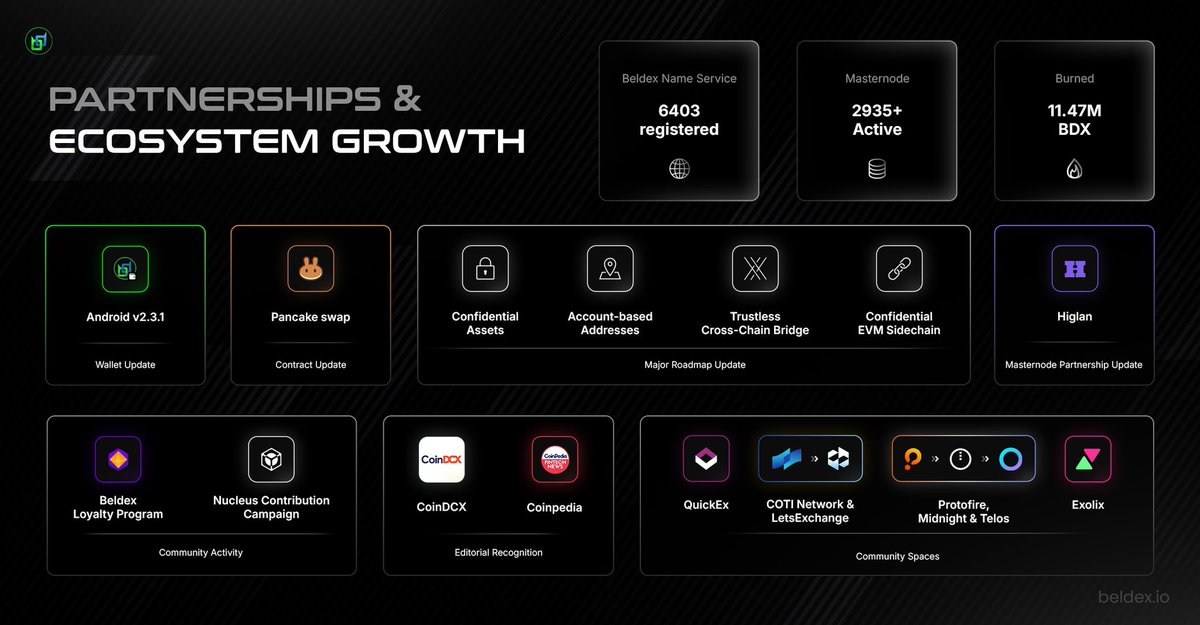
That's one of the reasons I've kept an eye on @BeldexCoin. Every update shows gradual progress instead of short-term noise.
Whether it is expanding partnerships, improving the product suite, strengthening the network or pushing the roadmap forward, the focus seems to be on building a stronger foundation.
Privacy has become one of the biggest conversations in Web3.
As the space grows, users are becoming more aware of how important secure communication, private transactions and decentralized infrastructure really are.
Projects that invest in these areas today could play a much bigger role tomorrow.
July was not about one big announcement it was about consistent execution across different parts of the ecosystem.
That's the kind of progress I like to see because sustainable growth is usually built through continuous development, not headlines.
Looking forward to seeing what the team ships next.
Slow and steady building often creates the strongest ecosystems over time.
The biggest weakness in maritime tracking has never been a lack of data.
It is been a lack of verified truth.
AIS is useful but it only tells you what a vessel broadcasts. Signals can disappear, be delayed or even be manipulated. For industries handling billions of dollars in cargo, relying on one data source is not enough anymore.
That's why I'm paying attention to what @EthraShip is building with Sea Verity.
Instead of trusting a single signal, the platform combines multiple layers of verification:
> Real-world observations from seafarers, port workers and coastal contributors.
> AI that compares reports with satellite imagery, weather conditions and vessel activity.
> Independent community validators that review and confirm each submission.
The result is not just another tracking dashboard.
It is confidence-based maritime intelligence backed by visual evidence.
What makes this even more interesting is that the team is not approaching the problem from theory. Through Ethra Invest, they have been operating real Handysize bulk carriers for years, so they are solving challenges they've experienced firsthand.
Launching the first pilot around Fujairah and the Strait of Hormuz also makes perfect sense.
It is one of the world's busiest maritime corridors, where accurate information can directly impact shipping, insurance, commodities and global trade.
If this model proves itself in such a complex region, its potential extends far beyond a single shipping lane.
This is a strong example of how AI, decentralized validation and real industry experience can work together to modernize maritime infrastructure.
Definitely a project worth keeping on the radar.
A point from @jennyukim_bnb really stood out to me.
The biggest edge in AI today is not owning the tokens.
It is knowing how the technology actually feels to use.
Spend time with AI tools. Break them. Test them. Build simple workflows. You'll quickly separate real innovation from marketing.
The best investments usually come after experience, not headlines.
So I'm curious...
Are you:
- Using AI every day ?
- Investing in AI ?
- Both ?
- Or still waiting for the right moment ? 👇
Everyone talks about winning when the market is pumping.
Nobody talks about the small things that quietly eat your PnL when the market gets choppy.
⇒ Fees are one of them.
You can’t decide whether BTC goes up, dumps 10% or trades sideways for weeks.
But an exchange can decide how much of your trade it takes.
That’s why @MEXC catching my attention with its continued push toward 0 trading fees.
The interesting part is not simply “0 fees.”
It is the fact that MEXC seems to be turning it into a long-term product philosophy rather than another 48-hour campaign.
⇒ And that distinction matters.
Because if an exchange keeps reducing the friction around trading, users have more capital working for them instead of slowly leaking through fees.
MEXC was already experimenting with 0-fee products before the brand upgrade.
Now they have made it a much bigger part of the identity.
That makes 08/08 interesting.
I’m less curious about another flashy announcement…
I’m more curious about how far they are actually willing to take the 0-fee vision.
> More products ?
> More markets ?
> More users getting cheaper access ?
Let’s see.
The market decides the candles.
Exchanges decide the cost of participating in them. 👀
Real progress starts becoming obvious when people actually use what’s being built.
@sleepagotchi is a good example.
With the new chat inside Sleep Coach, you can now ask questions about your own nights instead of simply checking sleep stats.
The interesting part is that the guidance is based on the data the app already has about you, making the whole experience feel much more personal.
And then there’s @CNPYNetwork.
Games, active players and friendly competition are already happening within the ecosystem.
That kind of activity says more to me than another roadmap full of future promises.
You can announce what you plan to build.
But when people are actually using it, playing, competing and coming back, that’s when things start getting interesting.
Useful products + real users + consistent activity.
That’s the kind of progress I’ll always pay more attention to.
yeah they do once @NucleusCodes steps in.
It just reads your actual onchain activity and social footprint.
Then opens the right doors without the usual nonsense.
The ocean generates an endless stream of signals but raw data doesn’t always tell the whole story.
@EthraShip is taking a different approach with Sea Verity.
Instead of relying on one source, the idea is to connect and validate multiple signals to build a more reliable picture of what’s really happening at sea.
Because knowing a vessel’s reported position is only one piece of the puzzle.
The future of maritime intelligence is not just about collecting more information.
It is about making that information more trustworthy.
Season 2 is almost over on @NucleusCodes and honestly, my view of the platform has changed along the way.
At first, I was mostly looking at the leaderboard.
> Who’s climbing.
> Who’s ahead.
> Where my rank stands.
But after spending more time with Nucleus, I started noticing the bigger picture.
Your activity is not just about a number on a leaderboard.
Your profile brings together tiers, on-chain actions, badges, analytics, referrals and the different opportunities you have participated in.
And that Opportunities layer is probably what interests me most.
⇒ Because the idea is not simply:
Complete a task → get a reward → move on.
⇒ It feels more like:
Contribute → build a track record → carry that reputation into the next ecosystem.
That’s a much more interesting model to me.
The $AURA rewards will obviously get most of the attention as Season 2 approaches the finish line.
But I’m more curious about what remains after the season ends.
Ranks can disappear.
Campaigns can finish.
But a reputation built through verifiable activity can keep compounding.
A few days left.
Let’s see what Nucleus turns all this activity into. 👀
Most people look at a crypto project through products.
I prefer looking at the research behind them.
That’s why the latest work from @BeldexCoin Research Labs caught my attention.
They have published an early proof-of-concept exploring how an EVM could potentially operate on a privacy-first base layer.
It is important to understand what this means:
> This is not a launch.
> No big product claim.
> No “coming tomorrow” narrative.
It is technical research into a difficult question:
Can you bring Ethereum-style programmability to a network designed around privacy without weakening the core privacy model ?
That question becomes even more interesting when you consider the existing Beldex ecosystem, including BChat, BelNet and BNS.
And this is not their only research direction either.
Their work around zero-knowledge age verification shows they are also exploring practical ways to use ZK technology for privacy-preserving verification.
⇒ For me, that’s the bigger signal.
Good infrastructure usually starts with people solving hard technical problems before turning them into products.
If you want to understand where @BeldexCoin could be heading long term, these research updates are worth watching.
Most sleep apps tell you how well you slept.
@sleepagotchi seems more focused on what happens between the nights.
Because knowing your sleep score is one thing.
Actually changing your routine and staying consistent is another.
The interesting part is how Sleepagotchi turns sleep patterns into practical, personalized guidance that can help users build habits over time.
And with $SLEEP at the center of the ecosystem, it is not just about collecting data.
It is about making better sleep a repeatable habit.
But @CNPYNetwork is exploring a more collaborative approach.
Instead of treating every new chain as another competitor, Canopy is building an ecosystem where new networks can contribute to the strength of the whole system.
Global trade depends heavily on the movement of ships, yet understanding what is actually happening at sea has always been a challenge.
Most maritime platforms rely on the Automatic Identification System (AIS), which provides vessel positions based on transmitted signals.
While useful, AIS has limitations because signals can be interrupted, delayed, switched off, or even spoofed, creating uncertainty for everyone who depends on accurate maritime information.
Sea Verity introduces a different approach by moving beyond traditional vessel tracking.
Instead of trusting a single source of data, it combines artificial intelligence, satellite intelligence, and a worldwide network of trusted maritime observers.
Every piece of information is analyzed and cross-verified, helping transform raw data into confidence-scored maritime intelligence.
This multi-layered verification makes it easier to detect suspicious activities, verify vessel movements and gain a clearer understanding of events taking place across the world's oceans.
Rather than simply displaying a ship on a map, Sea Verity focuses on providing reliable insights that support better operational decisions.
The benefits extend across the entire maritime ecosystem.
@EthraShip operators can improve situational awareness, insurers can strengthen risk assessment, traders can make more informed decisions and logistics teams can work with greater confidence knowing the intelligence is backed by multiple verification layers.
As global shipping becomes increasingly complex, the future belongs to platforms that deliver trustworthy intelligence instead of isolated location data.
Sea Verity is taking an important step toward making maritime information more transparent, verifiable and useful for the entire industry.
Markets are something we can’t control.
Green candles, red candles, volatility that’s part of the game.
≫ But trading costs ??
That’s a choice.
This is why I’ve been watching what @MEXC is doing with its 0-fee approach.
It is not being treated like a short-term marketing gimmick. They are making lower trading costs part of the bigger product experience.
And honestly, that matters.
When users keep more of their own capital, the platform has a much stronger reason to earn their loyalty.
MEXC was already moving toward 0 fees before the brand refresh.
Now it is one of the things they are putting front and center.
So the interesting question is not whether 0-fee trading works.
≫ It is:
How far is MEXC willing to push it next ? 👀
08/08 might give us the answer.
Security is not just a feature it is the backbone of trusted blockchain infrastructure.
As the Web3 ecosystem continues to grow, secure and reliable cross-chain solutions are becoming more important than ever.
Keeping this vision in mind, Beldex has taken another major step forward with the successful completion of a comprehensive penetration testing process for its upcoming @BeldexCoin Bridge.
The new Beldex Bridge was carefully reviewed by @hackenclub a respected blockchain security company known for conducting in-depth security assessments across the industry.
The penetration testing process focused on examining the bridge’s architecture, identifying potential security risks, testing possible attack scenarios and ensuring that the infrastructure is prepared for a safe and efficient user experience.
Security findings from the assessment were thoroughly evaluated by the Beldex team and necessary actions were taken to strengthen the system and improve overall resilience.
This approach highlights Beldex’s commitment to transparency, user protection and building infrastructure that can support the future of decentralized applications and cross-chain interactions.
A secure bridge is a crucial component of any blockchain ecosystem, allowing users to move assets with greater confidence while maintaining reliability and efficiency.
With improved security measures, enhanced functionality and a stronger foundation, the next-generation Beldex Bridge is getting closer to launch.
The journey toward a more secure, private, and connected Web3 ecosystem continues.
Stay tuned the new Beldex Bridge will be live soon.
The journey of innovation inside the @CNPYNetwork ecosystem continues every single day.
Behind every breakthrough is a process of experimenting, improving and building with purpose.
Developers, creators and innovators are constantly exploring new possibilities and turning ambitious ideas into meaningful solutions.
From creating flexible chain infrastructure to supporting the next generation of Web3 applications, Canopy is focused on empowering builders with the tools they need to bring their visions to life.
The future of Web3 won’t be shaped by promises alone it will be built through consistent effort, collaboration and real-world utility.
Weekends are more than just a pause. They are an opportunity to discover new ideas, contribute to growing ecosystems and keep building toward what comes next.
The question is simple: what are you learning, creating, or exploring today?
Thinking about @NucleusCodes Web3 needs better ways to recognize real value.
Actions, contributions and reputation often go unnoticed.
Nucleus aims to connect user signals with meaningful opportunities.
Turning activity into identity.
Turning effort into recognition.
The RWA narrative has expanded significantly but one thing still stands out to me.
Not every real-world asset needs to follow the same playbook.
Most attention naturally goes toward familiar categories like treasuries, private credit, real estate and other financial assets.
But the real economy is much bigger than that.
Shipping alone connects vessels, cargo, logistics, ports, financing, operations, insurance and a massive flow of global commerce.
That’s what makes @EthraShip particularly interesting to watch.
Instead of looking at RWA as simply putting an asset onchain, EthraShip is exploring something broader building an onchain layer around an industry where real economic activity is already happening every day.
That opens up some interesting possibilities:
> Maritime assets becoming more transparent and digitally connected
> Operational data becoming more valuable and verifiable
> Contributors participating in a structured ecosystem
> Onchain mechanisms creating new ways to coordinate value
> $SHIP becoming part of an ecosystem built around real maritime activity rather than pure speculation
What I like most is the direction behind the idea.
The opportunity isn’t just about creating another tokenized asset.
It’s about connecting blockchain infrastructure with an industry that already has established businesses, physical assets, and real economic demand.
Of course, the thesis still needs execution.
The real test will be adoption, actual usage, data quality, ecosystem participation and whether the product can solve meaningful problems for maritime stakeholders.
That’s where the difference between a good RWA narrative and a sustainable RWA ecosystem will become clear.
For me, EthraShip is interesting precisely because it is taking the RWA conversation somewhere less crowded.
Shipping may not be the obvious choice.
And sometimes, that’s exactly where the most interesting opportunities are.
Most blockchains are still playing the same game:
Compete for users.
Compete for liquidity.
Compete for validators.
But @CNPYNetwork is exploring a more collaborative approach.
Instead of treating every new chain as another competitor, Canopy is building an ecosystem where new networks can contribute to the strength of the whole system.
More chains can bring:
> Stronger connectivity
> Deeper liquidity
> More opportunities for validators
> More space for builders to experiment
> A more connected multichain economy
The interesting part is the flywheel.
When infrastructure is designed for cooperation, ecosystem growth doesn't have to come at another chain's expense.
One chain grows and the wider network can benefit with it.
That's a much more interesting vision for the future of multichain infrastructure.
Built for builders. Designed for a connected ecosystem.
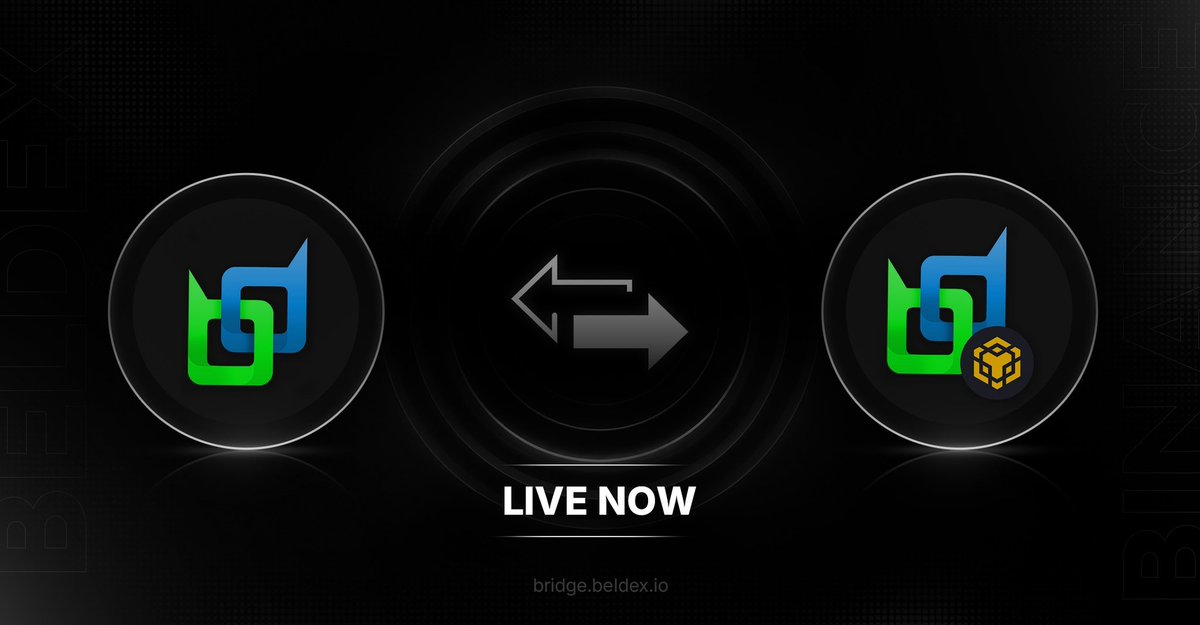
$BDX just got a stronger connection between two blockchain ecosystems.
The upgraded @BeldexCoin Bridge is now live, allowing users to move BDX between the Beldex Native Chain and BNB Smart Chain through a more refined cross chain experience.
At first glance, a bridge might look like a simple transfer tool.
But underneath, it plays a much bigger role.
A blockchain can have strong technology, useful products and an active community, but if assets remain isolated, users face unnecessary friction when they want to interact with another ecosystem.
That's why reliable cross-chain infrastructure matters.
With the new Beldex Bridge, the focus is on:
> Cross-chain accessibility
Users can move BDX between the Beldex Native Chain and BNB Smart Chain, creating a more connected environment for the asset.
> Improved performance
A smoother bridging experience can reduce unnecessary friction when users interact with different networks.
> Security-focused infrastructure
When assets move between chains, security becomes one of the most important considerations. Strengthening the bridge layer is therefore essential for long-term usability.
>Greater ecosystem connectivity
Connecting Beldex with BNB Smart Chain creates another pathway for users to interact across networks.
> More flexibility for BDX
Cross chain availability can make an asset easier to access and use across supported blockchain environments.
And this is the part I find most interesting.
Web3 is moving toward a multi-chain world.
Users won't always stay on one network. Liquidity won't always remain on one chain. Applications will increasingly need infrastructure that allows different ecosystems to communicate and interact.
Bridges are an important part of that transition.
For Beldex, this upgrade isn't simply about launching another feature.
It's about making the ecosystem more connected, reducing friction around BDX , and giving users more flexibility when interacting with different blockchain environments.
The bridge is live.
Now the interesting part is seeing how the community puts this new connectivity to work.