Whoever Follows His Desires has His Intellect and Judgement Corrupted
🎙️Shaykh Dr. ‘Abdullāh al-Bukhārī (حفظه الله)
المتبع لهواه يفسد عليه عقله ورأيه لأنه قد خان الله في عقله،
🎙️ للشيخ أ.د عبدالله البخاري حفظه الله ورعاه
Mocking The Religion is Not A Joke
By Shaykh Dr. Muḥammad bin Ghālib al-ʿUmarī (may Allāh preserve him).
Translation: Zubayr bin Muḥammad ʿAbbāsī (may Allāh preserve him). @ZubayrAbbasi
https://t.co/cKHFXxFEii
#religion#mockery#disbelief
DOWNLOAD BROWTHER Built by a Salafi @devndin : https://t.co/klz7dADSDB
Use Referral CODE: XFFJNT for additional features.
The Browther browser BLOCKS ads on ALL websites ⛔ And soon, in shaa Allah, you'll also be able to blur people in images and videos and remove music.
📺 [New]
📌 Advice to Those Who Write on Social Media (Cause of weakness in faith and brotherhood).
🎙️ Shaykh ‘Arafāt ibn Hasan al-Muhammadī (حفظه الله) @Arafatbinhassan
✍🏻 Translation: Yasin ibn Jamal (حفظه الله ) @Yasin_ibn_jamal
🔗 https://t.co/XCwMDKPtxp
Arrogance blinds a person from accepting the truth. Submit to the truth, for pride and stubbornness were among the causes of the destruction of nations before us.
🎙️- Shaykh ʿAbdullāh al-Bukhārī حفظه الله
Following after ones desires and seeking authority corrupt people's souls, May Allah guide them and prevent their oppression.
Division and Seperation cause sadness and sorrow, but in-sha-Allah, we hope for reward from Allāh.
If you ask them which senior scholars of today or in the past said that Nizar, Bilal, Fawaz and Ali al-Sharifi are among the elders of knowledge or those we should be returning to; they have no answer for it.
But, But they do know actual men whom those senior scholars advised.
Ibn ʿAbd al-Barr رحمه الله (d. 463 AH) said:
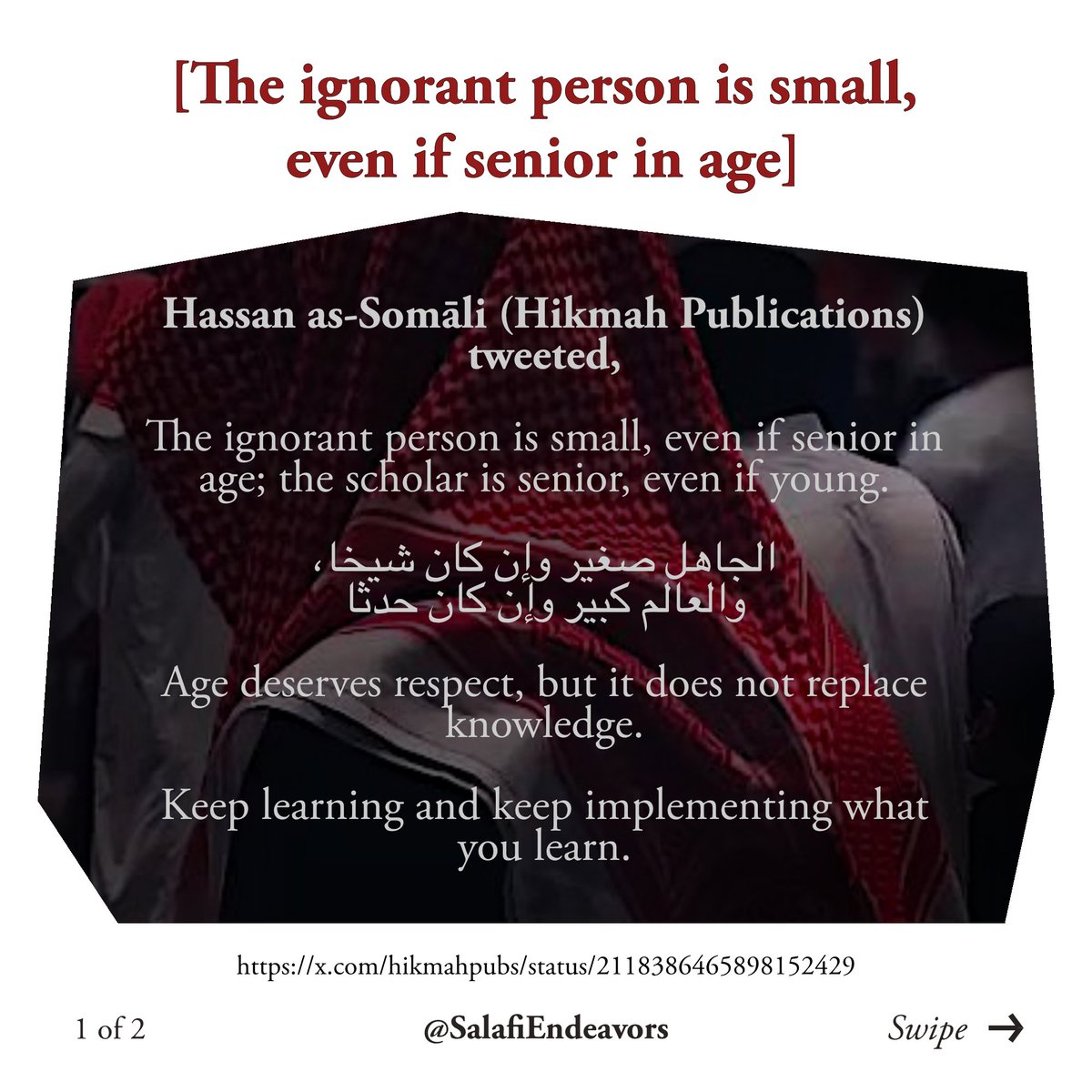
“Some of the people of knowledge said: Indeed, the ‘Young one’ mentioned in the Hadith of ʿUmar, and other Ahādith similar to it, is only intended to refer to the one who is asked for a religious verdict whilst he possesses no knowledge.
And the ‘Elder’ is the scholar, regardless of what age he may be.”
📓- Jāmiʿ Bayān al-ʿIlm wa Faḍlih
Shaykh ‘Abdullāh al-Bukhārī :
Don’t be Like the People of Innovation and Desires; Chasing After & Seeking to Find the Errors & Faults of the Scholar.
Advise him when he errs and don’t spread his mistake after he repents!
How strange the time we're living right now, if not for Allah's tawfeeq no one is saved. May Allah make us die upon Islam, Sunnah, Tha'aa and Salafiyyah.
How excellent advisor He is, May Allah give him a long life and take good care of him. Jazakumullahu Khairan.
A Muslim woman’s daʿwah is among women, not engaging in debates and discussions with non-Muslim men. 🌸
Question: How does a woman call to Allāh if she possesses knowledge and enthusiasm and wishes to call to Allāh? What methodology should she follow? And what are the areas in which she is able to call to Allāh?
Shaykh Muḥammad ibn Ṣāliḥ al-ʿUthaymīn (d. 1421 AH) said: “The methodology she should follow is that which Allāh has commanded in His Statement:
“Invite (mankind, O Muḥammad ﷺ) to the Way of your Lord (i.e. Islām) with wisdom (i.e. with the Divine Revelation and the Qur’ān) and fair preaching, and argue with them in a way that is better.” (Sūrah al-Naḥl | 125)
As for the areas (in which she can give daʿwah), then they are gatherings of women, such as schools and other than them. She should attend these gatherings and call them to Allāh, the Mighty and Majestic.
For every occasion, there is an appropriate manner of speaking. Thus, she can determine whether the occasion calls for encouragement, admonition and warning, or a combination of both, according to the circumstances.
Therefore, the areas in which she carries out her daʿwah are gatherings of women only. As for gatherings of men, then they are for men.”
📓-[فتاوى نور على الدرب ١١/٢٢٩
Ibn ʿAbd al-Barr رحمه الله (d. 463 AH) said:
“Some of the people of knowledge said: Indeed, the ‘Young one’ mentioned in the Hadith of ʿUmar, and other Ahādith similar to it, is only intended to refer to the one who is asked for a religious verdict whilst he possesses no knowledge.
And the ‘Elder’ is the scholar, regardless of what age he may be.”
📓- Jāmiʿ Bayān al-ʿIlm wa Faḍlih
A Warning Against Translating using AI Without Scholarly Review
Today, I (Rasheed Barbee) wanted to test AI translation, so I pasted the following chapter heading from Ṣaḥīḥ al-Bukhārī into ChatGPT
بَابُ إِذَا دَخَلَ بَيْتًا يُصَلِّي حَيْثُ شَاءَ أَوْ حَيْثُ أُمِرَ وَلَا يَتَجَسَّسُ
ChatGPT translated the heading as follows: “Chapter 45: When Someone Enters While the Imam Is Praying, Wherever He Wishes, or Wherever He Is Instructed, and Does Not Step Over People's Necks.”
If AI can make such a significant mistake in a relatively short simple chapter heading, imagine the potential errors when translating hundreds of pages containing Qur'anic verses, hadith, statements of the Salaf, explanations of Islamic creed, and detailed matters of jurisprudence.
Using AI to translate from Arabic to Spanish is particularly dangerous because in many communities, there are fewer qualified Spanish-speaking students of knowledge available to review these translations and identify mistakes than there are in English-speaking communities.
Consequently, an inaccurate Spanish translation could circulate among Muslims for years without its errors being discovered or corrected.
Mocking The Religion is Not A Joke
By Shaykh Dr. Muḥammad bin Ghālib al-ʿUmarī (may Allāh preserve him).
Translation: Zubayr bin Muḥammad ʿAbbāsī (may Allāh preserve him). @ZubayrAbbasi
https://t.co/cKHFXxFEii
#religion#mockery#disbelief