We were taught that Earth orbits the Sun in a closed circle. In reality, Earth has never returned to the same point in space once in 4.5 billion years.
Right now, the Sun is carrying Earth and every planet around the center of the Milky Way at 230 km/s (828,000 km/h), more than 18,000 kilometers every 80 seconds.
Because the Solar System is tilted 60.2° to the galactic plane and bobs up and down through the galactic disc roughly every 30 million years, the planets trace open 3D corkscrew helices across deep space rather than flat loops.
The last time the Sun stood where it stands today, one Galactic Year (230 million years) ago, the very first dinosaurs were only beginning to appear on Earth. Since forming 4.6 billion years ago, our Sun has completed only 20 laps.
🚨🚨🚨BREAKING: FRENCH PRESIDENT ADDRESSES THE MBAPPÉ SAGA AND ISSUES A STRONG WARNING OF POSSIBLE ECONOMIC CONSEQUENCES
“Let me make something very clear. France has no intention of turning a football controversy into an international crisis. But we will also not sit quietly and watch a French citizen become the target of an escalating campaign over an internet meme.
We have watched the apologies, the statements, the outrage, and the demands for further explanations. At some point, we must ask ourselves a very simple question: what exactly does China want from Kylian Mbappé?
He is a footballer, not a diplomat. He is not responsible for managing relations between Paris and Beijing, and he certainly did not wake up one morning intending to provoke an entire nation.
France respects China. We respect its people, its culture, and its institutions. But respect must work in both directions. You cannot demand respect from another country while refusing to extend the same courtesy to its citizens.
And let me be clear about something else. France does not negotiate its dignity under pressure.
If this situation continues to escalate, if further commercial decisions are taken against French interests, and if this controversy becomes a pretext for targeting French individuals and businesses, then our response will no longer be limited to statements from the Élysée Palace.
We have diplomatic channels. We have economic partnerships. We have strategic interests. And we have the ability to reconsider the terms on which those relationships operate.
I do not want an economic confrontation with China. Nobody should want that. Such a confrontation could hurt businesses, workers, investors, and consumers in both countries. But avoiding a confrontation cannot mean accepting unlimited pressure without consequences.
So my message to Beijing is simple: this madness must stop before it becomes something neither country can easily control.
Give diplomacy a chance. Allow this controversy to end. Let football remain football.
Because if certain people believe that France will be intimidated into silence, they have seriously misunderstood the position of this country.
We are prepared to cooperate with China. We are prepared to resolve disagreements through dialogue. But if dialogue is replaced with economic pressure and public humiliation, France will be prepared to protect its interests with measures proportionate to the situation.
And I sincerely hope that nobody forces us to reach that point.”
@kookrangie O Brasil esta se tornando um narcoestado mesmo, tantas pessoas falando de drogas como se fosse normal usar algo que mata tantos jovens, faz chorar tantas mães, acaba com tantas vidas.
A gyroscope is probably one of the most fascinating physics toys and one of the most useful applications of conservation of angular momentum in several branches of science and technology.
@apaula_apob As imagens das câmeras de segurança, as testemunhas devem ser ouvidas, a perícia no local, a questão de sigilo do telefone da vítima. Tanta coisas para descobrir o que aconteceu.
A filha morr3 na casa do namorado e da sogra (morava com eles) e a mãe não é avisada. A mãe, suspeitando de algo, vai até o apartamento e a sindica é quem avisa que a filha morr3u na noite anterior e o corpo está no IML. O namorado e toda a familia somem e não vão nem ao enterro.
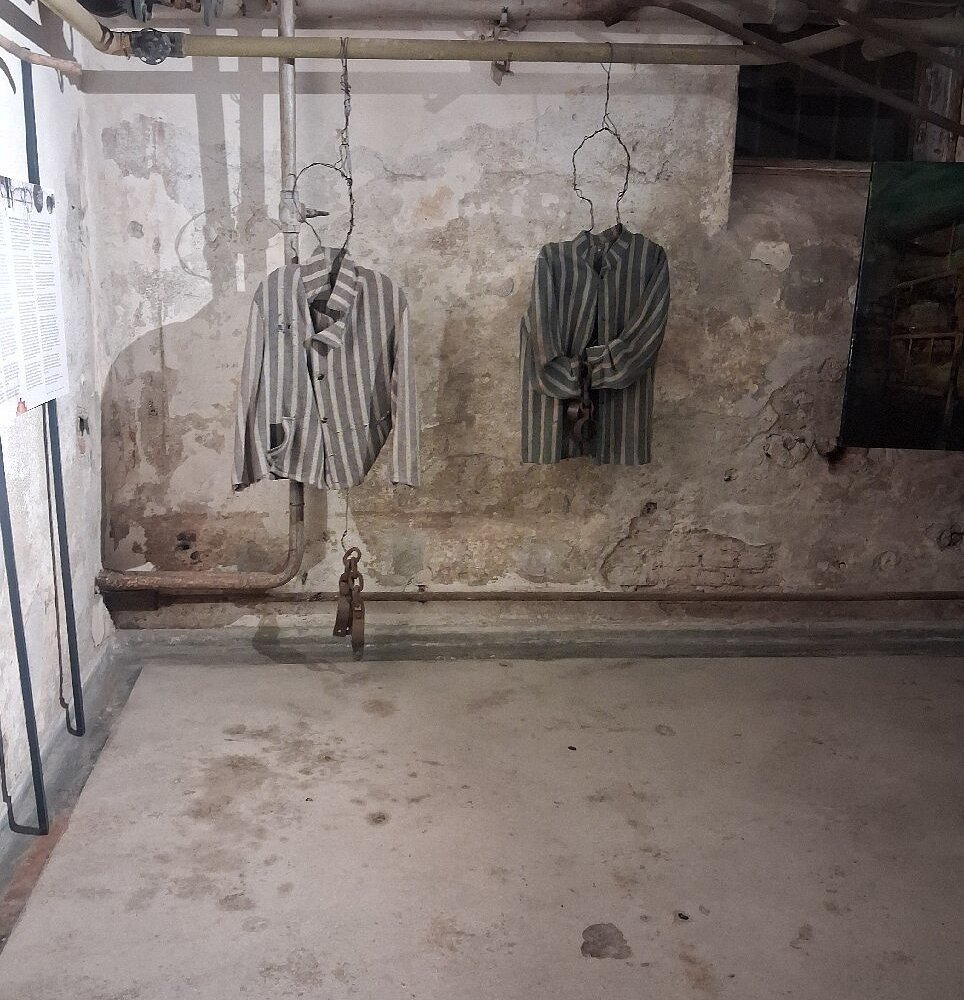
The Pitești Prison incident, known as the Pitești Experiment, was a brutal brainwashing and "re-education" program carried out by the communist regime in Romania between December 1949 and September 1951...
On December 6, 1949, a guard entered a cell in Pitești Prison and ordered a young prisoner named Sandu Anghelescu to surrender his sweater.
It was winter. The cell was unheated. Anghelescu protested after the guard left, unaware that his complaint had provided the signal.
Another prisoner, Eugen Țurcanu, struck him across the face. Then the men Anghelescu had come to trust turned upon him.
They had shared food, whispered together, and spoken like fellow enemies of the communist regime. Now they beat Anghelescu and the other unsuspecting prisoners while the guards stood outside.
Thus began one of the most horrifying experiments ever attempted inside a communist prison. Its purpose was not merely to extract information. It was to destroy the human personality.
. . .
After Romania fell under communist control, thousands of students, priests, political opponents, and ordinary people suspected of disloyalty disappeared into its prisons. Some had belonged to or sympathized with the fascist Iron Guard. Others had supported liberal, monarchist, or peasant parties. Some were seminarians. Some had scarcely been political at all.
The regime did not distinguish carefully. Anyone who possessed convictions beyond the state’s control was dangerous.
At Pitești, however, the communists attempted something more ambitious than imprisonment. They intended to create a “new man.”
The plan was brutally ingenious. Guards would not perform most of the torture themselves. Prisoners who had already been broken would torture the others. Friendship would become a weapon. Loyalty would become impossible. The victim would eventually be forced to become the tormentor.
Țurcanu, himself a prisoner, directed the experiment under the protection of communist officials and the secret police. It began with what they called “unmasking.”
A prisoner was beaten until he confessed everything he had concealed during earlier interrogations. When the truth was exhausted, he invented crimes simply to satisfy his tormentors. He named friends, teachers, and relatives, placing others within reach of the secret police.
Then came the “internal unmasking.”
The prisoner was forced to denounce anyone who had shown him kindness—a sympathetic guard, a doctor, or a fellow inmate who had offered encouragement.
The final stage was the destruction of everything he loved.
He had to curse his parents. Denounce his friends. Ridicule his deepest convictions. Christians were ordered to blaspheme Christ and mock the sacraments. Religious ceremonies were turned into grotesque rituals of degradation.
Beatings continued for hours. Prisoners were deprived of sleep, forced into agonizing positions, humiliated, starved, and watched constantly. Many became so desperate that they tried to bring their suffering to an end by their own hands.
Yet the most terrible command was still to come.
To prove that his old identity had been destroyed, the prisoner had to beat someone else. Often it was a close friend.
The communists understood something ancient and terrible: suffering can wound a man, but forcing him to betray someone he loves can make him despise himself. The victim would look into the face of his friend and see what remained of his own humanity.
That was the real purpose of Pitești.
The regime did not simply want men too frightened to resist. It wanted men who believed themselves unworthy of resistance—men so burdened by shame that they could no longer remember who they had once been.
More than six hundred students were tortured at Pitești between November 1949 and May 1951. At least eleven died directly from violence, according to the memorial now housed inside the former prison. Countless others emerged physically and psychologically shattered.
#archaeohistories
Le père spirituel de l'éducation moderne a méthodiquement condamné ses cinq enfants à une mort quasi certaine par pur confort personnel.
L'Histoire a fait de Jean-Jacques Rousseau l'idole des humanistes et le grand théoricien de la bienveillance. Son célèbre traité L'Émile est encore aujourd'hui la bible des pédagogues progressistes.
La réalité est celle d'un égoïsme effroyable.
Entre 1746 et 1752, Rousseau partage la vie d'une lingère, Thérèse Levasseur. Le couple donne naissance à cinq enfants.
Le grand philosophe de la compassion n'en gardera pas un seul.
Dès leur naissance, il les arrache à leur mère pour les déposer anonymement à l'hospice des Enfants-Trouvés de Paris.
À l'époque, cette institution n'est pas un orphelinat classique, c'est un mouroir. Les registres historiques établissent que le taux de mortalité infantile y dépassait allègrement les 70 %.
Que sont-ils devenus ? Absolument personne ne le sait. Ils ont purement et simplement disparu de l'Histoire.
Des années plus tard, la maréchale de Luxembourg, une riche protectrice du philosophe, tentera de mener l'enquête pour les retrouver et les sauver de la misère. Ses recherches se heurteront à un mur sordide.
Rousseau n'avait même pas pris la peine de conserver les dates exactes de leurs naissances ou de glisser un signe distinctif dans leurs langes, comme cela se faisait couramment pour espérer les récupérer un jour.
Ses cinq enfants ont été engloutis dans l'anonymat absolu. Statistiquement, ils ont probablement fini dans la fosse commune de l'hospice avant l'âge de savoir marcher. S'ils ont survécu, ils ont grossi les rangs des vagabonds dans les caniveaux de Paris.
Le père de l'éducation ne s'en cache même pas. Dans ses propres Confessions, il assume cet abandon avec une froideur terrifiante.
Ses justifications officielles ? Les enfants faisaient trop de bruit, son travail de penseur nécessitait le calme, et il refusait d'assumer la charge financière de sa propre descendance.
D'un côté, le philosophe écrivait des milliers de pages pour apprendre à l'humanité entière comment élever, écouter et chérir la jeunesse. De l'autre, il effaçait méthodiquement sa propre progéniture pour ne pas être dérangé pendant son processus créatif.
Le mythe du grand éducateur humaniste s'effondre. L'idole absolue des Lumières a bâti sa légende de moraliste sur l'abandon méthodique de ses propres enfants.