I'm at #ICML2026 in Seoul 🇰🇷 — presenting tomorrow!
ReviewArena: A Large-Scale Cross-Conference Dataset & Benchmark for LLM Peer Review, a spotlight at the AI for Science workshop.
🎤 Talk: Hall C, 14:00–14:10 KST
📌 Poster: Hall A, board #416
Come by!
I'll be in Seoul this week for #ICML2026 🇰🇷
will present our work:
ReviewArena: A Large-Scale Cross-Conference Dataset and Benchmark for LLM Peer Review
accepted as a Spotlight at the ICML 2026 AI for Science Workshop.
Say hi if you're around!
@icmlconf
Chinmay is genuinely one of the most cracked people I've worked with
the depth of his knowledge in RL for LLMs and post-training is insane, learnt so much from him over the 6 months at MSR
anyone would be lucky to have him on their team
On a more personal note:
I am wrapping up my internship and looking for full-time roles in post-training and adjacent areas. At MSR I worked on agentic RL for general tool-calling on benchmarks like BFCL, Taubench, and MCPBench and on self-distillation and synthetic-environment data curation and training.
More of my work can be found on my github and website, linking below.
Please RT/QT for helping w the algo:)
Introducing our first model, Un-0!
We trained an image generator powered by a backbone of coupled oscillators in place of a more traditional conventional neural network.
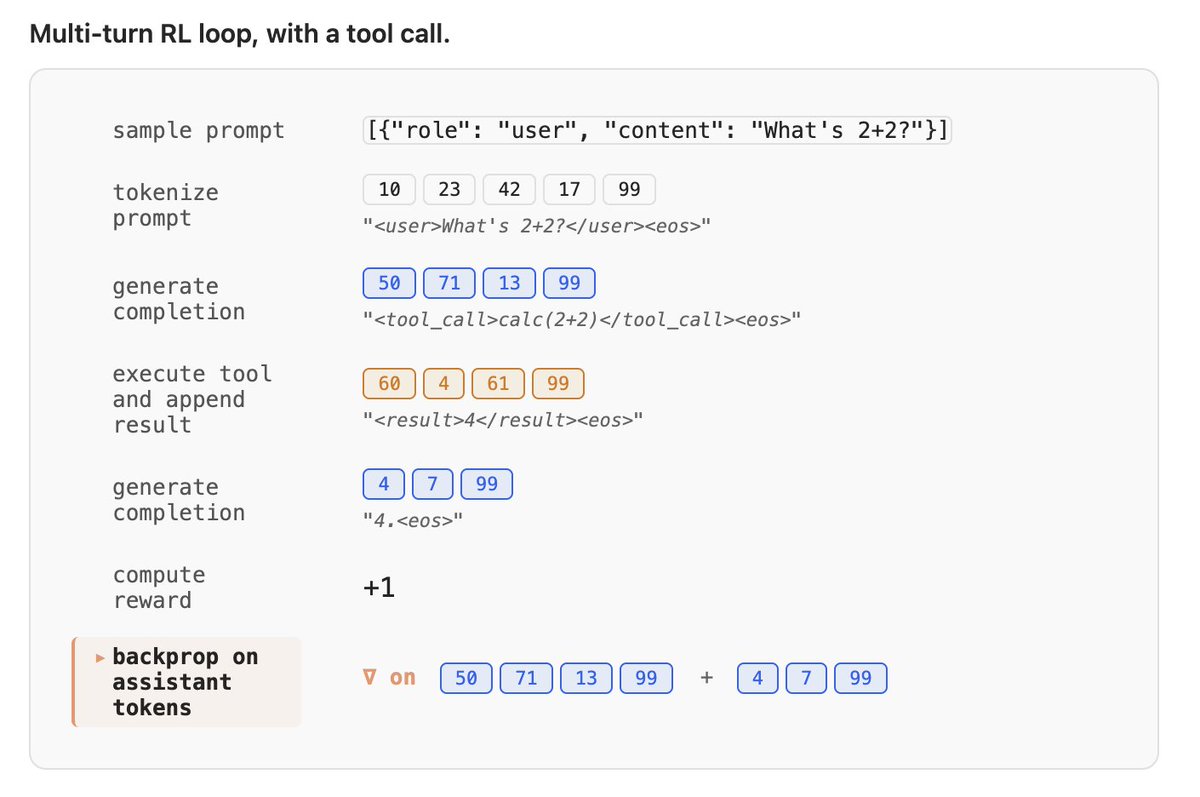
Most people training agentic LLMs with RL right now have a silently broken training loop and have no idea.
Here's the trap: single-turn RL works beautifully. Clean curves, sane rewards, everything converges. Then you add tools so the model can act mid-rollout, and things get weird. Loss spikes for no reason. Eventually a shape-mismatch error.
The culprit: every time you parse the model's output to detect a tool call, then re-tokenize the updated conversation for the next turn, you're rolling the dice. Usually the round-trip gives back the same tokens. Sometimes it doesn't and your gradient lands on a sequence the model never actually sampled. No crash. Just quietly wrong math and a useless gradient signal.
The fix is one rule: never re-encode tokens you've decoded. Keep the sampled tokens in one buffer, never re-render them, and both failure modes disappear. That's Token-In, Token-Out done right.
Our team just published a beautiful deep-dive on exactly this, including an audit across the major open-weights model families showing most chat templates already support it. Required reading if you're doing multi-turn RL 🤗🔥
https://t.co/zmx0EQl3jM
Introducing Repo2RLEnv
Turn any repository into runnable, verifiable coding environments built from real PRs and commits for coding-agent evaluation or RL training
> uv pip install repo2rlenv
Launching NayanaOCR Corpus
👉🏼 1M+ Document images across 22 languages
Largest open source synthetic
> multilingual
> multimodal
> multitask
document corpus