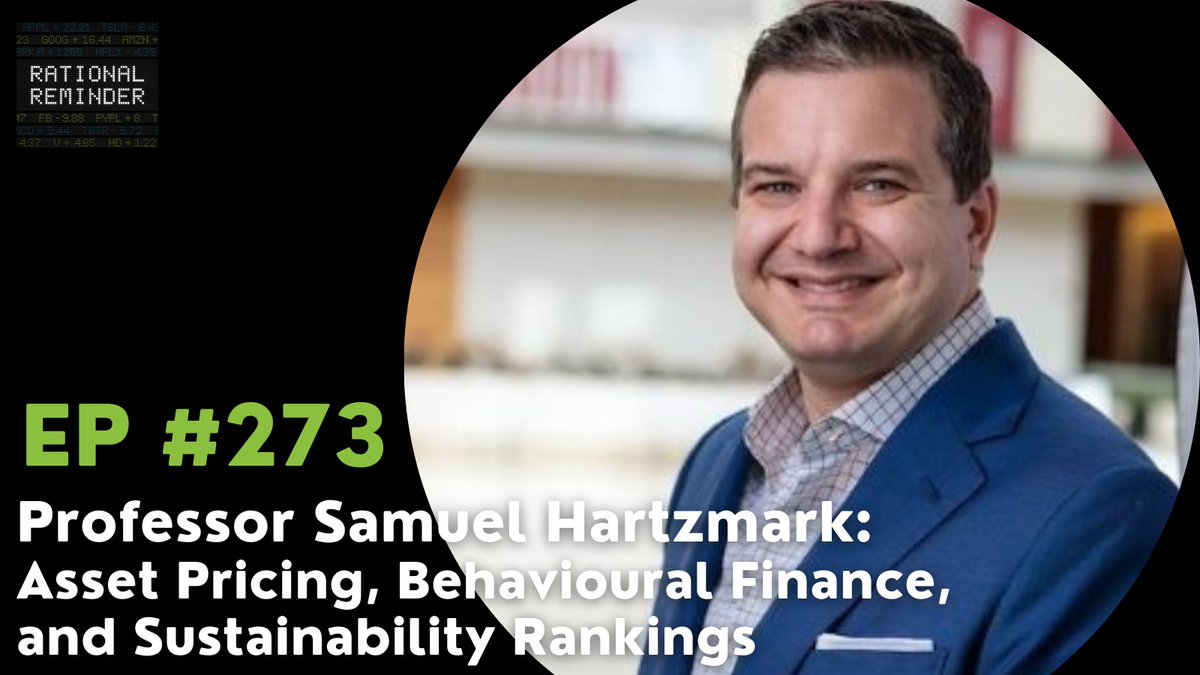
For most investors, listening to this podcast is like learning Santa isn't who you thought he was.
Bummer. But also....good to know, right? Do you feel a little taken advantage of? Embarrassed?
Probably.
But certainly better than believing in some magical free 12% yield!
My conversation with Samuel Hartzmark (@SamHartzmark), who may be the most knowledgeable person on irrational investor behavior related to dividends.
We cover:
• 𝗙𝗿𝗲𝗲 𝗗𝗶𝘃𝗶𝗱𝗲𝗻𝗱𝘀 𝗙𝗮𝗹𝗹𝗮𝗰𝘆 - Dividends are 𝘯𝘰𝘵 passive income
• 𝗝𝘂𝗶𝗰𝗶𝗻𝗴 - Mutual funds purchase stocks before dividend payments to artificially increase their dividends
• 𝗗𝗶𝘃𝗶𝗱𝗲𝗻𝗱 𝗠𝗮𝗿𝗸𝗲𝘁𝗶𝗻𝗴 - Investors are willing to pay 15-20% higher expense ratios for a fund marketed as "Income" or "Dividend Focused"
• 𝗗𝗲𝗺𝗮𝗻𝗱 𝗳𝗼𝗿 𝗗𝗶𝘃𝗶𝗱𝗲𝗻𝗱 𝗦𝘁𝗼𝗰𝗸𝘀 - Demand changes based on interest rates and recent market performance
I think about this study a lot regarding safetyism. Saving 57 children's lives a year is good, but missing out of 8000 children because of it is extremely bad.
We did a survey on how dividends work and received thousands of responses...
Q: "Which of the following best describes how dividends work for a stock investor?"
A1: "A stock yields 5%. The stock is trading at $100 and pays a $5 cash dividend. After distribution, the investor now has a stock worth $95 and a $5 cash dividend."
A2: "A stock yields 5%. The stock is trading at $100 and pays a $5 cash dividend. After distribution, the investor now has a stock worth $100 and a $5 cash dividend."
The good news? Meb's audience (mostly) gets its.
90% of pros understand how dividends work, and 80% of individuals. 👏
HOWEVER, for the broad-based audience, the results are DISMAL.
60% of pros understand how dividends work (despite 90% rating their knowledge at "average to very good")...
Only 25% of individuals understand how dividends work.
You read that right, 75% of individuals think that dividends are free money paid out like an allowance or bonus...
This agrees with my experience over the last 20 years.
Most individuals, and a non-trivial number of professionals, do not understand the most basic input in all of investing!
This explains everything from the irrational preference for dividends to predatory offerings focused on paying out magically high dividends to hope and dreams of passive income.
We will publish a longer paper on this soon, but in the meantime, stay tuned for a great podcast on the topic dropping shortly!
This is a *phenomenal* piece from @denitsa_tsekova and @VildanaHajric on the bonkers rise of @YieldMaxETFs and the cult that's grown around some pretty wild ... interpretations ... of how investing math works. Must reading for ETF nerds.
@alphaarchitect@walter_kissling@CliffordAsness@orrdavid@wjruss84 This weird quirk has a ton of marketwide effects. We show investors usually see the wrong number (price changes, not returns) driving flows, press coverage and (my favorite) market betas. Betas reflect price changes, not returns (unless you're Germany and show a return index )
Professor @SamHartzmark has the most interesting research out there when it comes to investor behavior. Strongly recommended you check out his research website: https://t.co/hNHVcsU6si
Avoid the Black Hat firms at all costs .
Fun podcast....wonder what % of investments are made based upon misunderstanding this one chart?
Over half?
https://t.co/mQVErg9ao3
According to the paper "The Dividend Month Premium," by @SamHartzmark, investors are chasing yield and inflating prices in the process.
In a surprising turn of events, it turns out that dividend investors are the yield!
@MebFaber@alphaarchitect That's roughly what we find. In the US most investors can opt into auto-reinvest, but most don't. We estimate funds reinvest a bit over 50% back into the market and they don't tend to reinvest into the stock that paid.
@alphaarchitect@MebFaber Thanks Wes! @MebFaber, in the div disconnect paper we show reinvestment in the stock that paid the dividend is rare. If you care about reinvested back into equities, you want this paper:
https://t.co/Y6HLyfxwWs
~35% is reinvested in the market, causing high market returns
@david_h_solomon and I explored the wide ranging impact of showing a systematically biased number for market performance. It influences the press, fund flows, market betas, long-run expectations and can help explain some AP puzzles. https://t.co/Yig4syVwhR
Wonderful to see @Vanguard_Group discussing the importance of shifting default performance metrics to total returns. Kudos to @mark_hebner for trying to make this important goal a reality.
Here's an approved statement from Rodney Comegys, Global Head of Equity Index Group at @Vanguard_Group
“Price return calculations for indexes are largely a holdover from the early days of indexes. Before computers became ubiquitous, price returns were much simpler to calculate, and so became the default methodology for presenting index returns. Despite many decades of advancements in computing and the advantages of evaluating total returns, price return calculations are still commonly quoted. Vanguard believes that total returns present a more comprehensive assessment of the investor experience, and should be the go-to method for presenting and discussing returns in the capital markets.”
Please review and sign my petition to change the presentation of indexes in the media to total return indexes at https://t.co/8fmf3lfkWJ
Explore the intersection of asset pricing and behavioral finance with CSOM finance professor @Samhartzmark in this recent episode of the @RationalRemind podcast.
https://t.co/0f8DbxEB5s