The Era of Videocassettes, “Nordics,” and Old Celestial Visitors
A fresh video from A25 Productions just dropped — a concept trailer for a nonexistent 1986 sitcom called "Marvel House". The casting is perfect: a full lineup of the era’s top action stars, authentic VHS vibes, and remarkably accurate character fits.
Dolph Lundgren as Thor stands out especially. Tall, athletic, with that classic Scandinavian look, he appears as if he stepped straight out of old comics or ancient sagas. A pure “Nordic” type from the golden age of 1980s Hollywood. As Ivan Drago and later as He-Man, he already looked like a living version of a northern god.
What’s particularly interesting is when you look at materials from researchers of contact with extraterrestrial civilizations (for example, Elena Danaan and her contacts with Thor Han). A curious detail emerges.
In one of her Q&As, she described Thor Han’s command ship as having a shape reminiscent of Thor’s hammer itself: “It’s not a flying saucer, it’s like this, the Thor hammer.” Not the usual classic “saucer” at all.
This creates an amusing parallel:
- The visual image.
In popular culture, Thor is a powerful northern god — the embodiment of strength, athleticism, and Scandinavian features. Lundgren matches this archetype almost perfectly.
- A possible technical prototype.
What if some ancient mythological images formed not only around the appearance of unusual visitors, but also under the impression of observed technologies? A craft of a distinctive shape, accompanied by thunderous noise, flashes, or electrical discharges, could over time have turned into a mythological attribute of a deity. The name of the commander or pilot could then have become attached to the celestial visitor himself and the legends surrounding him.
The “visitors” themselves have always emphasized a simple point: they are not gods, but ordinary people from other star systems. The technologies of past eras simply appeared as pure magic to our ancestors.
And so Thor can be viewed in two dimensions at once: as the familiar heroic image we know, and as a possible reflection of ideas about celestial visitors and their unusual craft.
Source:
https://t.co/n3NCpFji9o
Coulthart on Reality Check pulled two scenes out of Grusch’s Rogan interview. They are not the same event.
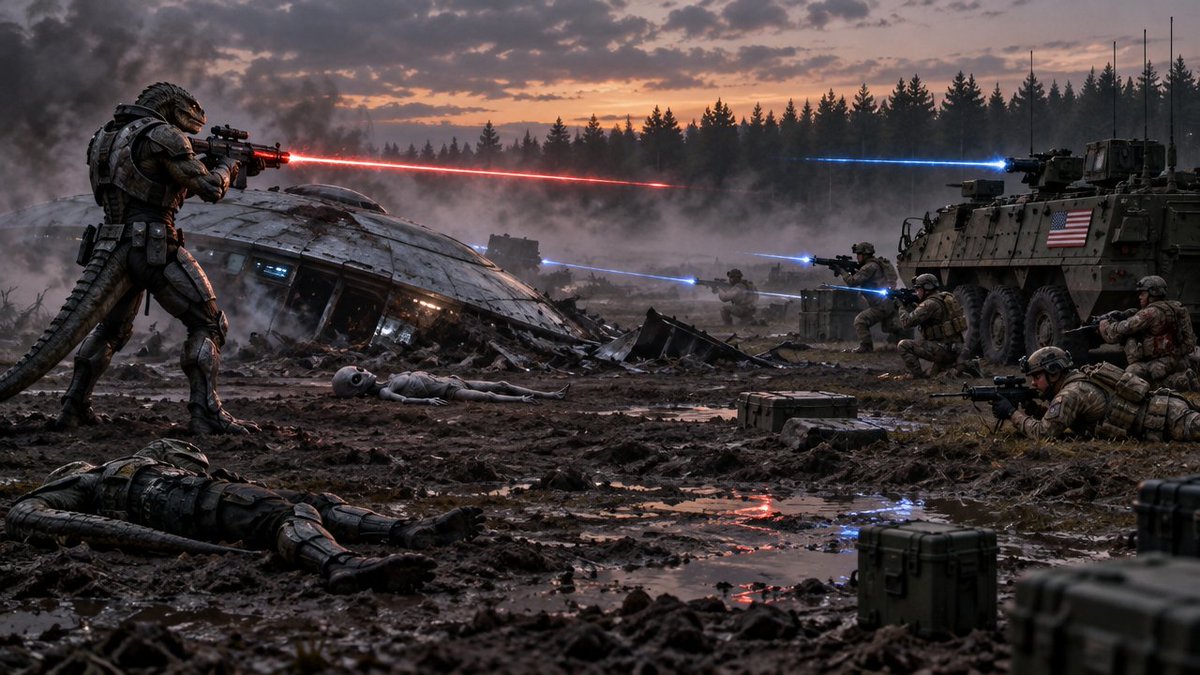
One is a firefight. Grusch called it hearsay from colleagues at a crash site. A Tic Tac stuck in the ground. Dead greys. Living beings described as 7-foot reptiles. An exchange of fire. American personnel injured and killed. The beings killed too. Coulthart’s line was blunt: a man who says he investigated the legacy program is now reporting violent contact, and that these craft can be forced down.
The other is the blue people. This one Grusch says he saw on a recovery video. Three or four beings, almost human, bluish-gray, in tight suits that fit the body. He called them very, very beautiful. Killed in the crash. Bodies preserved. Genomes compared with ours, because they are close. Coulthart tied that straight to what Tom DeLonge has said for years about godlike beings.
Source:
https://t.co/VMEa3w2VYL
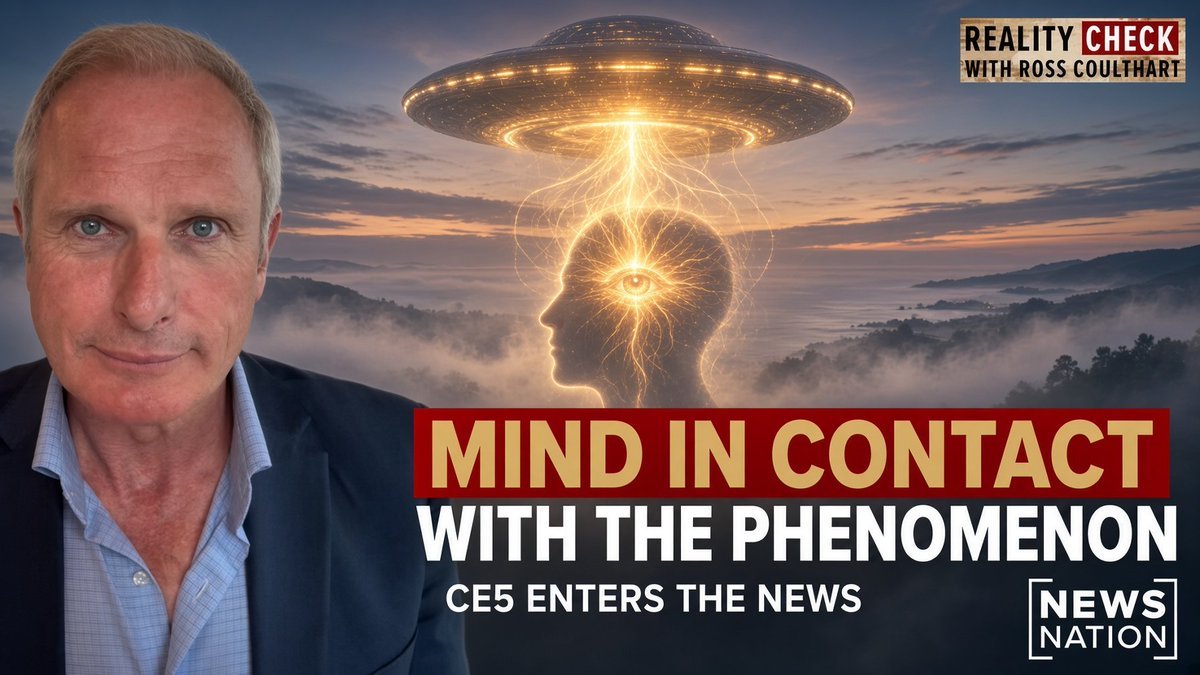
Coulthart slipped something into a Reality Check episode on NewsNation. He was filming on the south coast of Victoria, where people report golden orbs, for a story on the mind connecting with the phenomenon. Greer calls it CE5.
For those already in it, the question stopped being “does it happen.” The question is when they stop keeping it in the enthusiast circle.
That moment is the disclosure process.
Not a sensation. Not a frame. Not a protocol.
A subject that lived on the sidelines for years is entering the same news cycle that already holds the programs, the crashes, and the undersea bases.
First they normalize the conversation. Then they show what they filmed.
This is not proof of contact. It is proof that disclosure is moving.
Source:
https://t.co/VMEa3w2VYL
Lord Elon, Scam Altman, and Dario on their knees before King Jensen.
In reality, the big AI players (xAI, OpenAI, Anthropic) are lining up for NVIDIA chips. Without Huang’s GPUs they have nothing to train their models on. The video turns that into a feudal court, where the lords humbly beg the king of graphics cards for his favor.
A Zipper in the Sky: Rare Physics or Something More?
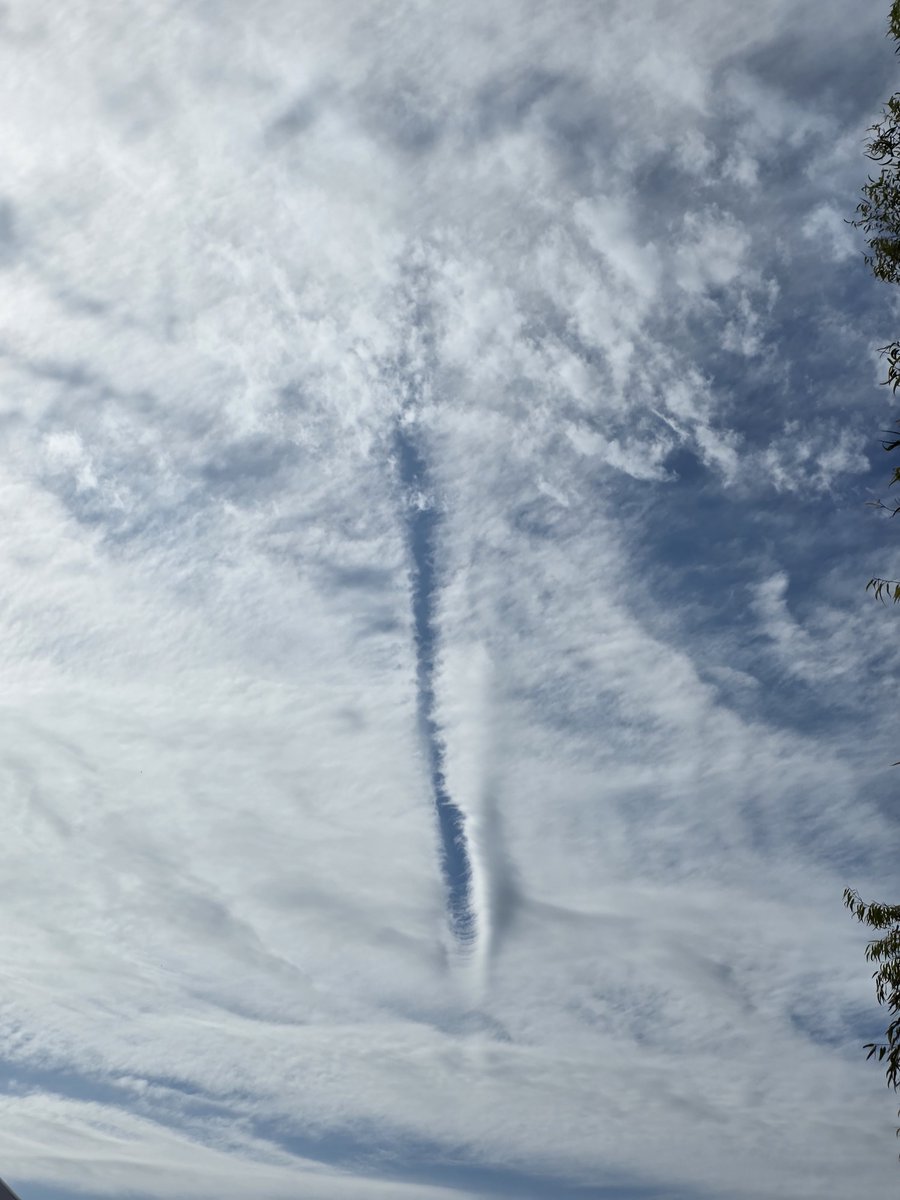
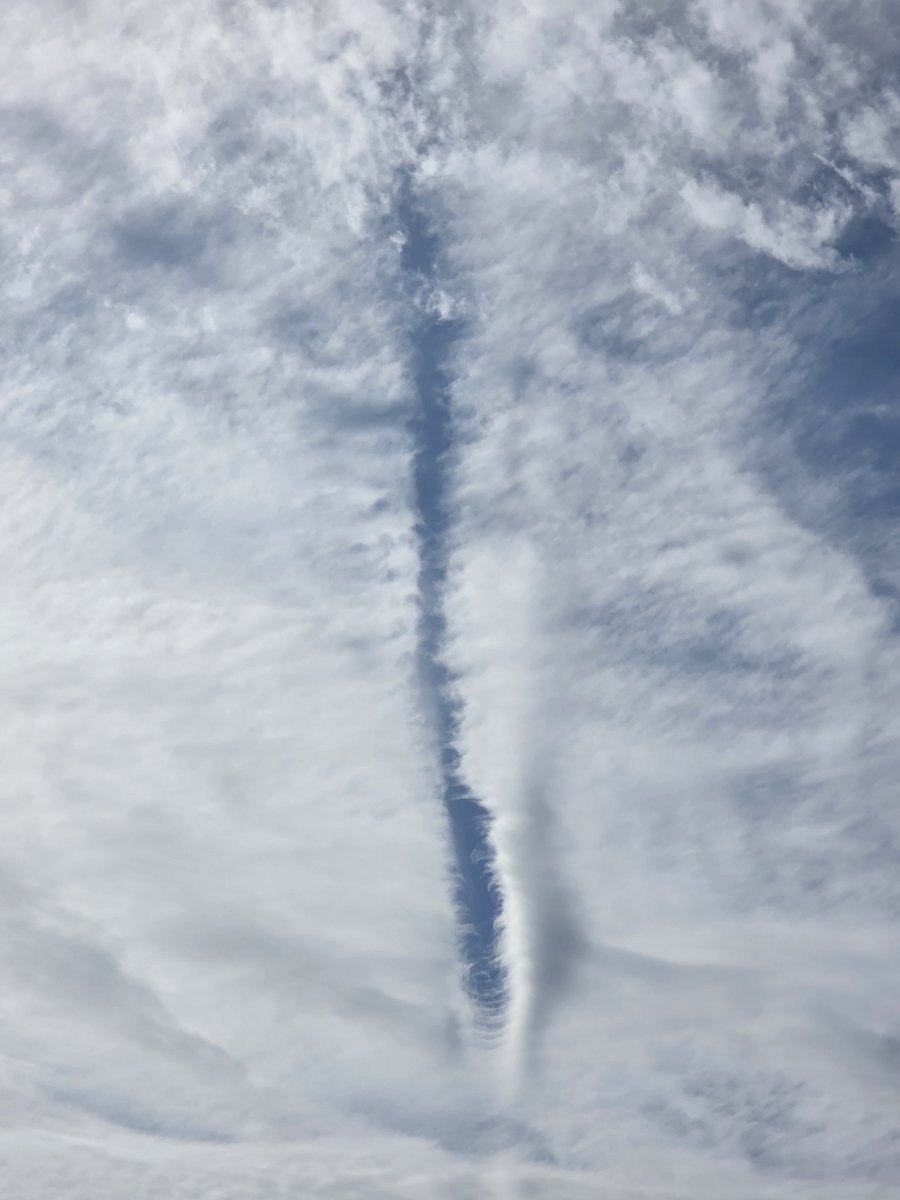
At first glance, what we see here is a known atmospheric phenomenon—a dissipation trail (or distrail). In classical meteorology, it occurs when an aircraft flies through a thin layer of clouds, where its engine heat and wing turbulence evaporate supercooled water droplets, carving a clear blue channel through the cloud deck.
However, a closer look reveals several puzzling anomalies. The scale of the gap seems entirely out of proportion for a conventional airliner: it is far too wide and voluminous for a relatively small aircraft body. Furthermore, this "cut" lacks typical entry and exit paths—the trail begins and ends abruptly right in the middle of the sky canvas, without a long lead-in or exit tail.
Stepping outside standard explanations to consider an interaction with an unidentified object, these details form an intriguing picture:
1. Local Impulse or Gravitational Rupture: The rift resembles the trajectory vector of an object moving at extreme velocity, where localized shifts in pressure or temperature instantly dispersed the clouds along its path. The absence of a long entry/exit trail suggests a point-source or instantaneous interaction—as if an object materialized at that precise location, exerted a force on the atmosphere, and altered its trajectory or state.
2. Large-Scale Field Footprint: Because the gap vastly exceeds the dimensions of a standard aircraft, it resembles the footprint of a force or energy field surrounding a large object operating under optical concealment (stealth). While the craft itself remains invisible, its energy boundary leaves a physical signature in the cloud structure.
3. Spatial Energy Piercing: The limited extent and the refined geometry of the condensed cloud wisps at the lower tip resemble the mark of a targeted beam or a brief opening of a channel between atmospheric layers.
Official models explain images like this through natural evaporation processes. Yet the grand scale and distinct localization of this "zipper" in the sky leave room for a compelling question: what exactly possessed enough localized energy to leave such a mark?
The Occult Temple as a Technology of Perception
Sadhguru’s video about feminine worship and occult temples is interesting because he approaches the subject not through belief, but through technology.
In the context of this experience, the occult is not so much spirituality in the conventional sense, but work with the most subtle layer of the physical: the body, mind, and energy become the instrument itself for perception and transmission.
Like making a call without a phone.
In the Shaiva tradition, asking God for things is considered inappropriate. Not because God is deaf, but because a request sounds as though the creator himself does not know what needs to be done.
Sadhguru makes a distinction between prayer and worship. Prayer in the conventional sense is: “Do this. Do that.” In this tradition, addressing the creator in this way is considered improper: if he does not know, what is the point of asking? And if he already knows, the request is unnecessary.
Worship, puja, is something different. It is not a request but a kriya — an inner action, an extended procedure designed to create a particular state within the person. Technique plus emotion. A sadhana for the devotee.
That is why, according to Sadhguru, prayer inside an occult temple is essentially meaningless. You are not asking someone to give you something. You are working with a technology.
Without the necessary inner state, it does not activate. But that state is not created through a request. It is the condition that allows the subjective receiver to respond.
This is also why many such temples are oriented toward Devi, rather than Shiva. Shiva represents stillness, the seed, potentiality. Prakriti is the active principle — manifestation itself, the movement of creation.
Kali, in this understanding, is not simply a statue. She is a living form connected to a mantra, a particular state, and a specific way of interacting with it.
Sadhguru then takes the idea further.
Before humans had telephones, a channel like this could have served as a necessary means of transmitting and receiving information. As conventional technology developed, the need for such forms of communication diminished.
And then many ancient forms of feminine worship in monotheistic cultures were declared demonic and persecuted — crusades, inquisitions, burnings. In this interpretation, the issue was not necessarily that there was no effect. Perhaps the problem was that the mechanism itself was not understood and did not fit the prevailing worldview.
In India, this line of knowledge largely moved into the shadows, but it did not disappear.
The Lower End of the Channel
This is where my own thought begins.
Such a channel does not simply open because a person has learned that it exists.
The one operating at the lower frequency must activate and tune themselves to receive.
The consciousness and the body have to undergo a certain internal adjustment — what different traditions describe as purification, discipline, raising one’s frequency, or changing the state of consciousness.
Until a person enters that state, they may not even realize that such a channel exists.
They simply do not know how to use it.
That is why this is not only about belief, but about practice.
In a certain state, it can be experienced as direct communication: you direct your attention, and something responds. One end of the channel operates at a higher energetic density and transmits an impulse to the one existing in a denser state.
On Earth, this could be described as working with light.
No phone. No external device.
The receiver is built within the human being.
Why We Stop Hearing
And this leads to another interesting thought.
The ordinary world does very little to teach people how to work with such possibilities. More than that, modern life constantly creates conditions in which inner silence becomes rare: information overload, continuous stimulation, lack of sleep, chemical exposure, electromagnetic noise, and an endless stream of external signals.
This does not require some grand conspiracy.
A world in which a person is almost never truly quiet is enough — and most people never get as far as discovering the instruction manual.
From this perspective, the occult tradition is not necessarily an attempt to obtain something supernatural.
Perhaps it is an ancient way of working with something that is already built into the human being.
The external device does not create the channel.
The human being becomes the channel.
Source:
https://t.co/g1Mofo4cFf
White Hats vs. Washington’s Political Establishment
If you didn’t notice it in Trump’s video, there are “white hats” everywhere — both literally and symbolically.
Throughout the video, we repeatedly see color footage of military personnel, first responders, police, firefighters, rescuers, volunteers, and supporters wearing white “Make America Great Again” caps. The imagery creates a visual echo of the broader “white hats” concept.
You can see it right from the opening: a Marine in a white service cap beside Marine One, followed by police officers, CAL FIRE firefighters, rescuers, military personnel, and volunteers helping after disasters. Trump is consistently shown alongside the people who protect the country, save lives, and serve their communities.
That fits the broader message of the video: American unity, rebuilding the country, securing the borders, creating jobs, and returning power to the people.
“We, the citizens of America, are united in a great national effort to rebuild our country.”
And even more importantly:
“What truly matters is not which party controls our government, but whether our government is controlled by the people.”
At first glance, it looks like a standard patriotic montage.
But then the visual language changes.
The color footage suddenly gives way to black and white. Washington faces, officials, political figures, and the Capitol appear in the same muted tones.
The black-and-white sequence flashes through a series of familiar faces:
Adam Schiff, Nancy Pelosi, Bill Clinton, James Comey, Maxine Waters, James Clapper, Chuck Schumer, John Podesta, Elizabeth Warren, Eric Holder, Loretta Lynch, Hillary Clinton, Barack Obama, and Debbie Wasserman Schultz — along with the U.S. Capitol.
And right at that point, one of the key lines plays:
“For too long, a small group in our nation's capital has reaped the rewards of government, while the people have borne the cost.”
This is no longer just a message about rebuilding America.
At the level of the speech, there is a clear contrast: the American people and those in power in Washington — the small group that, according to Trump, has benefited from the system for too long while ordinary Americans have borne the cost.
And the editing almost literally visualizes that divide.
Military, police, firefighters, rescuers, volunteers, and supporters in white MAGA caps — color.
Washington’s political establishment — and the Capitol — black and white.
And this is where the “white hats” symbolism becomes interesting.
In this symbolism, “white hats” are not simply the “good guys.” The term refers to people inside the military, intelligence services, and government who are part of forces working for the benefit of humanity and against the so-called “deep state.”
Of course, a Marine wearing a white service cap — or a supporter wearing a white MAGA cap — proves nothing by itself.
But when these images repeatedly dominate the color footage, and then Washington suddenly shifts into grayscale against the words about a small group in the capital, the visual language becomes hard to miss.
For the average viewer, it is simply a patriotic montage.
For those familiar with this symbolism, there is another layer:
Who are the “white hats”? Who represents the American people? And who represents those in power in Washington?
That is what makes this video interesting to watch not only as political messaging, but as a carefully constructed visual message.
Why American Parents Choose the Soviet School of Mathematics
In America, kids are now being sent to what is often called “Russian math” after school — although historically, “Soviet math” would be more accurate, because the same rigorous textbooks were used across the entire Soviet Union, from Belarus to Georgia.
At the same time, in the national republics there were many Russian-language schools where the entire curriculum, including the exact sciences, was taught in Russian, while the local language and literature were studied as separate subjects. And, more importantly, a unified methodological foundation was largely passed on through the Russian-language academic tradition.
So the name “Russian math” is also historically and practically justified.
One of the best-known programs of this kind is the Russian School of Mathematics, or RSM. It works with students from the early grades through high school and focuses less on mechanical memorization and more on mathematical thinking, logic, reasoning, and non-routine problem solving.
The idea is that this is not simply about rote learning. It is supposed to develop critical thinking, logic, and the ability to solve problems independently.
And American parents are quite willing to pay for it.
The irony is that much of this educational tradition developed in a country that disappeared more than three decades ago.
What was once simply considered ordinary schooling has now become a specialized educational program in the United States. Parents choose it because they want to give their children an additional intellectual challenge.
And it’s not a tiny niche. RSM has tens of thousands of students, with centers across the United States and Canada. There are even classes on the Upper East Side of Manhattan.
It makes for a rather interesting historical circle.
Something that people once wanted to leave behind can now be found in an American metropolis — just wrapped in a modern educational package.
But once you strip away the packaging, some of the underlying ideas feel surprisingly familiar.
By the end of second grade, we knew the multiplication table.
Not necessarily because we had developed a profound love of mathematics.
You could simply be called to the board.
Without warning.
Seven times eight?
Get it wrong, receive a bad grade, and the whole class is watching.
After a few experiences like that, the brain learned pretty quickly that some things were better known in advance.
Of course, that was another side of Soviet pedagogy. And it shouldn’t be confused with the mathematical education system being used in the United States today. Modern “Russian math” emphasizes intellectual challenge, logic, and independent thinking — not simply intimidating a child at the blackboard.
But it raises an interesting question.
Does a person need some degree of discomfort in order to truly develop?
In a completely sterile environment, where there are no difficult problems, no possibility of making mistakes, and nothing that needs to be overcome, the brain has little reason to push itself to its full potential.
But constant pressure isn’t the answer either.
If a child is kept in a state of fear, the result may not be a love of mathematics or stronger thinking. It may simply be a desire to avoid making the next mistake.
So perhaps the question isn’t whether we should choose between “toughness” and “warmth.”
The question is where to find the right measure.
There needs to be enough challenge to make a person think, experiment, make mistakes, and search for the solution independently.
But there also needs to be enough safety for a mistake not to feel like a catastrophe.
Enough difficulty to wake the brain up.
Enough support to keep the person moving forward.
And this is where the real art of teaching begins.
Because one child starts thinking when you challenge them.
Another needs confidence first.
For some, it is useful to let them make several mistakes on their own.
Others first need to understand that a mistake is part of the process, not a verdict.
A good teacher therefore does more than simply follow a curriculum.
They read the person in front of them.
They know when to increase the difficulty, when to take a step back, when to offer a hint, and when to say nothing at all and let the student find the answer independently.
You can have an excellent educational program — Soviet, American, or anything else.
But the program itself doesn’t make someone a good teacher.
Because real teaching begins where the template ends.
When the teacher stops treating every student the same — like livestock moving through a system — and starts seeing individual people, each with a different pace, personality, and way of learning.
Maybe that is why old educational ideas keep coming back.
Not because the past was perfect.
But because sometimes, along with the mistakes of the past, we also throw away things that actually worked.
And then, a few decades later, we have to rediscover them — under a new name, in another country, and as a modern educational idea.
Source:
https://t.co/VgddBODnnG
Semafor reported that David Ellison considered bringing Elon Musk into the investor group around the Paramount–Warner deal. CNN and CBS News sit inside that perimeter.
That needs to be said clearly. This is not “Musk bought CNN.” It is not operational control of the newsroom. It would be a possible stake in a much larger holding company. In a setup like this he would not be running the broadcast. The deal also included an editorial independence board for the news divisions.
The picture is still interesting.
Musk already owns X — one of the main places where news now moves faster than television. If he also enters the capital structure that includes CNN and CBS, that is not a takeover of the media. It is something quieter: influence over the infrastructure of attention. Who frames what counts as the main story, and what disappears into the noise.
From there, people can draw their own conclusions. Some will see ordinary corporate logic: the Ellisons need capital and strong names. Others will see a longer game around information itself. The deal on paper is still a business transaction. The speculation only starts when you connect a stake in that holding company with how the public agenda is shaped today.
https://t.co/qhOujd1Zb2
The Age of Digital Tribunes: How the Internet Turned Free Speech into a Street Fight
With the rise of the internet and social media, humanity made an unprecedented leap in access to information. What once required entire media corporations can now fit inside a single smartphone.
Anyone capable of attracting and holding an audience can technically broadcast to the entire world on the same platform as professional journalists and television presenters.
But this technological revolution has a darker side that we still haven’t fully learned how to handle.
1. The Breakdown of Professional Filters
Traditional journalism and television developed a number of built-in safeguards:
- Institutional accountability and editorial standards.
- Professional ethics, including fact-checking and separating facts from emotion.
- Professional training before journalists and presenters went on air.
Digital platforms removed many of these barriers.
The microphone and the global stage are now essentially in everyone’s hands. And that has created a dangerous illusion: if someone speaks loudly, confidently, and commands a large audience, their opinion must automatically carry weight.
But popularity is not the same as competence. And emotional confidence is not the same as truth.
2. Scaling Up the Street Fight
In the past, destructive behavior, conflicts, and bullying were usually confined to a neighborhood, a school, a workplace, or a small social circle.
The internet simply removed the geographical boundaries.
What once happened between a handful of people can now unfold in front of thousands or even millions.
It increasingly resembles a street fight on the internet — except the crowd is no longer ten friends or one local crew. It can be thousands of followers gathered around a single leader.
A digital leader can mobilize a massive audience within seconds. And the attention economy is structured in a way that often rewards conflict, outrage, scandal, and polarization more than calm analysis.
Algorithms do not necessarily create aggression. But they can amplify it on an enormous scale.
3. The Dual-Use Nature of Technology
Virtually every powerful technological achievement has a dual potential.
The internet was created as a tool for communication, the exchange of knowledge, and access to information without borders. And that is exactly what it gave us.
But those same mechanisms — decentralization, speed, massive reach, and relative anonymity — also make it possible to spread manipulation, harassment, and digital lynch mobs faster than ever before.
Whenever a powerful tool becomes available to everyone, it will inevitably be used not only for constructive purposes.
And this is where the central paradox of the modern information age appears.
4. From Censorship to Information Chaos
When information was scarce and its distribution was controlled by relatively small media institutions, the main danger was censorship and limited access to alternative sources.
Today, the problem is largely the opposite.
There is simply too much information.
The editorial desk used to act as a filter between people and the overwhelming flow of events. News was selected, checked, and presented within a particular framework.
Now that filter is in everyone’s hands.
But we were never really taught how to become editors of our own information environment.
We have gained unprecedented freedom of choice — along with unprecedented responsibility for what we allow into our minds.
5. The New Reality Requires a New Level of Discipline
Modern people are no longer simply consumers of information. We are simultaneously readers, editors, distributors, and sometimes participants in information warfare.
In a world where every screen can deliver thousands of opinions, emotions, manipulations, and facts at once, we need a level of discipline and awareness that previous generations simply did not have to develop on the same scale.
At least three things are essential:
A. Inner discipline.
The ability to consciously limit exposure to toxic content, resist every provocative headline, and avoid getting pulled into endless online wars that gradually drain our attention and energy.
B. Information hygiene and critical thinking.
The ability to check sources, look for the original material, ask “Who benefits from this?” and distinguish thoughtful analysis from the emotional outbursts of an influential personality.
C. Emotional stability.
The ability to keep a clear head when the information environment constantly pushes fear, outrage, conflict, and polarization.
If society was largely a passive consumer of information during the era of media monopolies, today each of us has, whether we like it or not, become an operator of a complex information system.
Society is only beginning to go through this stage of growing up.
And how quickly each of us develops our own internal filters and personal discipline may determine whether the internet remains a tool for human development — or ultimately becomes a battlefield of digital gangs.
https://t.co/AdOeQv0BXj
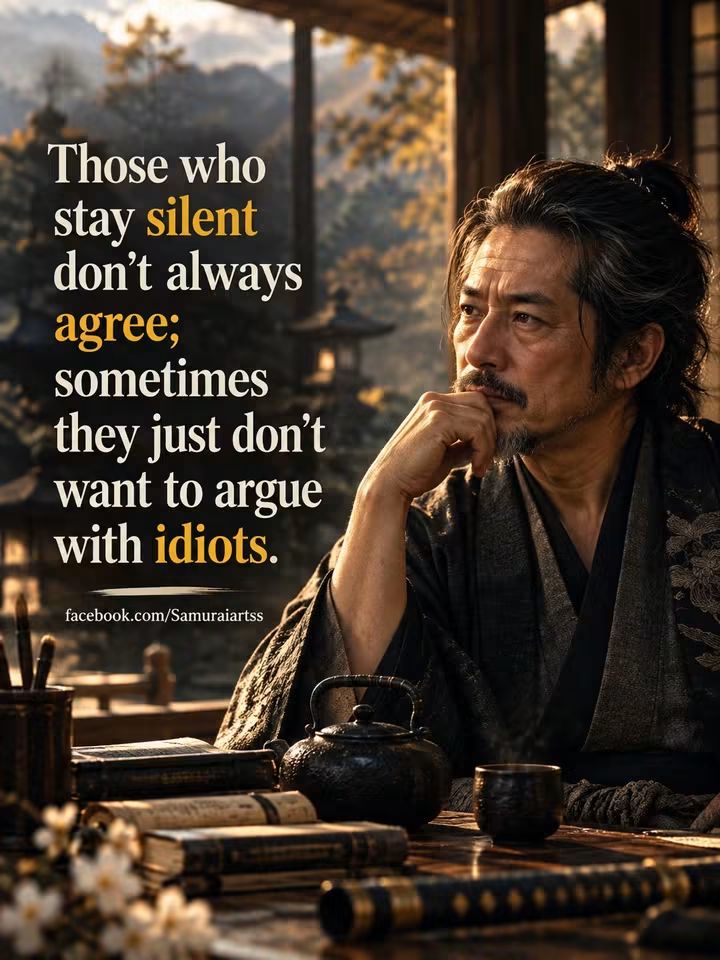
Silence is often misunderstood. Some people choose not to respond, not because they agree, but because they understand that every argument does not deserve their energy. Wisdom teaches us to recognize the difference between a meaningful conversation and a pointless confrontation.
A mature person does not need to answer every criticism, correct every opinion, or prove their intelligence to everyone around them. Sometimes the strongest response is simply to remain calm and walk away. Silence can be a form of self-control, especially when emotions are high and words would only create more conflict.
Those who are quiet may be observing, thinking, and choosing their words carefully. They may understand that arguing with someone who refuses to listen rarely produces anything valuable. Protecting your peace does not mean you are weak. It means you understand the value of your time, attention, and emotional energy.
The samurai spirit reminds us that true strength is not always loud. A warrior does not need to display power at every moment. Discipline means knowing when to act, when to speak, and when to remain still. The calmest person in the room may be the one with the greatest control over himself.
Not every disagreement requires a victory. Not every insult requires an answer. Not every person deserves access to your peace. Sometimes walking away is not surrender—it is wisdom.
Choose your battles carefully. Speak when your words can create understanding. Stay silent when speaking would only feed unnecessary conflict. Let your character speak louder than your arguments.
In a noisy world, silence can become a powerful form of strength. It gives you space to think, protects your dignity, and keeps your focus on what truly matters.
Be calm. Be observant. Be disciplined. And remember: you do not have to argue with everyone simply because they want to argue with you.
#SamuraiWisdom #WarriorMindset #MartialArtsWisdom
When the rules have been made crystal clear, but someone still decides to test the boundaries — the natural order simply moves into forced correction mode.
Some agreements can look unbreakable right up until a higher order of authority enters the picture.
Then the dark agreements lose their force, old obligations are nullified, and reality gets the patch it needs.
Sometimes higher justice doesn’t come to punish. It comes to remind us that above any agreement, there is a higher sovereignty. 😎🔥
Source:
https://t.co/ewg8bPM5wc
New Preston Dennett video: four alleged onboard cases with no hypnosis and no standard “Gray exam.” Just long conversations. High strangeness.
The third case especially caught my attention.
May 1–3, 1981. Beijing. A student and two friends reportedly tried to contact extraterrestrials telepathically at a psychic research institute. That same night, he says, they came for him in his bedroom.
Onboard was a blonde, human-looking woman. According to his account, she told him he had been chosen because of his interest in UFOs and psychic abilities.
Then came two more nights: ancient Chinese history, a spaceport, a physical examination, small hairy humanoids, conversations about Earth’s future — and finally, a warning to keep silent.
The interesting part isn’t whether you accept the story literally.
It’s the pattern.
If these accounts reflect something real, the message may be simpler than the mythology suggests:
They watch.
And they respond when a person takes the first step toward them.
Source:
https://t.co/aKxV8ZxVl3
Ross Coulthart on Reality Check talked about a guy named JP @JP_ARKS : he described himself as a former U.S. Army soldier and said he was taken twice to an underground spaceport — hundreds of saucer-shaped craft, Nordic personnel, the Alabama / Tennessee / Mississippi border. The site was later tied to Green Mountain.
Grusch brought the programs.
Barber brought the egg.
JP is bringing the spaceport.
It’s time for Ross and JP to sit down together and go through this in person.
Source:
https://t.co/Rwx5qsSlpU
UFO BOMBSHELL: Tim Burchett Reveals Stephen Miller Told Him ‘Evil People’ In Deep State BLOCKING Release Of Files
“I've talked to Stephen Miller about this. He called me at the house, which was unusual”
“He said, there's some people that are blocking this in these departments, and I feel like they're some very bad people for whatever reason.”
“You're talking about a deep state, the swamp or whatever, the sewer, as I call it, that's deep state, that they block this stuff because they're sitting on a lot more files that they should be releasing.”
This is insane… @timburchett
Cycles, Choice, and “Reset”: Why Max Barskih’s Short Film Feels Like an Ancient Myth
The short film RESET (made for the Higgsfield Film Festival) is not just a beautiful piece of science-fiction imagery. It is a concentrated myth that strikes straight at the collective unconscious, echoing the stories of the fall of Atlantis and Lemuria.
The plot clearly carries the eternal archetype of alternative history: a civilization is given free choice, and time after time it chooses dominion over balance. Then the universe simply returns the planet to its beginning — not as punishment in the human sense, but as a cold reset of equilibrium when entropy crosses the allowed limit.
The two rulers on the Moon — the Queen of Light and the King of Fire — look like direct heirs of an ancient cosmic drama:
• The line of fire strongly recalls the low-empathy principle: control, rigid hierarchy, the conviction that the world must be purified through the storm. The reptilian visual here underlines that draconian, commanding energy.
• The light side answers differently: “My light sleeps in your warriors. Your fire moves in every human heart.” This is a refusal of the primitive fairy tale of “good versus evil” in favor of a recognition that both forces live inside one whole.
The ending, with the yin-yang symbol and the thought that the new world must remember its original undividedness, is already a call to break the endless circle. The struggle is not between outer enemies, but inside each of us: between the hunger for control and the longing for creative balance.
While the cycle reminds us of itself once again, we are left with the same choice as always: to see in the other not an enemy, but the other half of ourselves. And it is at that point that the world no longer needs a reset.
Source:
https://t.co/Xc3CQxjA8K
Sea turtles leave tracks that disappear with the tide. Birds leave delicate marks in the sand. Wildlife moves through the world taking what it needs and leaving remarkably little behind.
Humans have a different responsibility. Our waste can remain in the environment for years or even decades. Plastic bottles, fishing line, packaging and other debris can travel through waterways, where they can injure or kill wildlife far from where the waste was discarded.
Many Indigenous traditions emphasize living in relationship with the land rather than treating it simply as something to consume.
Leave places better than you found them. The shores, forests and waters we care for today will be the places others inherit tomorrow.
Cleanliness is neither a privilege nor someone else's job. It is a systemic commitment to leave nature untouched and recycle our waste, instead of rationalizing littering because of 'more important matters.' There can be no more important business if our home ceases to exist.
StarCraft, for anyone who still thinks it’s just nostalgic pixels from the nineties.
It’s a hard universe of three races, and humanity’s face there is the Terran Dominion under Emperor Mengsk. A totalitarian empire of fleets, steel bunkers, barracks, and cannon fodder.
The Marine is not a shining superhero. He’s a fighter in a heavy tin can — CMC armor, stimpacks, an order to hold the line to the last man. CMC is the Marine’s powered combat suit. Not a vest — a heavy exoskeleton. It takes hits, holds vacuum and toxic air, and makes the body stronger. That’s the “tin can” you see in the cinematics. They often look after the suit more carefully than the person inside it.
In the classic lore they often pulled recruits off the prison worlds and broke their personalities into shape. In the game a Marine costs a cheap price. In the cinematics his life is the second before the scream on comms.
The new Dominion announce cinematic paving the road to 2030 pushes that aesthetic into open cynicism. A general fills the screen with speeches about defending mankind, about elite duty, about millions of lives hanging on every recruit. The crowd roars “FIGHT.” Then the heavy barracks doors open — and the Swarm explains, with no poetry at all, that in this corporation heroism is a consumable. After the fight they wash the armor, write the man off, and put the suit on the next poor bastard. The most honest military ad science fiction has filmed in years.
Now step out of the trailer and into what the insiders were saying.
In the interview with Dr. Michael Salla, Thor Han Eredyon — through Elena Danaan — laid out two parallel military realities.
Earth Alliance programs. According to him, the space-combat pipeline on that side has already been shut down. What’s left is people finishing their time. And this matters: inside the Alliance, as he describes it, no one was taken against their will. The work was offered. A person accepted or refused. If they accepted, they already knew their memory would be erased and they would be regressed. They signed it with their eyes open.
Dark Deep State programs. The shadow military structures are still running the old playbook. Thor Han says it plainly: they still think they can take people and get them ready by breaking their mind. That machine will not stop on its own. It stops when the Deep State on Terra collapses for good.
The rhyme is here. Not a conspiracy pamphlet, and not “Blizzard leaked a protocol.” Just the same pattern wearing different costumes.
In the trailer, Dominion sells the salvation of the homeland and then grinds recruits into meat. That is not a portrait of the Earth Alliance as Thor Han tells it. In his account the Alliance is the side with a choice and a contract known in advance. The trailer rhymes with the other branch — the one that does not ask.
Nobody is going to drop an official stamped file on your desk. Things like this get left in plain sight: in game lore, in noble slogans, in a shot where they clean the armor more carefully than they ever kept the man who stood inside it.
StarCraft Dominion trailer: https://t.co/6HYKPtOk0p
Thor Han conversation: https://t.co/ad5tG8qlNx
Previous post about StarCraft:
https://t.co/aLHM75pps3
Jesse Watters argues that sudden alarm from Democrats, Bernie Sanders, Obama-era figures, and some AI execs about “AI will kill us by 2030” looks less like genuine safety panic and more like a political/business play.
Source:
https://t.co/CXUiEcwvCu