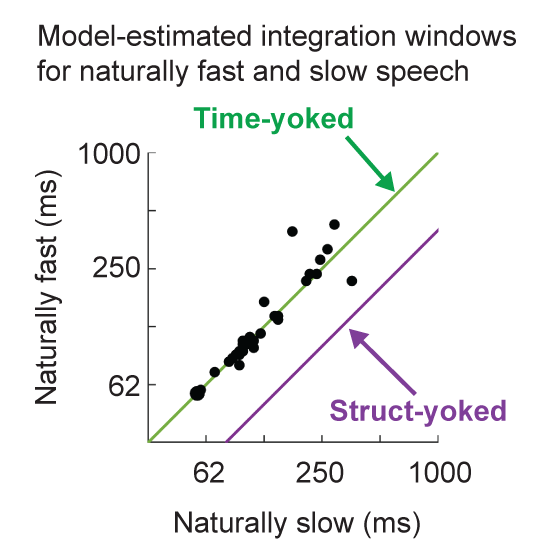
Human auditory cortex integrates information in speech across absolute time (e.g., 200 ms), not phonemes, syllables, words, or any other time-varying speech structure: https://t.co/63T8qdQkUH
Human auditory cortex integrates information in speech across absolute time (e.g., 200 ms), not phonemes, syllables, words, or any other time-varying speech structure: https://t.co/63T8qdQkUH
Recent proceedings paper from David Skrill (PhD student in my lab), which shows how to characterize integration windows in LLMs and their dependence on linguistic structure, providing clear, interesting, and testable predictions for neural experiments: https://t.co/WGkIKaNobB
@alex_ander@_avaidya@LibertySays This is neat: Fit a DNN encoding model with an HRF and then throw out the HRF and see if you get the right integration window. Qualitatively seems to work.
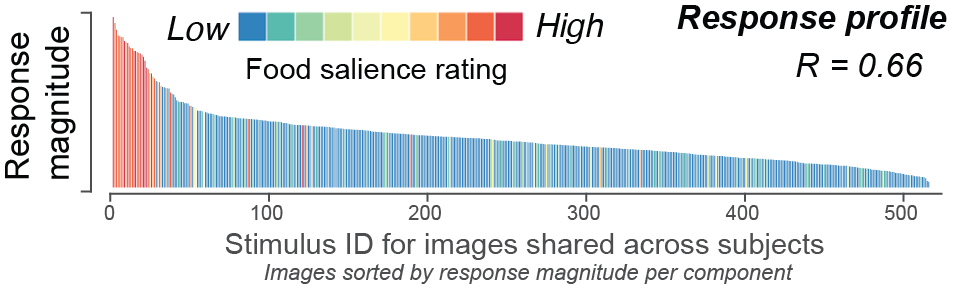
I'm psyched to share a new study led by @meenakshik93, with @apurvaratan collaborating: Data-driven methods applied to the NSD fMRI dataset reveals that the ventral visual pathway has neural populations that respond very selectively to images of food: https://t.co/K31HTJJq0s
New paper!
https://t.co/pWkqM9VuVz
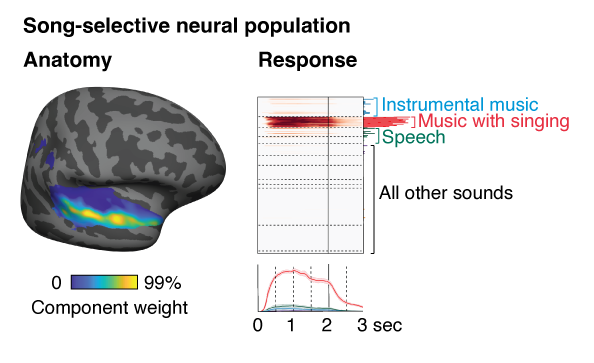
Using intracranial recordings and modeling, we uncover a neural population in human auditory cortex that responds selectively to song, but not instrumental music or speech.
@Nancy_Kanwisher@JoshHMcDermott@jenellefeather@dlboebinger
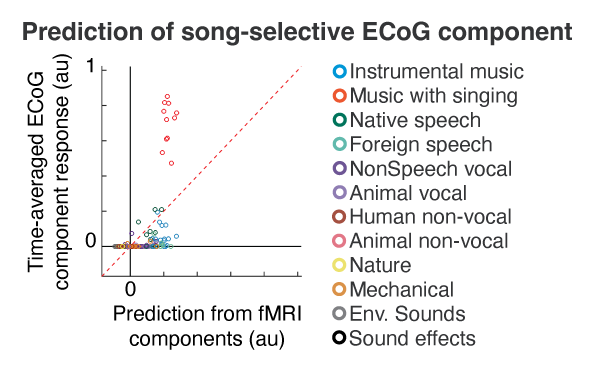
In contrast, we could not predict the song-selective ECoG component using our prior fMRI components. This asymmetry suggests that ECoG indeed provides a more precise measure of the neural response, replicating and extending prior fMRI research.