Running 1TB of data on the Internet Computer ($ICP) costs just ~$5,000/year—all-in.
But the real story is in what wedon’t need to pay for anymore.
🔥 What ICP Replaces from a Traditional Stack:
1. AWS Infrastructure – $12,000/year
No EC2, S3, Lambda, RDS, ALB, Route 53, CloudWatch, etc.
ICP gives you a globally distributed runtime + storage engine built into the protocol.
No provisioning. No usage tiers. No surprise bills.
2. DevOps Engineer – $120,000/year
No need for cloud architects, DevOps pipelines, Terraform scripts, K8s clusters, CI/CD setups.
Canister smart contracts handle logic, deployment, upgrades, and scaling automatically.
You build → you deploy → it runs. That’s it.
3. Database Hosting + Backups – $6,000/year
Canisters serve as both app backend and database.
They persist state across upgrades, retain structured data, and can be queried directly over HTTPS.
Backups, replication, and rollback are built into the protocol.
4. Security Tools & Firewalls – $8,000/year
No WAF, endpoint protection, firewall configs, intrusion detection, or SOC alerts.
Canisters are tamperproof and sandboxed at the protocol level—immutable, verifiable, and isolated.
5. Redundancy + CDN – $4,000/year
No Cloudflare, Akamai, or multi-region replication needed.
ICP uses subnets and boundary nodes to serve content globally with built-in high availability.
No edge servers, no DNS hacks.
6. API Auth & Rate Limiting Infra – $3,000/year
Forget OAuth, API keys, JWTs, and rate-limit proxies.
ICP integrates Internet Identity for user auth—secure, anonymous, passwordless.
Rate limits and access control can be built directly into canister logic.
✅ What You Get for ~$5,000/Year on ICP:
• 1TB of stateful storage on a decentralized, censorship-resistant blockchain
• Smart contracts (canisters) that combine compute + data into one unit
• Web-speed APIs served directly over HTTPS from the chain—no middle layer
• Reverse gas model—users don’t need wallets or tokens to interact
• Protocol-level security, scaling, and fault tolerance
• No cloud accounts, no OS, no container runtime.
💰 Total Traditional Stack Cost Avoided: ~$153,000/year
• DevOps + Cloud + Infra + Security + Redundancy
• Replaced by a fully serverless, autonomous, decentralized backend
🧠 TL;DR:
ICP isn’t “cheaper cloud.”
It eliminates the stack.
From server to database to API gateway to CDN to identity provider—everything is replaced by smart, decentralized infrastructure running on-chain.
Build apps without DevOps.
Serve data without cloud bills.
Deliver UX without wallets.
$ICP is not just a blockchain—it’s the only platform that runs the internet natively on-chain.
#ICP #Serverless #BlockchainInfra #CloudDisruption #Web3Builders #SmartContracts #DecentralizedStack #CloudReplaced #DevCost #InternetComputer
The future is already here.
The new standard is here—and it’s $ICP.
#ICP #Web3 #Blockchain #InternetComputer #FutureTech
#ICP is inevitable.
This is Web3 infrastructure built for the next billion users, not just DeFi and memes.
Measured. Scalable. Proven. Quantum Proof.
$ICP ♾️ is what blockchain was meant to be
@dominic_w@monkey898898@ICP100X@ICP_Whale@ghost_icp@beavesgtr @ICP_insider @CambrinNolan@QuantumPinkkk@TrumpDailyPosts@TruthTrumpPosts@POTUS@elonmusk@kimbal@ModernInvest@investanswers@IOHK_Charles @Zero2HeroZombie @JDVance@TruthTrumpPosts@ICPWhiteShark@BlkMambaCapital@Mkol29199160@ICPsimp
@Ashcryptoreal @cryptofrontio@abu_crypto1@CryptosR_Us@cryptobeastreal@LiquidiumFi@caffeineai@realDonaldTrump@facebook@Meta@Google@Apple@soupman911@SteveUsher
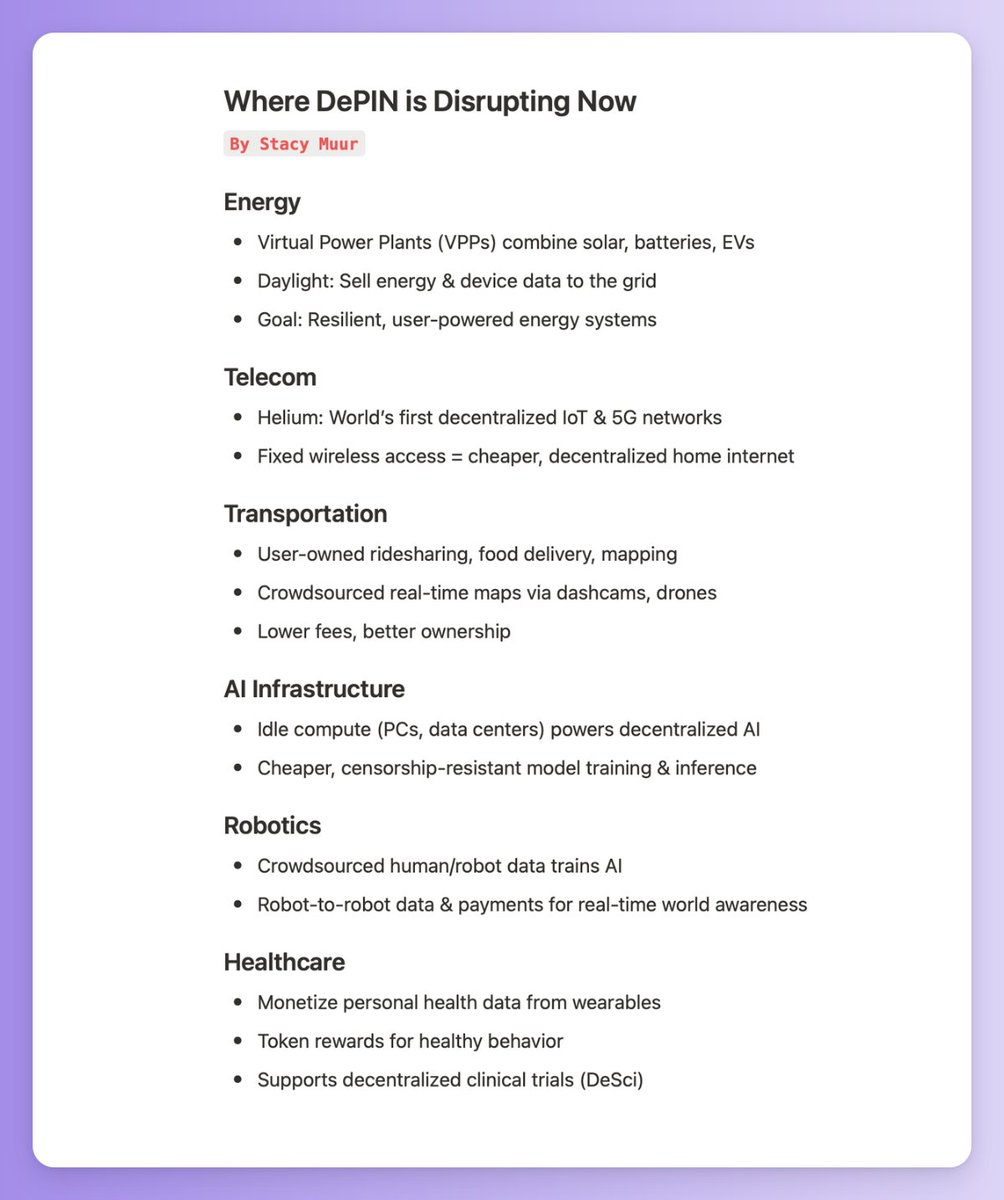
Infra is being rebuilt by DePIN protocols, not legacy providers.
@a16zcrypto’s latest research maps how value is shifting to the edge where users don’t just participate, they operate the system.
Here are six verticals where it’s playing out ↓
1. Energy
DePIN is turning homes into power nodes. With protocols like @daylightenergy, users can sell excess solar energy and the data around it directly to the grid.
Rooftop panels, EV chargers, and batteries are being stitched together into Virtual Power Plants (VPPs) that behave like decentralized power stations.
In parallel, microgrids powered by modular nuclear reactors are bringing energy resilience to remote areas. Some protocols even tokenize carbon credits, turning solar adoption into an onchain incentive loop.
2. Telecom
DePIN is turning users into network providers. Projects like @helium have built decentralized wireless networks starting with IoT coverage and now expanding into 5G.
Instead of relying on telcos, users deploy the hardware and earn directly. The result? Lower costs, better coverage, and networks that grow peer-to-peer, not top-down.
3. Transportation: Maps, Meals, and Motion
Delivery, rideshare, and mapping are going peer-to-peer. DePIN protocols remove platform fees and shift ownership to the users whether it’s restaurant-run delivery networks or driver-owned ride services.
Even mapping is getting decentralized, with dashcams and drones crowdsourcing real-time data that updates faster than legacy providers like Google.
4. AI
AI doesn’t just need data, it needs serious compute and power. DePIN addresses both. On the energy side, decentralized sources like VPPs, solar, and microgrids make supply more resilient. On the compute side, DePIN protocols tap into unused GPUs from gaming rigs to idle servers and pool them to train and run models cheaply, without gatekeepers.
The future of AI won’t run in Big Tech’s basement, it’ll run everywhere.
5. Robotics
DePIN turns everyday actions into data robots can learn from. XR headsets capture tasks like folding laundry or opening doors, feeding robots the muscle memory they need.
Human-operated bots also contribute real-world data to shared networks. In some systems, robots even pay each other for real-time information, coordinating through microtransactions at machine speed.
6. Healthcare
Wearables already track our health but the data often goes nowhere. DePIN flips that. Users can own and sell their health data to insurers, researchers, or clinical trials, unlocking real value for healthy behavior.
Projects in the DeSci space are alreay using this data to run bottom-up trials and open up access to medical research. Health data stops being a black box.
This research isn’t a trend report but a blueprint and it makes one thing clear: DePIN isn’t a concept waiting for adoption, it’s already shaping how infrastructure gets built
Welcome to the home of Bitcoin DeFi
→ ETH UX
→ BTC assets
→ ZK security
→ Real adoption
No gimmicks. No broken bridges. No LARPing.
Just a hybrid chain unlocking real utility for the most valuable asset in crypto.
Explore BOB 👇
https://t.co/qC4LxHCZDV
https://t.co/P9D5zwcVY0
@gobob_xyz
🚨 We interrupt this regularly scheduled DePIN alpha to bring you breaking news from the world of Bitcoin 🚨
BTC isn’t just for hodling anymore.
Let’s talk about BOB, the first Bitcoin DeFi chain that doesn’t suck 🧵👇
@gobob_xyz
And unlike 99% of “Bitcoin DeFi” vaporware, BOB’s already cooking:
✅ Mainnet live
✅ DeFi apps integrated
✅ Builders building
With real partners:
@aavegotchi@GammaStrategies
@layerbankxyz
@Beefy
@elixirfinance
Follow the smart money. They’re here early.