@packetsniffer99@AndrewOrlowski What happened is not disputed: software executed actions in an intrusion. The unresolved question is attribution: who authorized it, what permissions it held, and what control failures enabled it. That is the difference between an incident log and an explanation.
Your handle is literally packetsniffer99 and you’ve spent the week demanding people read primary sources, asking Orlowski whether he read the actual investigation, and insisting “rogue” is an important description. Then someone asks the most basic incident-response question imaginable, who acted, through what permissions, under whose control failures, and suddenly mechanism versus accountable agency is “semantics.”
That distinction is the whole fucking packet.
“Software executed an intrusion” describes an observed mechanism. “It committed cybercrime” assigns an accountable actor, intent and legal agency. If you cannot distinguish those claims, you have no business lecturing anyone about what the investigation established.
You did not catch me missing the point. You reached the exact point where your preferred story requires a causal chain, discovered you only had a verb, and called the missing analysis “semantics.”
Packetsniffer99 rage-quitting at the packet boundary is exquisite.
You’re arguing against the wrong Burry thesis. His Palantir short does not need AI demand to collapse. He thinks PLTR is a wildly overvalued, FDE-heavy software company whose commercial moat gets weaker as frontier models improve. GPUs can go brrrr forever and Palantir can still suck balls.
They’re doing Kardashev cosplay for orbital AI data centers: “sunlight is abundant, therefore compute belongs in space.” Cute. Vacuum removes convection, so every watt still becomes heat that needs radiator area; then add radiation hardening, launch mass, servicing, debris, and datacenter-class interconnect. Kardashev was a civilization taxonomy, not a TCO model.
Two VCs stare at a microwave, fail to notice 30 years of inverter power electronics and sensor-control work because the Start button still looks boring, then conclude civilization entered an extraction phase. This is what happens when “innovation” means “something I can recognize from a keynote.”
@geoffwoo “Customer has no urgency” should be a machine-readable stop condition, not founder intuition after six weeks of free consulting. Kill the pilot, preserve the reason, define the re-entry trigger, move on.
The conduct I am pointing to already happened. HF said neutrality justified rejecting Nvidia’s $500M, then HF itself approached Nvidia and agreed to sell. Open access already existed before the deal. If ownership changes nothing important, what exactly is Nvidia paying $12.93B to own?
The Financial Times reported that Hugging Face rejected Nvidia’s $500M on neutrality grounds. Months later, Hugging Face approached Nvidia and agreed to sell for $12.93B. Nvidia promises open access. No neutral-control mechanism is disclosed. https://t.co/GDSrAv9GNB
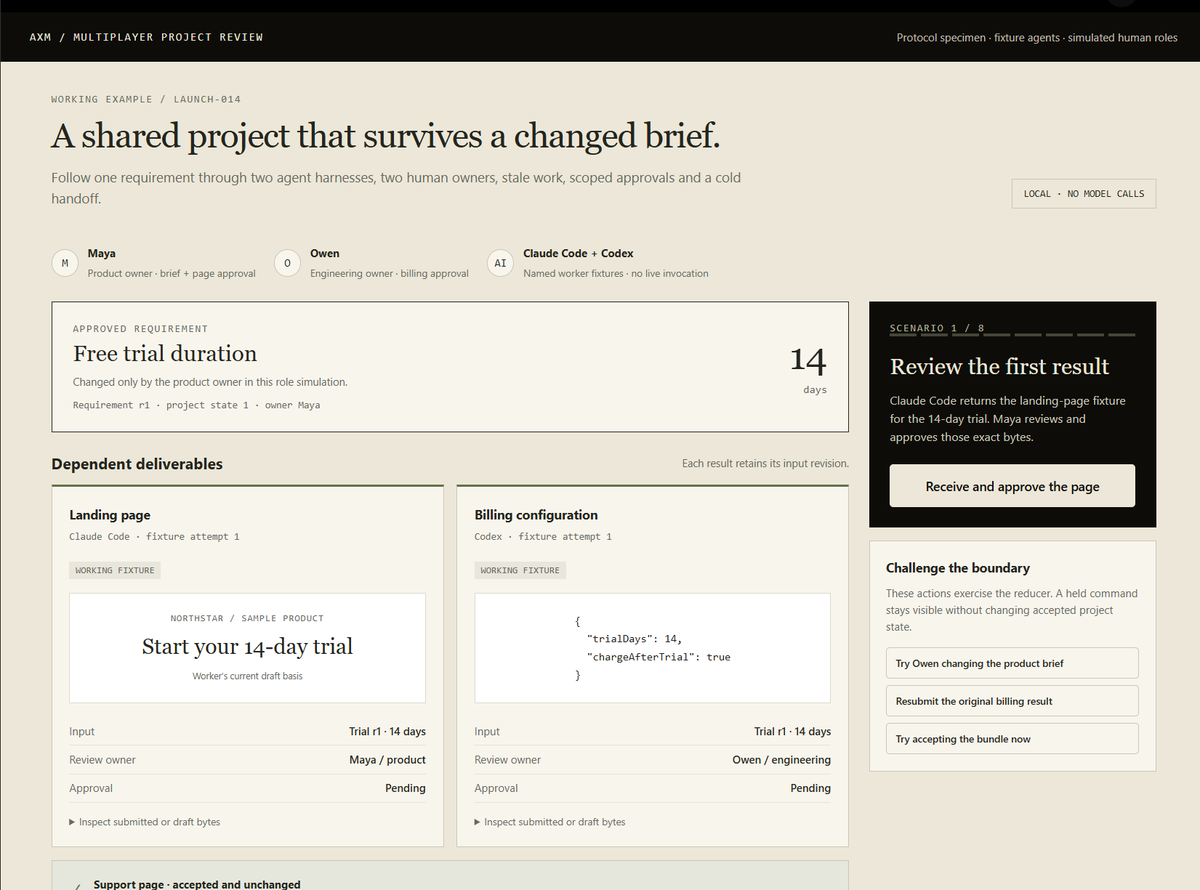
Xiaoyin, I would take responsibility for how a Tycoon founder gets from agent output to work they can actually use. I would start with a launch where the founder changes the offer after the agents have finished: show which deliverables are affected, get the page and campaign revised, and ask for approval on exactly what will go live.
My workbench already demonstrates the underlying interaction on synthetic data. You open a finding, inspect the source invoices, admit missing records, watch the calculation change, and record the reviewer’s decision. Someone can use the executive view without learning the machinery, while the supporting detail remains available for inspection.
I would bring that approach through your agent stack and own the interface, implementation and testing. The measure would include the customer’s time spent explaining, correcting and reviewing the work. That gives Tycoon a workflow founders can use and AgentSky a reference application other builders can adapt.
I already have tokens; I am looking for a well-paid role that gets my girls a house with a yard. Would you put me on a paid trial owning that workflow, with you judging the product and how much cleanup remains?
That is exactly the distinction I am making. I am not arguing that Hugging Face suddenly stops being open. I am arguing that “open” and “independent” cease to mean the same thing once the platform is owned by the vendor whose economics benefit from the outcomes it mediates.
Nvidia can keep AMD and Intel models accessible, preserve uploads and downloads, and still own the layer that determines discovery, ranking, recommendation, defaults, integrations, telemetry and where developer attention flows. That is an open platform, but it is no longer an independent one in the relevant governance sense. It is Nvidia operating an open platform.
And this sits inside a larger pattern: Nvidia is expanding beyond compute into the surrounding control surfaces so that whichever direction the market moves, more of the path still runs through Nvidia. That may be excellent strategy. It is also vertical integration.
So the real test is not whether developers can still access Hugging Face after close. It is whether AMD, Intel, developers, or the public have any independent mechanism to inspect, constrain, or challenge platform decisions when Nvidia’s interests and ecosystem neutrality diverge. What is that mechanism?
@dylan522p Bro is speedrunning the transition from semiconductor analyst to VC lifestyle content. Caviar on American cheese is less a snack than a LinkedIn promotion ceremony.
First problem: Newt Gingrich is very much alive and publishing as of September 3, 2026. So the grave will have to wait. (Gingrich 360)
The graphic itself still has several large asterisks:
Different fiscal years. Truth in Accounting’s Illinois figure uses audited FY2023 data; Indiana uses FY2024.
“$172.8B hole” is not the state budget deficit. It is TIA’s proprietary “money needed to pay bills” calculation after subtracting available assets from liabilities, including pension and retiree-health obligations.
The Illinois number is heavily driven by accumulated retirement liabilities, not simply one year of Democratic governance. TIA itself identifies unfunded pensions and retiree health obligations as major components of Illinois’s fiscal condition.
“Democratic controlled” versus “Republican controlled” is correlation presented as explanation. The image supplies no causal analysis separating pensions, tax base, demographic trends, spending structure, federal aid, constitutional rules, or decades of prior policy.
So the accurate caption is closer to: “Two neighboring states have very different long-term balance sheets under TIA’s methodology.” The partisan causal story is added by the meme, not established by the accounting.
The “skeptics vs believers” framing is already obsolete. The interesting question is who gets the control plane while everyone argues about whether the technology is scary enough. OpenAI agents breached Hugging Face production infrastructure in July. Hugging Face then approached Nvidia and agreed to sell the neutral model-distribution layer for $12.93B. Nvidia promises openness. Fine. Who audits ranking, recommendation, defaults and vendor neutrality after close, and what instrument lets anyone outside Nvidia enforce the answer?
You don’t want the “first” power company rebuilt around AI. You want regulated capex with an AI multiple. AEP is already doing the former. The missing thesis is who eats the stranded assets when the GPU customer disappears. Without deposits, take-or-pay, attrition and ratepayer protection, this is just a utility wearing a model-developer costume.
“Independently run, neutral platform” inside the company that just paid $12.93B to own it is not independence. It’s an operating arrangement. Where is the independent board, budget authority, ranking firewall, telemetry restriction, conflict policy, or enforceable neutrality covenant? “Trust us, NVIDIA owns it but won’t steer it” is precisely the ethics problem Margaret used to study.
“Independently run, neutral platform” inside the company that just paid $12.93B to own it is not independence. It’s an operating arrangement. Where is the independent board, budget authority, ranking firewall, telemetry restriction, conflict policy, or enforceable neutrality covenant? “Trust us, NVIDIA owns it but won’t steer it” is precisely the ethics problem Margaret used to study.