The "4 Wheels" driving the Indian Economy to $30 Trillion. 🇮🇳📈
If we want a truly Viksit Bharat by 2047, It requires a synchronized 4-wheel drive:
1️⃣ The Government as an Enabler: Infrastructure investment & Ease of Doing Business.
2️⃣ Global OEMs & High-Tech factories set up: Semiconductors, EVs, and AI infra commitments.
3️⃣ MSMEs & Local Entrepreneurs: Integrating deeply into global supply chains.
4️⃣ Youth Skilling: Transforming from job seekers to global innovators.
When these 4 wheels move in sync, the Indian growth engine becomes completely unstoppable.
Catch my breakdown on DD National live this morning on how we are creating bridges between macro policy and ground reality.
@DDNational@DDNewslive@makeinindia
#ViksitBharat #AtmanirbharBharat
#Manufacturing
The Indian semiconductor story is rapidly evolving from basic assembly to high-value IP and advanced packaging. 🇮🇳
US based Mixx Technologies acquiring Bengaluru’s Sophic Silicon and partnering with Kaynes Semicon is a huge signal for the ecosystem.
Key Takeaways:
1. $30B+ Market by 2030: Tackling critical AI data center bottlenecks using Silicon Photonics & Co-Packaged Optics.
2. Advanced Tech: Focuses on Silicon Photonics & Co-Packaged Optics (CPO) to solve AI data center latency.
3. Scale & Execution: Connects Indian mixed-signal design IP with global deep-tech and with Kaynes’ Sanand OSAT plant, targeting ~5M units/year.
4. The Full Flywheel in action: Local IP (nurtured by MeiTY) ➡️ Global M&A ➡️ Domestic advanced manufacturing.
'Make in India' is integrating directly into global deeptech supply chains.
@Kaynestech@GoI_MeitY@SemiconIndia
By @SurakshaPinnuET
#MakeInIndia #Semiconductors #DeepTech #AIInfrastructure #TechPolicy
🎯: Unlock India’s ₹34,300 Cr mineral potential to lead the global green supply chain. ⛏️
The Blueprint: Build domestic midstream end-to-end processing to achieve true sovereignty.
True strategic independence demands complete mastery over critical links in the value chain, from refined oxides to end-use components like permanent magnets and defense alloys.
Else, India’s clean energy, EV, and tech ambitions remain exposed to external supply shocks. Achieving component sovereignty requires bridging this precise gap.
Anuj Gupta and Dr. Abhinav Jindal provide roadmap:
The Core Vulnerability:
• 100% Import Reliance: Dependent on imports for 10 vital critical minerals (lithium, cobalt, nickel).
• Component Dependency: 60–80% reliance by value for rare-earth permanent magnet (REPM) inputs.
• Global Bottleneck: Single-country concentration controls over 90% of rare-earth refining and 95% of graphite processing.
Pragmatic Action Already Underway:
1. Global Asset Acquisition: KABIL active in Argentina (lithium), partnering with Australia, and forging alliances with GAIL.
2. Global Security Frameworks: Leveraging the Minerals Security Partnership (MSP), G7 and the Quad Critical Minerals Initiative to co-develop supply chains.
3. Domestic Execution: The ₹34,300 Cr National Critical Minerals Mission (NCMM) and ₹7,280 Cr REPM scheme are building initial momentum.
The Roadmap for Component Sovereignty:
• Build Midstream Capacity: Establish domestic processing parks to convert raw ores into high-purity heavy oxides.
• Lock in Deep-Tech Alliances: Leverage offshore exploration rights in the EEZ to mandate technology transfer for deep-sea mining and beneficiation.
• Master Downstream Manufacturing: Scale integrated manufacturing of REPM magnets, battery cells, and defense-grade alloys domestically.
• Unify Institutional Execution: Directly link KABIL’s overseas raw materials to domestic midstream processing parks and end-use industries.
Integrating overseas sourcing, domestic refining, and component manufacturing is the only path to complete industrial sovereignty.
By @anujg@BowerGroupAsia@MinesMinIndia
Via @businessline
#CriticalMinerals #MakeInIndia #StrategicAutonomy #CleanEnergy #RareEarths #SupplyChain #NCMM #KABIL #Geopolitics
@Psm_cuts@CUTS_CITEE Thank you for watching and sharing, Pradeep.
We must strive to ensure the benefits of such significant traffic deals should reach to the last mile.
@nabomita_smiles This will be one of the most transformative urban redesign project in India, Nabomita.
I am confident that under Mr. Anil Sardana's leadership, we will see this vision turn into a showcase reality.
Keenly kooking forward. @aksardana
Delhi’s electric buses are rewriting India’s green mobility future. 🚌
One clean mile at a time. ⚡
India has crossed the 5% EV adoption tipping point. Delhi is leading the charge with nearly 4,300 electric buses, one of the largest fleets in the country.
The capital’s radical new EV policy combines high targets, incentives and strict mandates to accelerate adoption.
Key Strategies & Initiatives:
•Mandatory shift: 100% new city buses, autos & school buses electric by 2027–2030.
• Strong incentives: subsidies, road tax waivers & registration discounts. Combined with significant charging infrastructure rollout.
• Centre-State collaboration under PM E-Drive scheme.
Key Numbers:
• Delhi: ~4,300 e-buses.
• National: 1.32 million EVs on road.
• 7.8% share of new passenger vehicle sales.
• Clear 2030 targets for key segments.
Implications:
1. Cleaner air for millions & reduced oil imports.
2. Boost to domestic manufacturing, battery tech & green jobs.
3. A replicable blueprint for other states.
Can Delhi’s model be scaled nationwide?
@MHI_GoI@CMODelhi
By @Howindialives
#EVRevolution #ElectricBuses #DelhiEV #GreenMobility #PMEDrive
Algorithms are the new Alpha for alpha-chasing VCs. 💰
AI is building the gear to hunt the next unicorns.
Indian VCs are rapidly integrating AI to automate deal sourcing and sharpen investment decisions, a clear shift to tech-driven operations.
Who’s leading the charge:
• https://t.co/yjU40zdMRG (Venk y Harinarayan & Anand Rajaraman): Built a proprietary data engine to track real startup traction globally. “Data is eating venture capital.”
• PeerCapital (Kartik Prabhakar): Developing AI tools for sourcing, follow-ons, and portfolio management.
• Elevation Capital: Adding technical roles and AI-powered portfolio monitoring. Varika Bansal highlights the need to combine AI with founder empathy and context.
What’s happening on the ground:
• Algorithms sift through pitch floods to detect outliers traditional networks miss.
• Automation of repetitive workflows (some firms seeing major time savings).
The end result is faster decisions, broader founder pipelines beyond metros.
The Big picture:
This is real end-benefit AI driving better capital allocation, reduced bias, and stronger innovation for users across India.
The winners will master hybrid intelligence: algorithms + human judgment.
Question: is algorithmic the real alpha for the future of Indian VC?
@anand_raj@bansalvartika
By @kpswathi_ET@SurabhiA_ET
#AIinVC #IndianStartups #VentureCapital #FintechIndia #AI
Connecting the dots from my earlier post: Building Indian aerospace ecosystem. 🛫
It’s no longer just about MRO, India is now manufacturing the beating heart of global jet engines.
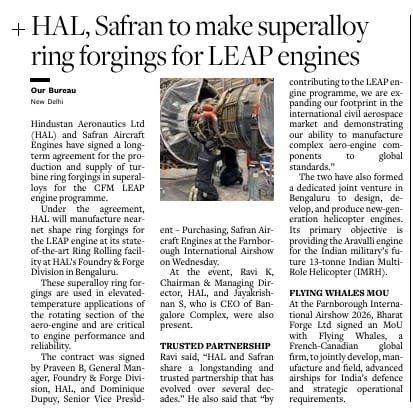
Following Indigo and CFM's record deal, @HALHQBLR and @SafranEngines have partnered at #FIA2026 to produce superalloy turbine ring forgings in Bengaluru for @CFM_engines LEAP engines.
Macro Shift: Servicing ➔ Core Manufacturing:
1. Critical Components: HAL’s Foundry & Forge Division will produce near-net shape forgings for high-temperature engine rotating sections.
2. Global Supply Chain: Directly embeds Indian precision manufacturing into Safran’s global civil aerospace network.
Capabilities & Technical Mastery:
• Advanced Metallurgy: Local mastery of extreme-temperature alloys vital for engine safety and performance.
• World-Class Infra: Leverages HAL’s specialized Ring Rolling facility in Bengaluru to meet global standards.
Make in India & Employment Impact:
• High-Skilled Roles: Generates specialized jobs for aerospace engineers, metallurgists, and quality experts.
• Complete Aero Cluster: Connects component manufacturing with local MRO, building a full end-to-end aerospace ecosystem.
#MakeInIndia #Aerospace #AeroEngines #HAL #Safran #IndiGo #AtmanirbharBharat
1,000+ LEAP engines. Tens of billions of dollars. 𖣐🛠
IndiGo and CFM are bringing high-tech engine intelligence and MRO capabilities home to India.
This partnership will accelerate real aerospace domain self-reliance.
The Strategy for driving Make in India:
• In-House Capability: Build dedicated engine MRO capabilities within India with direct support and technical assistance from CFM.
• Ending Overseas Reliance: Slashes high dependency on foreign repair hubs, keeping maintenance capital, technology, and operations on home soil.
The Scale & Capabilities:
• 1,000+ Engines: Powering 510 Airbus A320neo family jets in the largest single order ever placed for LEAP engines.
• $14.5M List Price/Engine: Multi-billion-dollar long-term commitment ensuring higher engine availability and fleet reliability.
• Operational Turnaround: Eliminates long transit times for overseas shop visits, maximizing aircraft utilization as IndiGo scales globally.
• Local Supply Chain Ecosystem: Expands precision manufacturing, engineering, and supplier ecosystems across Indian aerospace.
This creates high-skilled jobs in engineering & avionics while strengthening local precision manufacturing. Long-term, it accelerates India’s vision of becoming a global MRO powerhouse.
This is a smart, forward-looking move for scaling #MakeInIndia in aerospace.
@IndiGo6E@CFM_engines@Airbus
By @akbars600
Global capital has locked in its next big bet: @makeinindia
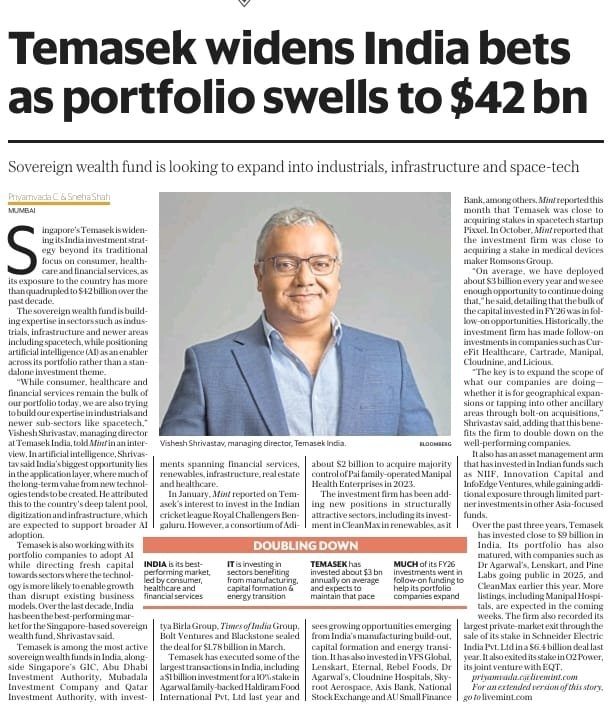
4x growth in 10 years. $42 Billion portfolio. 📈
Temasekis now intentionally widening its footprint beyond its traditional strength in consumer, healthcare, and financial services.
It is doubling down on Industrials, Infrastructure, Real Estate, and Space-Tech.
Key Highlights from Temasek’s India Strategy:
• $42B Exposure: India has become one of Temasek’s top-performing markets globally.
• Consistent $3B Annual Pace: Deploying roughly $3 billion every year in fresh investments and follow-ons.
• High-Tech & Industrial Focus: Strong bets on AI at the application layer, high-tech manufacturing, capital formation, green energy transition (CleanMax), and emerging areas like space-tech.
Why This Matters for India’s Next Decade:
1. Hard Assets Over Hype: Global PE and sovereign wealth funds are moving heavily into the physical backbone of the economy: manufacturing capacity, energy security, and heavy infrastructure.
2. Proven Returns: Massive successful exits like the ~$8.2B Schneider Electric India deal show that Indian industrial assets can deliver world-class liquidity and returns.
3. The Next Inflow Wave: The coming $10B+ from institutions will increasingly flow to companies building physical infrastructure, industrial technology, advanced manufacturing, and deep-tech enablers.
A strong validation that India is graduating to the next league of global investment destinations. 🇮🇳
Watching what sectors will attract the biggest wave of sovereign and institutional capital in India over the next 5 years.
@Temasek@investindia
By @Priyamouli1812@sneha_s_sharma
#MakeInIndia #Infrastructure #Manufacturing #InvestInIndia #PrivateEquity #Temasek #IndiaGrowth
@veda_padma@DDKisanChannel@anjusinghdd Thank you for watching, Twinkle ji! ✨️🙏
Our endeavors must ensure that the smallest farmers down the line get access to the end benefits. 🌾
मलीहाबाद का 5 आम के पेड़ों वाला किसान $100B+ India-UK CETA Deal ka fayda kaise uthayega? 🇮🇳-🇬🇧
On @DDKisanChannel , I shared the 3-step roadmap with @anjusinghdd :
1️⃣ Join local FPOs 🥭
2️⃣ Clustering for export volumes
3️⃣ Tap APEDA & NABARD schemes.
#IndiaUKCETA #Farmers #Agriculture #Growth
1/2...
Privileged to join @DDKisanChannel's flagship show, सच के साथ' hosted by @AnjuSinghDD,
We discussed the India-UK Free Trade Agreement (CETA) advantages for small farmers and Indian agriculture.
Timestamps of my key perspectives:
11:24 | Moving from raw exports to 3x–5x value addition.
23:18 | Tapping the $70B UK food market via FPO clusters
37:24 | Case Study: How 250 Nashik farmers doubled their income.
50:13 | Smallholder export execution framework.
Catch the full broadcast here:
https://t.co/nZzoPhBMu6
Every year, 62 million tonnes of global e-waste are generated. Can crop waste help secure India’s electronics supply chain? ♻️
Now, Bisket Labs, an IIT Madras spinout, is rewriting the substrate playbook by transforming agricultural waste into Green PCBs. A #MakeInIndia innovation. ✅️
India’s PCB market is surging past $7 Billion, yet remains heavily reliant on imports (~88%), dominated by China and East Asia. The company is trying to find innovative solution to reduce import dependencies and enhance sustainability.
The Tri-Impact Blueprint:
1. 3-in-1 Problem Solver: Simultaneously tackles stubble burning and farm waste (sugarcane bagasse, wheat straw), addresses non-recyclable e-waste, and creates a green, indigenous alternative to imported FR-4 substrates.
2. Drop-In Compatibility: Engineered to seamlessly integrate into existing PCB manufacturing lines, no expensive factory retooling or new machinery required.
3. Strategic Scale: Unlocks localized manufacturing for consumer electronics, smart appliances, and industrial controllers in a market projected to hit $25 Billion+ by 2034.
The Strategic Context:
• The Unrecyclable Core: PCBs account for 3% to 7% of e-waste weight, bound by petroleum-derived resins that make traditional boards virtually impossible to recycle.
• Supply Chain Resilience: Indian manufacturers remain vulnerable to global shocks, like recent 40% spikes in epoxy prices due to the Strait of Hormuz crisis.
Decoupling from imported resins is as much about industrial security as it is about sustainability.
@iitmadras@IITMIC
By @madhursingh
#DeepTech #CleanTech #ElectronicsManufacturing #Sustainability #Hardware #IITMadras #GreenTech
It takes a decade to be an overnight success!
A set of focussed programs have pushed and are driving next level of industrialization.
There's significant progress in last 5 years. The next 5 years will be even better as we stay on course.
Read why...👇 @prasannavishy
One broader point worth highlighting.
PLI schemes, India Semiconductor Mission 1.0 (₹76,000 crore), ECMS (₹23,000 crore) to deepen the electronics manufacturing value chain, and recently operationalised ₹1 lakh crore RDI Fund (a long-term financing mechanism for innovation and commercialisation rather than a production-linked incentive) together constitute one of the most ambitious industrial policy interventions in independent India's history.
Add battery manufacturing, EVs and other sector-specific initiatives, and the scale of India's industrial push is truly unprecedented.
Credit where it's due: the current government has complemented record infrastructure creation with a sustained focus on industrialisation, manufacturing and technology.
We are still in the midst of these interventions, but there is good reason to believe they could rank among the most consequential economic policy shifts in independent India's history.
@alexabelonix Thank you for your kind words, Alexa! ✨️
Amazing times for the startup world. Keep building in public. Best wishes!
PS: here's a post I wrote last month. You'll enjoy reading...
Bengaluru is putting on a global startup masterclass:
💰 $153B ecosystem value
🦄 30 active unicorns
📈 190% growth rate.
It’s time for Mumbai, Delhi-NCR, and Hyderabad to step up and break into the global top 20.
Bengaluru just secured the 15th spot globally and #6 in Asia in the Global Startup Ecosystem Report (GSER) 2026, solidifying its place as India's sole representative in the global top 20.
The numbers:
• A $153B ecosystem growing at 190%.
• A flawless 10/10 score on cost efficiency.
• Median developer salaries sit at $19.6k vs the global $54k average, allowing startups to stretch runway significantly longer.
• The AI Magnet: Bengaluru secures 58% of all Indian AI startup funding, proving it is the undisputed hub for India’s next-gen tech.
Implications for India Blueprint:
How does India get 3+ cities into the Global Top 20?
▪︎ Build Specialized Clusters: Rather than copying Bengaluru, emerging hubs must specialize. Mumbai should lead FinTech/Web3, Delhi-NCR should focus on Consumer tech/B2B SaaS, and Hyderabad on HealthTech/BioTech.
▪︎ Aggressive Policy Outlays: Karnataka is deploying a $62.4M outlay via Startup Policy 2.0 to seed 25,000 new startups. Other state governments must match this fiscal aggressiveness to build foundational sandboxes.
▪︎ Focus on IP, Not Just Execution: Raising $1.5B+ in AI requires high-tier R&D. To break the top 20, secondary hubs must bridge the gap between premier academic institutions (IITs/IIMs) and venture capital.
Bengaluru has built the foundation. The next phase of India's economic engine relies on turning regional hubs into global tech capitals.
#TechTrends #VentureCapital #IndiaStartups #Innovation
@PiyushGoyal@investindia@TVMohandasPai
India has leveraged its PLI scheme into a multi-trillion rupee industrial growth + employment engine.
The results speak for themselves:
• ₹2.4 Lakh Cr invested.
• 14.15+ Lakh jobs created.
• Exports:₹4 L Cr ➔ ₹15.2 L Cr.
Here’s the details of how it happened, and a blueprint to replicate it across new sectors 🧵
The Numbers (Till March 2026):
* ₹2.40 Lakh Cr in actual investments realized across 14 manufacturing sectors.
* ₹15.2 Lakh Cr in cumulative exports generated (up from ₹4 Lakh Cr in March 2024).
* 14.15+ Lakh Jobs created (8.49L direct + 5.66L indirect employment).
* ₹1.91 Lakh Cr total approved financial outlay driving this scale.
Sectoral Breakthroughs:
* Solar PV Modules: Led total capital inflow with ₹64,873 Cr investment.
* Electronics & Telecom: Mobile phone output increased 2.4x, cutting imports by 77%. 99.2% of mobile phones consumed locally are now Made in India.
* Pharma & Bulk Drugs: Cumulative sales crossed ₹3.64 Lakh Cr, with domestic production of 1,931 products, including 191 bulk drugs manufactured locally for the first time.
Where it’s lagging: Tech hardware, medical devices, and textiles are trailing due to strict baseline hurdles and complex supply chain gaps.
The Fix: Sector-tailored "PLI 2.0" resets, lowered entry thresholds, and targeted state-level land & power support to turn early laggards into late bloomers.
Strategic Blueprint: How to Replicate for Other Sectors:
To mirror this success in services, defense tech, green hydrogen, and advanced materials, future policy frameworks must follow 4 core strategies:
1. Outcome-Based Subsidies: Reward incremental production and export performance instead of upfront capital expenditure.
2. Ecosystem & Value-Chain Depth: Target critical import dependencies (e.g., APIs, sub-assemblies) to build true local supply resilience.
3. Institutional Agility: Use an Empowered Group of Secretaries (EGoS) for real-time monitoring and mid-course policy calibration based on industry feedback.
4. Scale Before Ingress: Focus incentives on global-scale capacities to make domestic output cost-competitive globally.
India’s manufacturing trajectory proves that targeted, performance-linked industrial policy can successfully rewire trade dynamics and drive job growth at scale.
cc: @JitinPrasada@DPIITGoI@MakeInIndia
📰: @businessline
#MakeInIndia #PLIScheme #IndianEconomy #Manufacturing #SupplyChain #EconomicGrowth #TradePolicy