Por favor lean este documento sobre los posibles efectos del cambio demográfico en Colombia. Algo que creo aún no esta tan presente en el debate público como debería.
¿Cómo afectarán el envejecimiento de la población y la caída de la fecundidad al futuro de Colombia y de sus regiones? Este artículo del #ESPE analiza la evolución y las perspectivas del cambio demográfico, compara escenarios alternativos y muestra cómo las diferencias regionales pueden influir en el crecimiento económico, la salud, la educación y las pensiones en las próximas décadas.
Consulte el más reciente Ensayo Sobre Política Económica “Cambio demográfico y sus impactos económicos en Colombia” 👉 https://t.co/fXdsXJTUfm
Las urnas cerraron a las 4:00 p. m. y, apenas 12 minutos después, ya teníamos los primeros avances de resultados.
Sobresaliente el trabajo de los jurados de votación, la Registraduría y el CNE. En medio de tantas críticas, vale la pena reconocer cuando las instituciones funcionan.
Colombia tiene un sistema electoral transparente, legítimo y capaz de entregar resultados con rapidez.
Smartphones are not the explanation for the recent decline in fertility. Instead, they are an accelerator of deeper forces already at work.
Let’s start with the facts. Fertility is falling almost everywhere: in rich, middle-income, and poor countries; in secular and religious countries; and in countries with high and low levels of gender equality.
The decline accelerated around 2014. So, no country-specific explanation will work unless you are willing to believe that 200 distinct country-specific explanations arrived at roughly the same time.
Smartphones look like the obvious candidate: the first iPhone was released in 2007, and global adoption has been astonishingly fast.
Economists understand the first major decline in fertility in advanced economies, from 6 or 7 children per woman throughout most of human history to about 1.8, that occurred between the early 1800s and roughly 1970, well before smartphones. The main drivers were a sharp fall in child mortality (effective fertility was rarely above 3 and often close to 2) and the shift from a low-skill, rural agrarian economy to a high-skill, urban industrial one. We have quantitative models that fit these facts well.
Country-specific factors mattered too, of course. Proximity to low-fertility neighbors accelerated Hungary’s decline, while fragmented landowning structures accelerated France’s. But these were second-order mechanisms.
This is also why most economists long considered Paul Ehrlich’s doom scenarios implausible. We forecast that fertility in middle- and low-income economies would follow the same path as in the rich, probably faster, because reductions in child mortality reached India or Africa at lower income levels (medical technology is nearly universal, and most gains come from handwashing and cheap antibiotics, not Mayo Clinic-level care). Much of what we see in Africa or parts of Latin America today is still that old story.
But in the 1980s, a new pattern appeared. Japan and Italy fell below 1.8, the level we had thought was the new floor. By 1990, Japan was at 1.54 and Italy at 1.36.
This second fertility decline began in Japan and Italy earlier than elsewhere, driven by country-specific factors, but the underlying dynamics were widespread: secularization, an education arms race, expensive housing, the dissolution of old social networks, and the shift to a service economy in which women’s bargaining power within the household is higher. The U.S. lagged because secularization came later, suburban housing remained relatively cheap, and African American fertility was still high. U.S. demographic patterns are exceptional and skew how academics (most of whom are in the U.S.) and the New York Times see the world.
My best guess is that, without smartphones, Italy’s 2025 fertility rate would be about 1.24 rather than 1.14. I doubt anyone will document an effect larger than 0.1-0.2. Italy was at 1.19 in 1995, not far from today’s 1.14. The TFR is cyclical due to tempo effects, so I do not read too much into the rise between 1995 and 2007 or the decline from 1.27 in 2019 to 1.14 today. The direct effect of smartphones is not zero, but it is not, by itself, that large.
Where social media, in general, and smartphones, in particular, matter is in the diffusion of social norms. What would have taken 25 years now happens in 10. Social media are not the cause of fertility decline; modernity is. But they are a very fast accelerator.
That is why social media are a major part of the story behind Guatemala (yes, Guatemala) going from 3.8 children per woman in 2005 to 1.9 in 2025. Without them, Guatemala would also have reached 1.9, just 20 years later.
Modernity, in its current form, is incompatible with replacement-level fertility. By modernity, I do not mean capitalism: fertility fell earlier and faster in socialist economies than in market economies. Socialist Hungary fell below replacement in 1960, and socialist Czechoslovakia in 1966 (both experienced small, short-lived baby booms in the mid-1970s). By modernity, I mean a society organized around rational, large-scale systems and formalized knowledge.
Countries will not converge to the same fertility rate. East Asia is likely stuck near 1, possibly below, given its unbalanced gender norms and toxic education systems. Latin America faces the same gender problem plus weak growth prospects, so I expect something around 1.2. Northern Europe has more egalitarian family structures and might hold near 1.5. The very religious societies are probably the only ones that will sustain 1.8.
All of this could change with AI or changes in population composition. We will see. But on the current evidence, deep sub-replacement fertility is the “new new normal.” Unless we reorganize our societies, better learn to handle it as best we can.
Estimadas, estimados: publicamos un nuevo ESPE sobre brechas de género coordinado por la fantástica @mramirgi. Aquí lo pueden descargar: https://t.co/QhjOEvfPbq
Vean el video en donde María T explica los principales hallazgos, descarguen el documento y compártanlo.
Durante años, el debate sobre igualdad de género se centró de manera correcta en acceso a educación, empleo y derechos políticos y sociales de las mujeres. Hoy, sin abandonar esas agendas, es necesario ampliar la mirada hacia la igualdad en el cuidado:
https://t.co/XIrBzYkkCy
Preferencias de fecundidad
Aumenta la proporción de mujeres que no desean tener más hijos o son infecundas: de 69,5% (2015) a 75,2% (2025).
Disminuye el porcentaje que desea tener más hijos: de 28,3% a 16,2%.
Aumenta el grupo indeciso: de 2,1% a 8,6%.
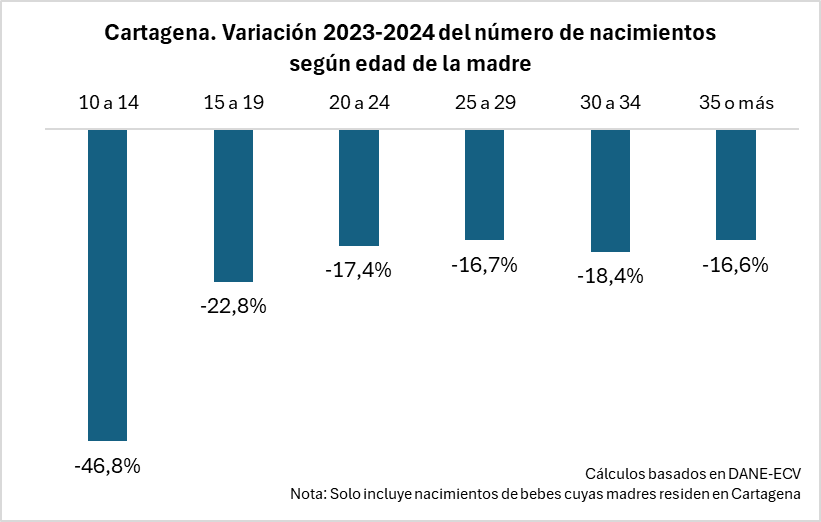
Natalidad en Cartagena.
Uno de los datos positivos de la reducción de la natalidad es que los grupos de edad donde mas cae el número de nacimientos es en niñas de 10 a 14 años y jóvenes de 15 a 19. Además, (sigue...)
Un reportaje hermoso, que hizo el colombiano sobre un trabajo en que entre muchas personas, ayuda mi madre. La historia del “milagro” diario que alimenta a 90 estudiantes en comedor de La Sierra, en Medellín https://t.co/etngZdxwIZ
Los invitamos a leer el ESPE No. 108 "Nueva Evidencia sobre la informalidad laboral y empresarial en Colombia", en el cual hacemos una caracterización muy detallada de la informalidad en Colombia y examinamos sus causas y consecuencias agregadas.
https://t.co/A5i8YQXFqp
@lucis_uwu 2. Puede existir un aumento en la inflación, la media de los trabajadores formales en Colombia ganan alrededor del mínimo, más salario no necesariamente significa mayor consumo si no aumenta la oferta, entonces aumentarían los precios