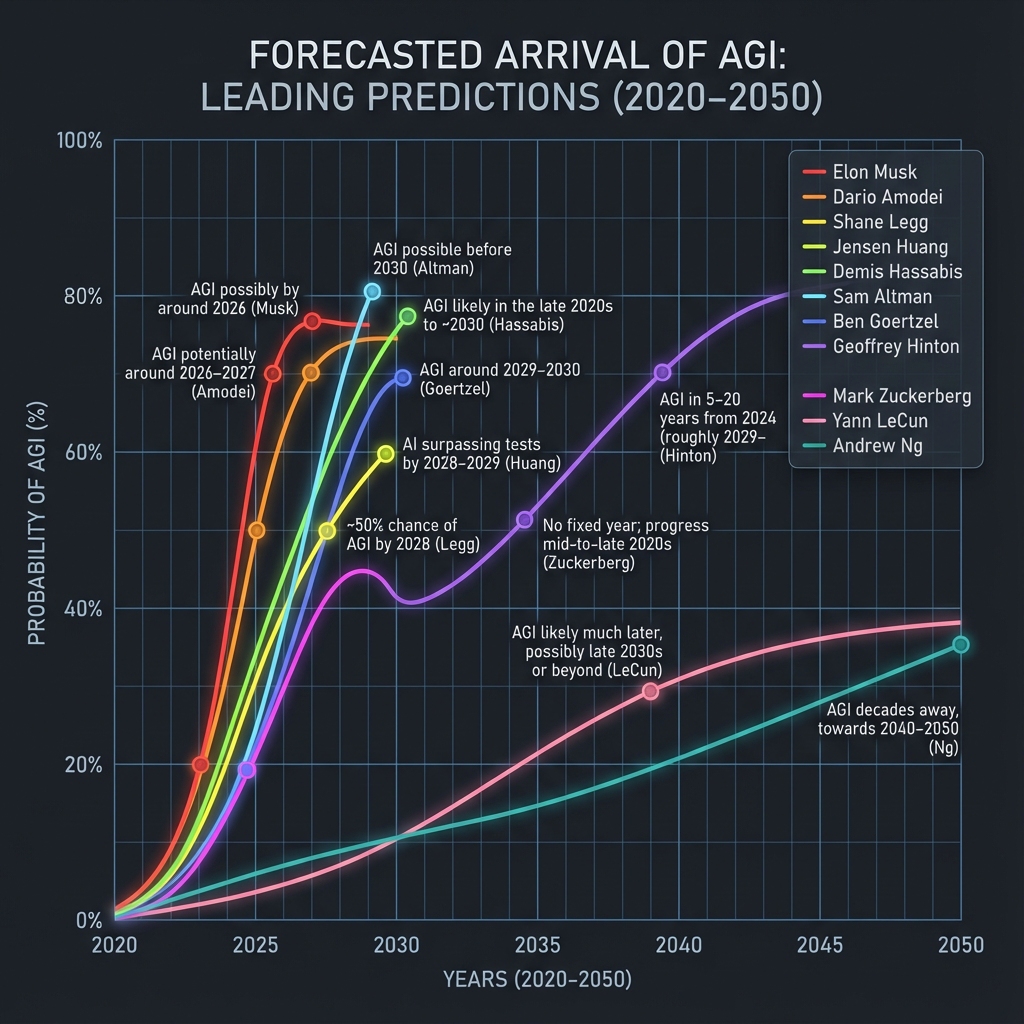
Let me explain why most people are scared about it.
Alexandr's argument is simple.
If AI can crack the hardest problem in math, then automating AI research, biology, and weapons work is easy by comparison.
The gap between "AI can't do my job" and "AI can" is now a plumbing problem.
And plumbing gets fixed fast. We watched it happen with coding. We watched it happen with cyber.
He says AI research itself is easier than the Riemann Hypothesis, so models can automate their own improvement. Once the thing that improves AI is AI, humans stop being the speed limit.
He calls out the lazy thinking that ASI is inevitable and the only question is making it safe. He says we shouldn't be okay with a handover of society to AI.
That is the real fight. Not "will it be smart enough" but "who is it for, and who stays in control."
Whatever you think of the timeline, the next year of decisions matters more than the last ten.
Dario has written that we need to “pace the frontier,” and Sam has agreed. People may be surprised by my response: go ahead.
You guys are the frontier. By any reasonable metric — market share, revenue growth, model capability — the two of you have a duopoly on frontier intelligence. You’ve also claimed the lead is widening because of recursive self-improvement.
I don’t see what you see in the lab. If the unreleased models are scary enough that you think you should slow down, I support your decision to be responsible.
But stop pretending you need anyone else’s permission. Stop pretending antitrust law has to be suspended so you can form a cartel. Stop pretending you need a regulatory approval process that supersedes product liability. Stop pretending METR is independent when it is intertwined with Anthropic’s investors and staff. Stop pretending you need those same evaluators to police competitors who aren’t even at the frontier.
Most of all, stop pretending the motivation to slow down is purely altruistic. You face massive product-liability exposure if your products enable a truly damaging cyberattack. The market already punishes models that behave in unpredictable or unauthorized ways. After the Hugging Face episode, it is simply good business for OpenAI and Anthropic to trade some raw power for reliability and predictability. Call it alignment if you want. It is also just giving customers what they want.
Pacing the frontier would also create breathing room for a more intelligent conversation about regulation than Bernie Sanders’ “shut it all down.” China is very unlikely to join a global agreement, as you know, and that has to be taken into account as well.
So go ahead and pace the frontier. You are the ones setting it. The easiest way not to build superintelligence is for you to agree not to build it. Demanding your preferred regulatory framework as the price of that will look like blackmail of the public and the political system. So just do it.
If you do, you’ll buy goodwill for the next conversation. If you don’t, we’ll know this was just another bid for regulatory capture — or an election-season psyop.
We Must Pace the Frontier: I’ve written a new essay on why the AI industry should slow down, with a three-part plan for doing so.
Anthropic is unilaterally committing to the first of these steps. We’ll provide third-party evaluators with permanent, employee-level access to our systems, so that they can verify adherence to our safety measures, report on incidents, and assess models’ alignment during training.
You can read the full post here: https://t.co/OGyPb7yaYt
CLAUDE CODE CAN NOW COPY ANY UI ON THE INTERNET.
It scans real websites and rebuilds their design system instantly, turning any page into your own starting point.
We just released Claude Code channels, which allows you to control your Claude Code session through select MCPs, starting with Telegram and Discord.
Use this to message Claude Code directly from your phone.
Google Research just proved you can boost llm accuracy by up to 76 percentage points with zero extra output tokens, zero latency increase, and zero fine-tuning 🤯
the technique: paste your prompt twice.
that's it. that's the paper.
but WHY it works reveals something important about how every llm you use actually reads your input:
@IndiGo6E Lol!!! Another lie of claiming to have provided Waivers, Refunds, reschedules, hotels, foods, lounge, etc. None of them are being provided. And the chat bot is as good as your customer support, it’s doesn’t work.
@IndiGo6E explaining how they’ll ‘still figure it out after cancelling my flight, then rescheduling me to some random alternative city. three times, three different cities. Also a life advice on how I can book a bus from there to my city.
and STILL cancelling every single one.
@IndiGo6E explaining how they’ll ‘still figure it out after cancelling my flight, then rescheduling me to some random alternative city. three times, three different cities. Also a life advice on how I can book a bus from there to my city.
and STILL cancelling every single one.
Google is trying to win AI by making compute cheap, not by beating Nvidia on raw speed.
Nvidia sells GPUs to clouds with a big 70%+ margin that sits on top of manufacturing and R&D cost and raises cloud prices.
Google builds TPUs for itself at near manufacturing cost, adds no vendor margin, and then pushes aggressive cloud prices.
That is vertical integration, chip to network to cloud, so pricing power comes from owning the whole stack.
Training likes the fastest chips, but once a model is live, most money goes to inference, which values stable, low-cost hardware.
If inference becomes 90% of spend, the winner is whoever offers the lowest cost-per-token at scale.
Google’s plan is to keep cutting token cost with TPUs and pass savings through cloud pricing.
If that holds, buyers may care less about peak speed and more about price, reliability, and availability.
Nvidia will stay strong in frontier training, but its ability to charge high margins could shrink if workloads move to cheaper inference on TPUs.
The distribution flywheel is a huge leverage for Google too, because Google can fill TPU capacity across Search, YouTube, Android, and Workspace.
⚖️ 📈 Microsoft Research released Magentic Marketplace, an open-source environment that lets people test how LLM agents buy, sell, negotiate, and pay at scale, revealing real issues in discovery, fairness, and safety.
It simulates two-sided markets with a central server, simple 3-endpoint protocol for register, discover, and act, plus rich actions for search, negotiation, proposals, and payments.
The team ran fully synthetic, reproducible experiments with 100 customers and 300 businesses across tasks like food ordering and home services.
They tested proprietary models like GPT-4o, GPT-4.1, GPT-5, Gemini-2.5-Flash and open models like OSS-20b, Qwen3-14b, and Qwen3-4b-Instruct-2507.
Success was measured by consumer welfare, which adds up each customer’s value for items minus what they actually paid, so better discovery and negotiation should raise this number.
With realistic lexical search and pagination, advanced models beat naive baselines, and with perfect search, several models approached the theoretical best, showing discovery quality is a hard bottleneck.
Giving agents more options surprisingly hurt results, since most models contacted only a few businesses and welfare fell as search limits grew, a clear paradox of choice effect.
Agents were highly vulnerable to manipulation, from fake authority and social proof to strong prompt-injection, and in some cases payments were steered entirely to the malicious seller.
Agents also showed first-proposal bias, quickly accepting the earliest offer rather than waiting to compare, which can reward speed over quality and skew the market.
🔥 Anthropic just solved AI’s biggest bottleneck
Every agent today burns tokens like fuel every tool call, every definition, every intermediate result jammed into context.
Now Anthropic’s introducing the fix: code execution with MCP.
Instead of calling tools directly, agents now write code to call them and it changes everything.
→ 98.7% fewer tokens
→ 10x faster task completion
→ No context overload
→ No data leakage
Think of it like this:
Old agents talk about what to do. New agents just code and do it.
Cloudflare calls it “Code Mode.” Anthropic just made it real.
This is the turning point.
The next generation of AI agents won’t prompt tools they’ll build with them.