Austrian economics. Proof of Work. The purest delegation of power is to individuals in a free market. Mindfulness, health, & presence #Bitcoin#UASF#NO2X#LN⚡️
Good evening.
Today, the US Treasury announced expanded buybacks of long term debt, the US National Debt surpassed $40 trillion, and Bitcoin rallied $5,400 to touch $70,000. And yes, all three events are related.
Have a great night.
THE SOVEREIGN REVOLUTION
I believe Bitcoin is the beginning of the Sixth Technological Revolution in the framework of @pmarca's favorite economist, @CarlotaPrzPerez.
Tell me why I'm wrong!
You are bored because you are not doing side quests.
Life is not just work and lying in bed doing nothing.
Here are 50 side quests every man should complete:
I particularily like this 2/2 setup. You keep multiple copies of each key.
You give the second key and only the second key to multiple second parties: your accountant, your wife. There is no risk of collusion.
On death, your copy of your first key is accessible in a safe deposit box, you wife can get it and unlock funds.
Assessing the risk: ChatGPT
--------------------------------------------------------
- My best estimate: 0.05%, or approximately 1 chance in 2,000, that Ledger has a serious, currently undiscovered entropy defect comparable to the Coldcard issue.
- For Trezor, my estimate is 0.02%, or approximately 1 chance in 5,000, of a serious undiscovered entropy defect comparable to Coldcard.
- For a 2-of-2 multisig using independently generated seeds—one Trezor and one Ledger—my estimate of a Coldcard-type entropy failure compromising both is approximately:
0.00001% — about 1 chance in 10 million.
The great lie is that society is divided between rich and poor.
The great truth, as David Friedberg puts it, is makers vs takers.
Makers build, create, and deliver real value: houses, software, art, businesses, and everything that moves civilization forward.
Takers watch, criticize, analyze, and politic. They push the lie that the rich hoard unfairly so the poor must seize it… all while positioning themselves to rule the chaos.
As @friedberg tells his kids: “At the end of the day, if you made something and someone else valued it, you were a maker. That was an amazing achievement. That is a great day.”
Takers thrive on division. Makers drive progress.
Time to choose your side.
US interest expense on public debt just crossed $1.27 trillion over the last 12 months. It took 73 years to 109x that number from 1947 to 2019. It has more than doubled in the six years since.
The 30-year treasury just cleared 5% for the first time since 2007. Japan's 20-year bond hit its highest yield since 1997. This isn't an isolated move. This is a global repricing of sovereign debt risk happening in real time.
The doom loop is simple: higher rates mean higher interest expense, which means more borrowing, which means more supply, which pushes rates higher. At this pace, interest on the debt will surpass Social Security as the largest line item in the federal budget. The US government will spend more servicing past borrowing than on the retirement safety net for 70 million Americans.
Global money supply just crossed $121.9 trillion, up $17.1 trillion in two years, growing at 7-8% annually. Central banks are trapped between inflation that won't die and debt loads that require low rates to service. Cut rates and you pour gasoline on the inflation fire. Hold or hike and the interest expense spiral accelerates. There is no clean exit.
The inflation side is getting worse. Electricity prices up 50% in five years. PPI leading CPI higher. Data center construction at $50 billion annualized, up 437% since 2021, now exceeding office construction. The Informationist's CPI overlay tracks the 1970s pattern with a 0.93 correlation. April 2026 CPI sits at 3.78%, right at the inflection point where inflation re-accelerated before peaking near 14%. The Fed declared victory prematurely then, too.
Meanwhile the S&P 500 just set a record for the most components hitting new 52-week lows on a day the index poked above its prior all-time closing high. The six-week rally is the biggest since QE1, concentrated in a handful of AI and infrastructure names. The index is a mask. Underneath it, the average company is deteriorating.
Twenty-one million against all of it.
He also said Real Estate is a bad investment.
What type of world do we live in if we don’t invest and improve the properties that we live in and occupy?
Dalio finds no value for the current and future generations to go restaurants, airports, hotels, and live in a homes?
His take is objectionably wrong. We must always invest in our communities and physical places we occupy.
(also GP’s make IRR’s 50%+, so math…)
@PeterLBrandt Looks more like an Elf Shoe pattern to me. Old man Jenkins wrote about this pattern from his hob-knobery up on lone mountain in 1912 before the war broke out. About as fundamental as your analysis. On par.
A powerful scene in the Odyssey happens when Odysseus finally returns to Ithaca after twenty years of war and wandering.
You would expect the story to end with celebration, with the hero coming home, the family reunited, and order restored.
Homer does something far stranger.
Odysseus arrives disguised as a beggar, because Athena warns him that the palace has been taken over by more than a hundred suitors who have been living there for years, eating his food, drinking his wine, and pressuring his wife Penelope to marry one of them.
They believe Odysseus is dead and in their minds the kingdom is already theirs.
So the king of Ithaca walks through his own halls dressed in rags while the men stealing his house sit comfortably at his tables. They mock him, throw scraps at him, and one of them even strikes him, and Odysseus takes it. That is the remarkable part, because the same man who blinded the Cyclops and survived twenty years of disasters now stands quietly while strangers insult him in his own home. Homer tells us his heart burns inside his chest and that he wants to attack them immediately, yet he restrains himself and waits.
Instead of striking, Odysseus studies the room carefully. He counts the men, watches their habits, and quietly observes which servants remain loyal and which have betrayed him. The hero of the Odyssey does something most people cannot do, which is delay revenge until the moment is right.
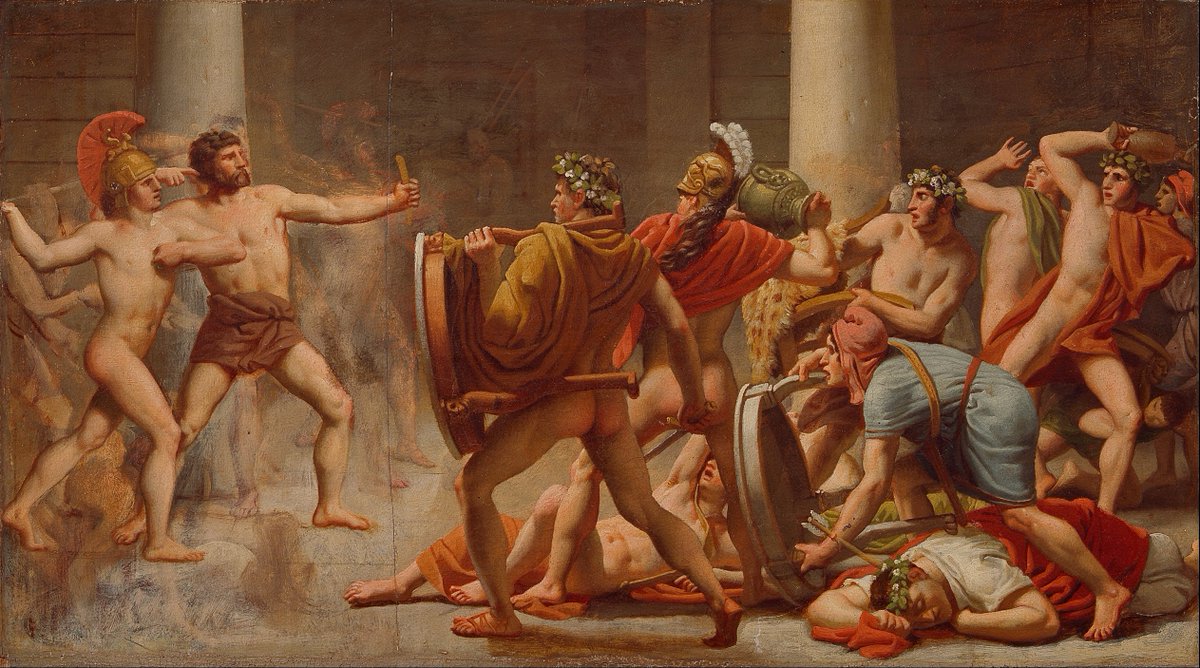
Eventually Penelope announces a contest and brings out Odysseus’ great bow, declaring that she will marry the man who can string it and shoot an arrow through twelve axe heads lined up in a row. One by one the suitors try and fail, because none of them can even bend the bow. Then the beggar asks for a turn. The suitors laugh at first, but the bow is eventually handed to him.
Odysseus takes it in his hands and strings it effortlessly. Homer says the sound of the bowstring tightening rings through the hall like the note of a swallow. Then he places an arrow on the string and sends it cleanly through all twelve axe heads.
In that moment the beggar disappears. Odysseus turns the bow toward the suitors and reveals who he is.
What follows is one of the most brutal scenes in Greek literature. The doors are sealed and the suitors realize too late that they are trapped inside the hall. Odysseus, his son Telemachus, and two loyal servants begin killing them one by one. There is no escape, no mercy, and no negotiation. The men who spent years consuming another man’s house die inside it.
It is a violent ending, but Homer wants you to understand something important. The real danger to Odysseus was never just the monsters and storms on the long journey home. It was the possibility that someone else might take his place while he was gone. When Odysseus finally returns, he reminds everyone in Ithaca of a simple truth: a man’s home is not truly his unless he is willing to fight for it.