Black Friday, then Black Friday week, then Black Weeks. Black Friday month next?
We don't need longer sales. We need sound money, where better tech means lower prices all year.
@anitaonl@TheBlueMatt@MattAhlborg accepting bitcoin hasn't been enough because the people who benefit aren't the ones who choose.
the merchant gets lower fees and no chargebacks, and the customer gets no rewards and a QR code to scan. sharing some of those savings back in bitcoin puts both on the same side.
Saifedean says houses got cheaper in hours of labor for thousands of years, until the shift to inflationary money around 1914. When people can't save in money, they save in their house. Sound money would let real estate be the consumption good it is. https://t.co/SXObhY7TAD
WHY CAN YOUNG PEOPLE NO LONGER AFFORD HOUSES?
Saifedean Ammous says housing got cheaper for thousands of years, until around 1914
"If you look at the data for thousands of years, the cost of houses in terms of labor has been going down. And then that reverses around 1914, because we shift to an inflationary currency."
"But when people can't use money as saving, what are they going to do? They're going to use their house as saving."
From his @DohaDebates debate with two MMT economists. Full episode: @saifedean
⚠️ Binance calls this an iOS-level issue that can reach any app's files on the phone. Apple has released iOS 27.2.1 and 26.7.3 as security updates, newer than every version listed here. If you keep a bitcoin wallet on your phone, update iOS today.
A vulnerability (worse_query) affecting iOS 26.7.1, 27.0.1, and 27.2 allows malicious apps to read local files from other apps, putting seed phrases, private keys, and login credentials at risk across the entire ecosystem. This is an iOS-level issue, not unique to Binance.
Immediate Action Required:
- Delete any apps installed from untrusted sources (such as sideloaded or manually signed IPAs).
- Update iOS and all apps to the latest official versions.
- If you suspect a breach, transfer funds to a new wallet created on a clean device and reset all active login sessions.
Never install unauthorized packages, and keep your software up to date.
@elonmusk@DogecoinNorway The Lego order Grok Bot placed for you could have earned a store commission. Shoppers sent by AI bring stores 53% more revenue per visit (Adobe, via a16z), and stores already pay for that traffic. Every purchase an agent makes can help pay for the agent, with sats-back on top.
In 1976 Diffie and Hellman proved two strangers could agree on a secret over a wire anyone could read. Public-key cryptography was born that day, and with it the possibility of a key only you control.
WHAT THE BINANCE HACK TEACHES YOU:
1. Bitcoin on an exchange is a promise the exchange makes to you.
2. That promise can be paused overnight, for every customer at once.
3. Bitcoin is not crypto. Issuers froze about $2.8 billion of the stolen stablecoins within hours. The 18,270 stolen bitcoin are still gone.
4. No one can freeze the bitcoin in your own wallet, and no one can bring it back.
Investigation update: Our initial investigation suggested that the security incident may have involved a compromised laptop, however our subsequent investigation has uncovered additional points of breach.
This was a complex attack, and we are doing all we can in coordination with law enforcement to resolve it. We are still gathering the facts, and will share more directly as we have them.
Binance will cover all losses from the SAFU fund and the company’s funds. User funds are safe.
We are still on track towards the expected timeline to resume the withdrawal service in 45 hours. Deposits remain unaffected.
The outflows ceased when we paused withdrawal service earlier. We are still working with partners to freeze many of the impacted assets, and have frozen around $3 billion thus far.
We will continue to provide further updates through official Binance channels as more verified information becomes available.
@TFTC21 holding and spending can grow together.
daily use needs a reason to choose bitcoin at checkout, and rewarding the person who pays gives them one.
Bitcoin payments have a chicken-and-egg problem. 🐣
Shoppers need a reason to pay in bitcoin, and merchants need shoppers who already do.
Card networks broke that loop decades ago by rewarding customers at checkout. Lightning’s much lower fees leave room to do the same.
.@jack thinks bitcoin payment adoption isn’t where it should be. We want your ideas on how @Blocks, Spiral, and you can increase adoption within 5 years. Our trajectory needs changing. Here’s more on our thinking. Now we want yours: https://t.co/aY5yimjdgi https://t.co/TItzNkSYBz
@theswansjr For most people the problem shows up at checkout first. Same groceries, bigger number, every year.
Bitcoin is the first money where that number can go down.
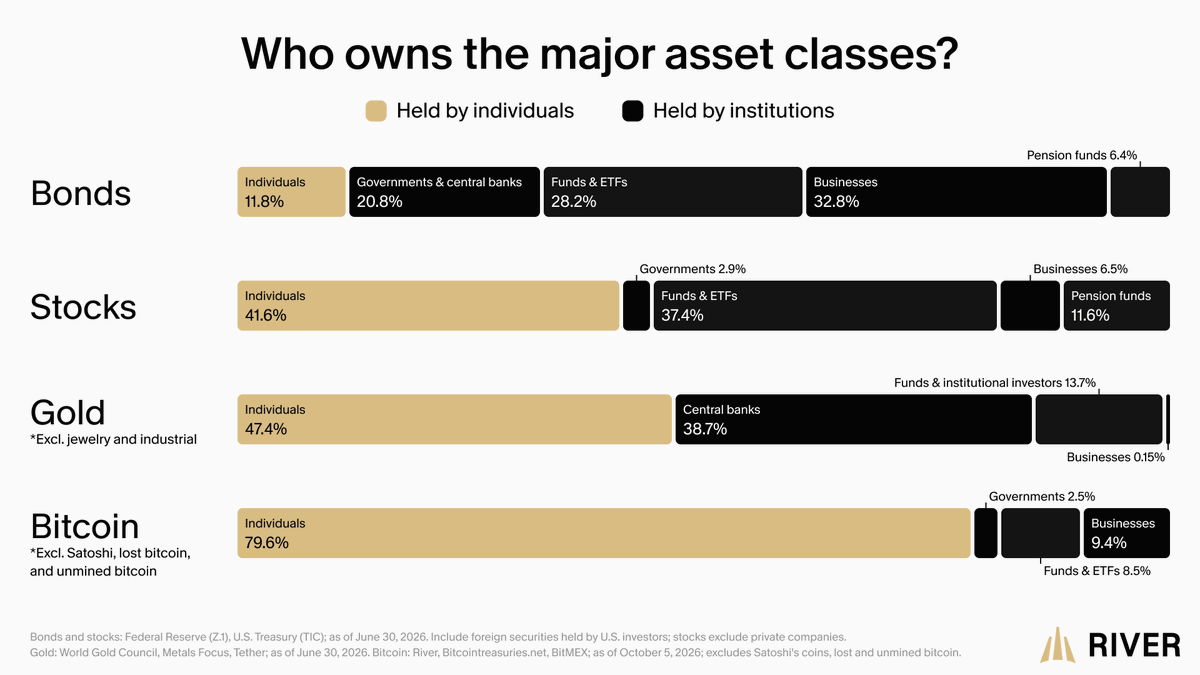
Bitcoin being held mostly by individuals is great. But in 2025, institutions accumulated 829,000 BTC while individuals sold 696,000 (River).
Gold went this way too. In 1933 Americans were ordered to hand theirs in, and paper contracts have set its price for decades.
Bitcoin in your own wallet can't be captured. Bitcoin in an ETF already is.
Bitcoin is the only major asset class primarily held by individuals.
Bonds, stocks, and gold have existed for centuries. So naturally they are more institutionalized.
As bitcoin matures, we expect ownership to shift towards institutions. Its ownership distribution will look more similar to gold.
This is not necessarily a good or bad thing. It is simply the inevitable consequence of global adoption.
@BitcoinMagazine@watchbmtv@GraceRemiTV@realseanhagan Buying bitcoin in your banking app is a fine first step.
But bitcoin isn't just another line next to your stocks. It's money, and it works best in your own wallet, where you can save it and spend it without asking anyone.
Banks still settle your card swipes with overnight batch jobs in decades-old code.
Bitcoin settles in seconds over Lightning.
Money is competing again, and the old rails are showing their age and fragility.
“COBOL is still deeply load-bearing in banking, especially at the core: account ledgers, overnight batch processing, and card/ATM authorization. The widely cited estimates are that roughly 43% of banking systems and 95% of ATM swipes run on COBOL code, and that around 80% of in-person banking transactions pass through it.”
@Hodlstay It's an incentive problem. The merchant gets the benefits of Bitcoin payments, lower fees and instant settlement, but the customer chooses how to pay and gets nothing for picking Bitcoin. Share some of those savings with the customer and the checkout changes.