Hành trình build X còn dài lắm. Không phải ngày một ngày hai là có kết quả, mà là từng ngày kiên trì, từng bài viết, từng lần đăng rồi lại chờ… đôi khi chẳng có tương tác nào. Nhưng vẫn phải đi tiếp.
Buổi sáng là công nhân ở công ty, làm việc theo guồng quay quen thuộc. Tối về lại mở X, trở thành “bác nông dân” cày content, gieo từng bài post, hy vọng một ngày nào đó sẽ “nảy mầm”.
Có lúc cũng tự hỏi: mình đang làm vì cái gì? Nhưng rồi lại nghĩ, đã bắt đầu thì phải đi cho tới. Xây dựng một thứ gì đó cho riêng mình chưa bao giờ là dễ, nhưng biết đâu một ngày nhìn lại, mình sẽ thấy những ngày mệt mỏi này lại đáng giá nhất.
The Pause Button is LIVE on Axis Hub .
A small update, but a very useful one.
Axis just introduced the Pause Button, giving us more control over simulations.
🟢 Pre-training
Pause after every move and take your time to think before making the next action.
🟢 Post-training
Each takeover is limited to 8 steps, so Pause helps you plan your moves without wasting your intervention budget.
For me, this is more than just a convenience feature.
It makes the simulation feel more strategic — observe → think → act → repeat.
Less rushing.
More control.
Better decisions.
Axis keeps improving the Hub based on how users actually interact with the simulation.
Curious to see what other improvements are coming next.
Keep training. Keep ẽexprimenting
@axisrobotics@KaitoAI
New Axis System
The old point system is ending — and a new contribution system is coming next week.
X → Y → Z is no longer just about collecting points. It’s about real contribution.
⚡ X-Axis: 200+ trajectories
⚡ Y-Axis: 600+ trajectories
⚡ Z-Axis: 1,000+ trajectories + Lead nomination
But trajectories are only the foundation.
Helping new users, sharing useful tips, giving feedback, joining community events, and creating valuable content — that’s what will matter.
I’m ready for the next chapter.
Let’s contribute. Let’s build.
X → Y → Z.
@axisrobotics@KaitoAI
Physical AI won't scale without a scalable data engine.
What I find interesting about @axisrobotics is the focus on the problem behind the models: robot training data.
Robots need huge amounts of diverse trajectories to learn different objects, environments, movements and tasks.
Axis approaches this through browser-based simulation, distributed human-in-the-loop data collection and a processing pipeline designed to turn raw interactions into training-ready data.
The important part is not simply generating more trajectories.
It's building a continuous loop:
Collect → Validate → Process → Train → Deploy → Improve
That's the infrastructure layer I think will matter as Physical AI moves from demos toward real-world deployment.
I'm currently following Axis closely through the Kaito campaign, and I'm especially interested in seeing how this data engine evolves from here.
@axisrobotics@KaitoAI
#AxisRobotics #PhysicalAI #Robotics #AI #Kaito
Data is becoming the most valuable resource in the AI era.
Everyone is focused on models, but models are only as good as the data they can access.
The challenge isn't just storing data anymore.
The challenge is making data available, readable, and usable at scale for AI agents, applications, and developers.
That's one reason why Shelby stands out to me.
Instead of chasing short-term narratives, Shelby is building the infrastructure layer that helps data move from storage to real-world utility.
The transition from testnet to production is an important step.
Now it's time to see how the infrastructure performs under real workloads and real demand.
Watching closely.
@shelbyserves
Key takeaway from Axis Sim Dataset V1: Given sufficiently large and diverse in-the-wild data, behavioral cloning converges toward a robust policy — even when individual demonstrations are noisy.
Real-world impact: 50K+ community-driven trajectories from Axis Hub lifted π0.5 on LIBERO-Plus from 83.9% to 88.8%.
Read the full blog post here:
https://t.co/e5lCyoJHG0
@axisrobotics
We wrote a blog about our key finding from Axis Sim Dataset V1: given sufficiently large and diverse, in-the-wild data, behavioral cloning converges toward a robust policy — even when individual demonstrations are noisy.
Think of it like many people pulling a heavy load with ropes. Each person pulls at a slightly different angle, but everyone pulls forward.
When there are enough people and the goal is shared, the sideways forces weaken each other while the forward forces add up, and the load moves steadily forward.
Every valid trajectory works the same way. It mixes the actions that complete the task with the operator's own deviations — jitter, hesitation, suboptimal paths.
These deviations aren't systematic; they point in different directions and weaken each other at scale. The task-completing actions, all pointing the same way, get reinforced.
We validated this in our paper. 50K+ community-driven trajectories from Axis Hub lifted π0.5 on LIBERO-Plus from 83.9% to 88.8%.
The point isn't how clean each trajectory is — it's how broad the distribution is.
Base capability comes from scale; the last mile comes from DAgger — the community continuously correcting the gaps the model reveals. And that's what Axis V2 is about.
Read the full blog: https://t.co/ujK1AVLotV
WE HAVE RAISED 10M
at a $100 million valuation
our partner NextGenIVF Group Limited, a NASDAQ listed company had exercised the option to increase their stake to 10%.
this is an additional 4m investment into us!!!
the pre-a round is now closed, where we are now moving onto our series A fundraising.
k25 is building the largest livestream x esports platform, where we incorporate prediction market mechanisms
good things are coming.
follow our socials and join our community to receive first hand news
Feedback – Task/Image Mismatch Issue
I want to report a very frustrating issue with the task images.
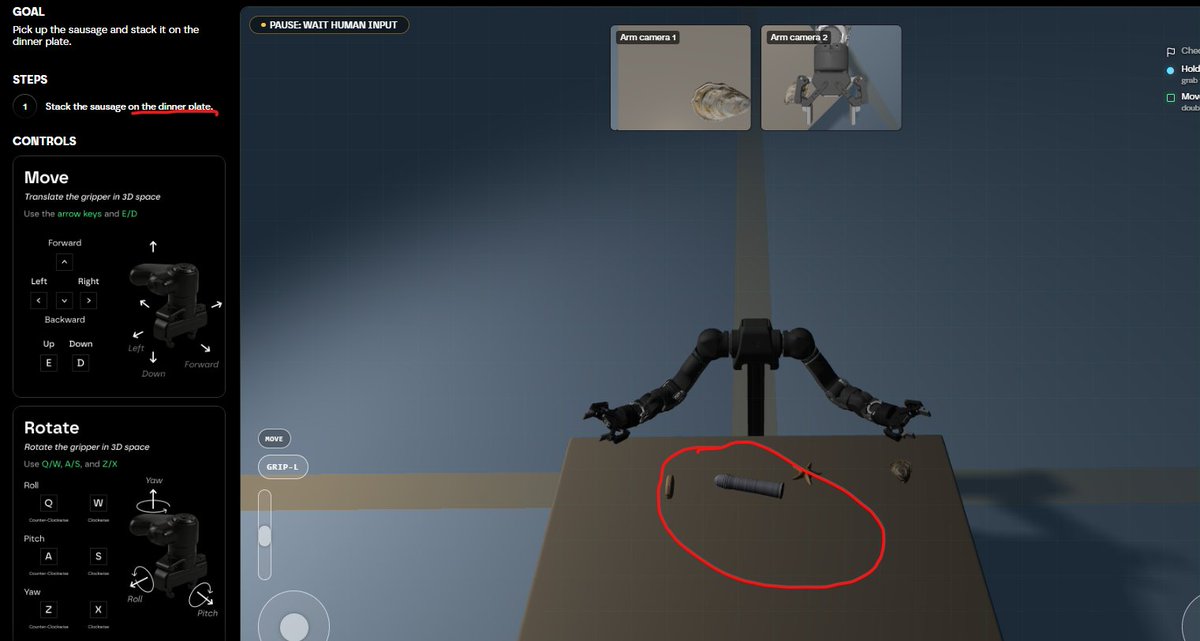
In the attached example, the task clearly says:
GOAL: Pick up the sausage and stack it on the dinner plate.
STEP: Stack the sausage on the dinner plate.
However, in the actual image, the dinner plate mentioned in the task is not clearly visible. Instead, completely different objects are displayed on the table.
This is not the first time I’ve encountered this issue. The same type of task/image mismatch has been happening repeatedly for several days.
This is extremely frustrating because we are trying to follow the instructions correctly, but the image does not match the task requirements. We have to constantly press F5 to reload and check the images, sometimes wasting a significant amount of time just waiting for a task to display correctly. This directly affects our task completion efficiency and makes the overall experience very frustrating.
Please investigate the image generation and assignment system and make sure that the objects described in each task actually appear correctly in the corresponding scene.
We want to complete the tasks accurately, but to do that, the system needs to provide accurate and consistent images.
This issue has happened repeatedly and really needs to be fixed.
@axisrobotics@plpiaoliang
The next AI breakthrough may not come from a smarter model.
It may come from better access to data.
AI agents need more than intelligence. They need reliable data they can access quickly and use when making decisions.
That's why data infrastructure matters.
Shelby is building toward a world where AI and Web3 applications can work with data that is fast, accessible and ready for real workloads.
Early Access was about testing the foundation.
The next phase is about putting that foundation to work.
Better models + better data infrastructure = smarter applications.
Watching Shelby closely.
@shelbyserves
AI agents are getting smarter.
But intelligence alone isn't enough.
An AI agent needs access to the right data, at the right time, with the right permissions.
That's why I'm watching Shelby closely.
Shelby is building infrastructure around a simple but important idea: data should be fast, accessible and ready for applications to use.
From AI agents to real-time Web3 apps, the demand for high-performance data infrastructure will only grow.
The next phase isn't about proving the idea anymore.
It's about seeing what happens when real workloads meet Shelby.
@shelbyserves
The more I learn about Shelby, the more I see it as more than just storage.
AI agents, real-time apps and Web3 products all have one thing in common:
They need data to be fast, available and usable.
Storing data is one problem.
Making that data accessible when applications actually need it is another.
That's where Shelby gets interesting.
Early Access was about testing the infrastructure. Now the focus is shifting toward real workloads, real builders and real usage.
Less hype. More execution.
That's the phase I'm most excited to watch.
@shelbyserves
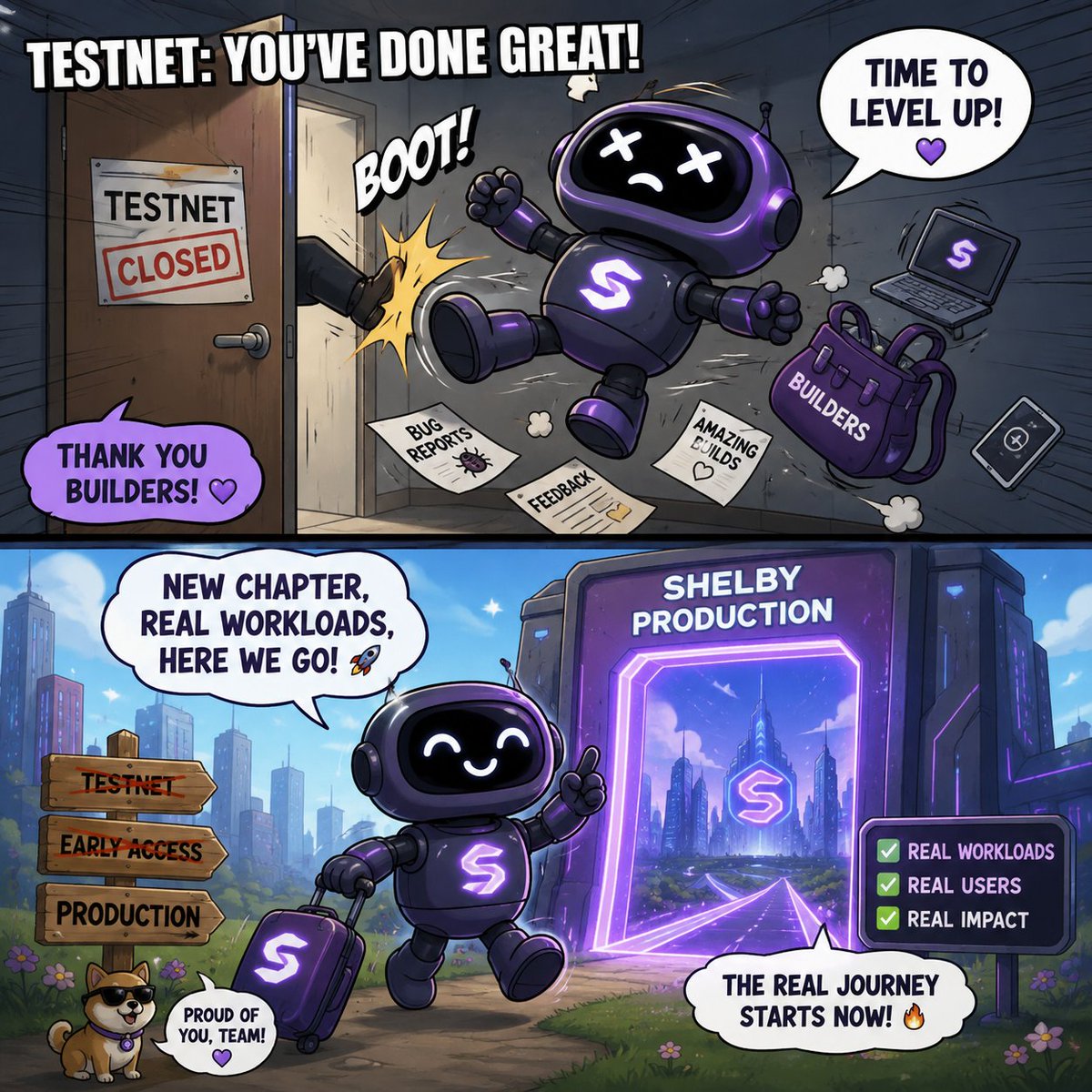
Shelby is entering a new chapter.
Early Access has done its job. After months of builder feedback and stress testing, the testnet is graduating and Shelby is moving toward a private production environment with real workloads.
This isn't the end—it's a transition from proving the protocol to using it in production.
Congrats to everyone who helped shape Shelby from day one. Looking forward to seeing what teams build next as the network gets closer to decentralized deployment.
The real journey starts now.
@shelbyserves