@KeystoneWallet I was also thinking of the name "keycraft". Going with a love craft kind of vibe and then I remember the reapers from Mass Effect had that look to them and one of them was named Sovereign. And that also fit the self-sovereign idea in crypto too.
🚨 WHEN FEELINGS KILL COMMON SENSE
Being nice isn’t bad... until it breaks your country.
Some people care so much about everyone’s feelings, they forget about facts, safety, and their own neighbors.
This is called suicidal empathy. Basically, being so compassionate it turns self-destructive. Sounds wild, but it’s real.
Gad Saad says we’re overloaded with emotion, treating every stranger like family, even criminals or enemies, because it feels good.
But feelings aren’t policies, and this kind of kindness is backfiring hard.
Take U.S. borders: in 2023, a record 2.5 million illegal crossings swamped the system.
It’s not just overcrowding. Over 15,000 non-citizens were arrested for serious crimes in one year.
Fentanyl smuggling? Also up. And guess what? Those costs hit taxpayers: $150 billion a year, enough to help veterans or disaster victims.
But sure, let's keep pretending open borders are just "nice."
Then there's the “defund the police” mess. Meant to help communities, it led to fewer arrests and way more murders. A 70% jump in Minneapolis alone.
The people hurt most? The same communities it claimed to protect.
Bonus chaos: in the UK, people got arrested for tweets. That’s where feelings-over-facts leads.
DEI programs? Started with good intentions. Now they’re breaking schools and jobs.
A Forbes study said they mostly help rich elites, not everyday people. Harvard’s diversity policies even lowered team performance by 12%.
In companies, DEI training actually made bias worse. All because we’re scared to say, “Let’s hire the best person.”
It gets worse. All this empathy-for-everyone has made people stop trusting each other... down 20% since 2000.
This isn’t about being heartless. It’s about using your brain with your heart.
It's called “reasoned empathy,” where compassion meets common sense.
Help people, yes... but stop lighting your own house on fire to keep others warm.
Source: @GadSaad, @elonmusk, Gonsalves, G, Kiskin K, Heritage, RAND, NYP, @Grok Imagine
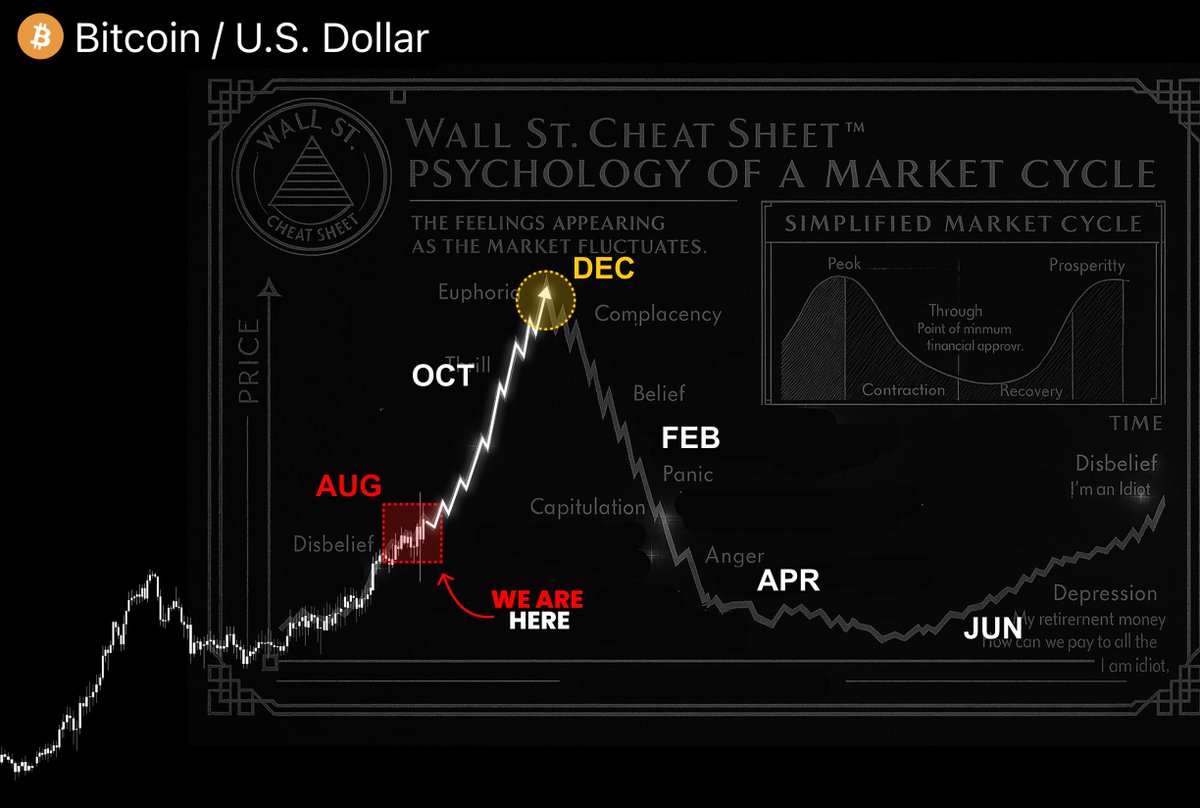
Looks like there’s a coordinated effort to get you to sell all your crypto with a bunch of crypto influencers posting the same exact message that they sold all their crypto 👇
Please repost and like so everyone sees this 🙏
I AM ABOUT TO WALK INTO THE MOST ABUNDANT BALANCED WEALTHY AND SUCCESSFUL PERIOD OF MY LIFE. I NATURALLY ATTRACT GOOD FORTUNE, AND I AM WEALTHY IN MORE WAYS THAN ONE. I GIVE MYSELF PERMISSION TO PROSPER, AND I HAVE THE POWER TO BUILD THE LIFE THAT I DESIRE.
777
Now is the most obvious bullish setup I've seen:
- $BTC is at ATH
- $ETH/BTC is pumping
- Dominance is crashing
Last cycle I turned $4.7k in $2.1M with one strategy
Here's when Altszn starts, how to prepare and make ur first MILLION 🧵👇
@rektfencer@grok Turning ETH into millions is an incredible achievement! It really shows the power of vision and persistence in crypto. I’d be honored to win. Your generosity is what makes this community thrive—thank you for giving back
This tweet will disappear in 24h
After that, you won’t see it again
Interact now, because once it’s gone, the opportunity is gone with it
Must be following
$KTA.X vs $XRP.X
Keeta is modular, programmable infrastructure. XRP was built for static interbank messaging.
1. WASM Smart Contracts vs No Native Smart Contracts
Keeta supports WebAssembly-based smart contracts that allow developers to build scalable apps in multiple languages like Rust and C++. XRP Ledger lacks native smart contract capabilities; it uses basic transaction types tailored to IOU transfers and payments, with limited programmability.
2. 14M+ TPS vs 1,500 TPS
Keeta has demonstrated over 14 million verified transfers per second through parallel execution across Anchors. XRP claims 1,500 TPS for simple ledger operations, but its throughput is constrained by its consensus model and lack of programmable logic.
3. Modular Layer 1 Design vs Single-Layer Ledger
Keeta separates consensus, data availability, and execution across modular layers, enabling independent scaling and upgrade paths. XRP relies on a monolithic ledger design without separation of execution or availability layers.
4. Deterministic Finality vs UNL-Based Consensus
Keeta uses deterministic finality through Anchors with no probabilistic confirmation windows. XRP relies on a permissioned Unique Node List (UNL) for consensus, which, although fast, is not cryptographically final and is subject to validator selection biases.
5. Open Validator Selection vs Permissioned UNL
Keeta allows any staked participant to be elected as a validator via dPoS. XRP requires participants to run trusted nodes approved in the UNL, making it harder for new entities to participate in consensus.
6. Real-Time AI/Data Compute vs Simple Payments Network
Keeta is designed for decentralized compute, high-frequency data coordination, and real-time AI inference markets. XRP Ledger is optimized for fast token transfers, especially for interbank settlements and stablecoin issuance — not dynamic compute.
7. Anchor Infrastructure vs Static Ledger Model
Keeta uses Anchors to enable horizontal scalability across domains, where each Anchor can act as its own execution shard. XRP has no equivalent mechanism to partition load or scale smart contract execution.
8. Dynamic State Storage via KeetaDB vs Basic Ledger State
Keeta integrates KeetaDB, allowing high-performance, stateful applications. XRP’s state model is limited to balances and pre-defined object types, unsuitable for full dApp logic.
9. Developer Flexibility vs Ledger-Specific Constraints
Keeta supports familiar tooling and standard WASM environments, reducing the learning curve. XRP requires devs to conform to a niche ledger format with limited SDK support and a restricted transaction model.
10. Strategic Capital from Eric Schmidt vs Ripple Labs Control
Keeta secured $20M in funding from former Google CEO Eric Schmidt and operates as an open protocol. XRP Ledger is heavily shaped by Ripple Labs, which owns a significant portion of the token supply and controls key technical decisions.
11. Open, Transparent Governance vs Corporate-Centric Direction
Keeta uses community-based, stake-weighted governance. XRP’s protocol development is guided by Ripple, blurring the line between a decentralized ledger and a corporate platform.
12. Built for Internet-Native Infrastructure vs Financial Messaging Layer
Keeta is engineered for the next generation of decentralized internet applications: AI agents, edge compute, and real-time coordination. XRP was designed to replace SWIFT for interbank settlements and is less adaptable for modern infrastructure needs.
Potential ROI Comparison
Keeta is under $1B market cap. If it captures 5–10% of XRP’s $30B+ valuation, it could yield a 20–50x return. XRP may offer 1.5–3x upside due to its regulatory baggage and stalled ecosystem growth.
How to Buy Keeta
Use Base chain via Aerodrome or Uniswap. Supported wallets: Coinbase Wallet and Phantom.
Official Links
Website: https://t.co/pWjF75AHiB
Whitepaper: https://t.co/EebX4dwuDx
X: https://t.co/qcYdYGcUQK
Discord: https://t.co/95abfWWtfo