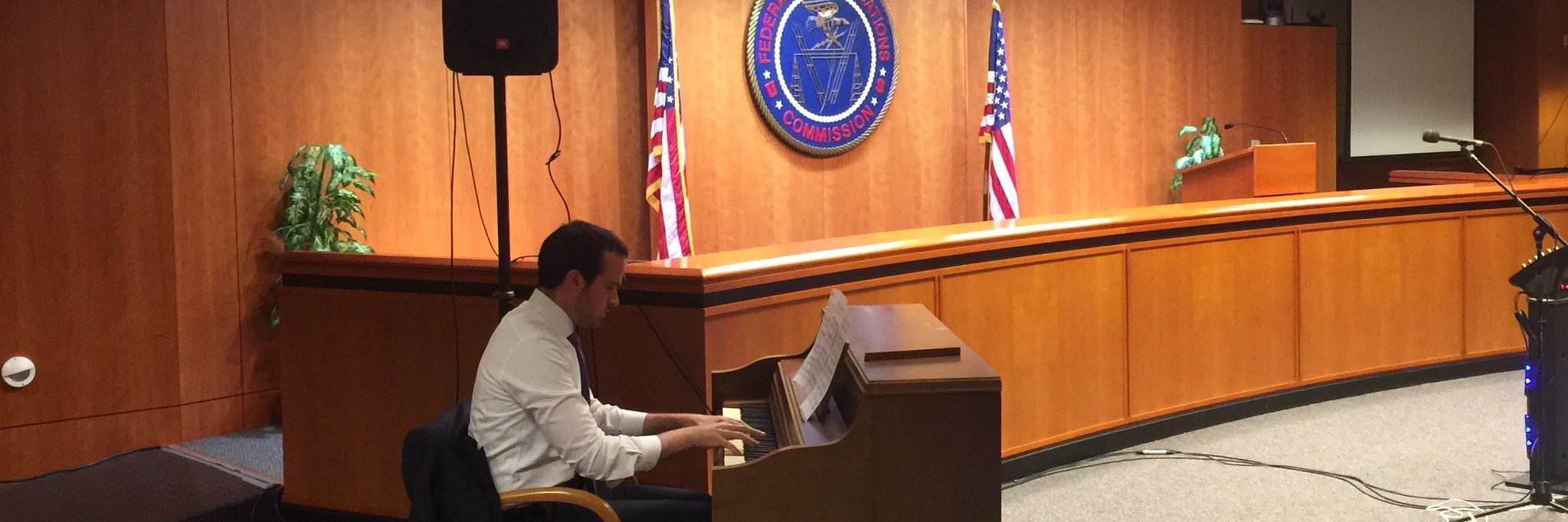
Full video of my Episode 1 interview with @BrendanCarrFCC.
We chat about:
✅American drone dominance
✅Foreign-made Wi-Fi routers
✅Future of satellite direct-to-device connectivity
✅Chinese equipment testing labs
✅The wireless workforce
Listen and subscribe👇
A few things we cover with @BrendanCarrFCC:
🎮Why all foreign-made drones are now on the FCC's covered list
📶 The foreign-made Wi-Fi router ban
🛰️ The $42B EchoStar deal and future of direct-to-device
🏗️ Tower-climber protections in merger reviews
https://t.co/4hqFGI4i1e
Apple's claims here are grossly misleading. The $1.4 trillion figure includes $1.1 trillion in what the company calls physical goods. Apple essentially wants a gold star for not taxing your Uber rides, DoorDash orders, and airplane tickets.
Reps @JayObernolte and @RepLoriTrahan deserve credit for a good-faith, bipartisan effort at national AI legislation. If we want more members of Congress to engage like this, we as citizens need to encoruage it. Hyperbolic reactions to a discussion draft have the opposite effect.
Agree with most of this but disagree on the preemption point, especially when reading the provision in tandem with subsequent rules of construction (c)(1)-(2). Together, it’s more likely that it only applies to laws attempting to govern pre-deployment designs or developments, which wouldn’t implicate many AI child regulations like AV or custodial account mandates.
This is positive as it shows a significant shift away from the “relates to” preemption in previous AI bills.
The point is well taken, and it could be further clarified by another rule of construction.
Keep in mind, this is a discussion draft (not the final product). Overall it’s a step in the right direction, even on the preemption side.
“We’re talking about the three Ps: permitting, poles, and private easements.”
@SayreEvan, @RCimerman, Deb Collier and Tim Lee join us to talk about the barriers surrounding the success of BEAD funding.
FDA recently authorized two American, flavored vapes.
Some senators want a reversal, but that would
would only fuel the black market dominated by illegal Chinese vapes.
👇In my latest op-ed, I argue legal alternatives are necessary to fight the flood of smuggling from China.
This is absolutely the right call. E-Rate has been subsidizing school connectivity for years, yet educational outcomes are on the decline.
Taxpayers deserve answers, and Carr is launching a review to get them.
Over the last few years—and especially during COVID—schools dramatically increased screen time for students.
But research is now pouring in showing that excessive screen time has been associated with poor academic performance, and we’ve seen a serious slide in reading and other basic skills along America’s students.
For its part, the FCC has been subsidizing connections to and within schools for three decades—spending roughly $3 billion annually today.
It is time to review the FCC’s program (known as E-Rate) to ensure great educational outcomes—not distractions or declining performance.
So today, I have announced that the FCC will vote this month on a proposal to conduct a thorough review of the agency’s program.
This aligns with a broader trend we are seeing in states, in Congress, and across the Administration to empower parents and address excessive screen time.
Private providers are investing $11 billion in matching funds for BEAD, far exceeding the 25% program minimum.
That's a lot of skin in the game, and it makes solving permitting and pole attachment issues all the more important.
Chinese authorities shape Apple's manufacturing decisions, how it governs user data, and deploys software.
"What distinguishes Apple is how its China exposure reaches into functions normally treated as settled questions of corporate control."
https://t.co/tgp4hrNkaF
Apple spent decades building one of the most sophisticated manufacturing ecosystems in the world, in China.
What once looked like the ultimate globalization success story is now a strategic liability.
Neither Washington nor Beijing sees Apple’s dependence on China as politically neutral anymore.
My new essay explores the trap this creates for Apple — and increasingly for corporate America more broadly.
https://t.co/U5UDqkJjat
Interesting piece on how the AI startups meant to disrupt Big Tech incumbents are dependent on those very same tech giants for investment, cloud services, and compute.
Given the potential antitrust implications, the FTC opened inquiries into "AI partnerships."
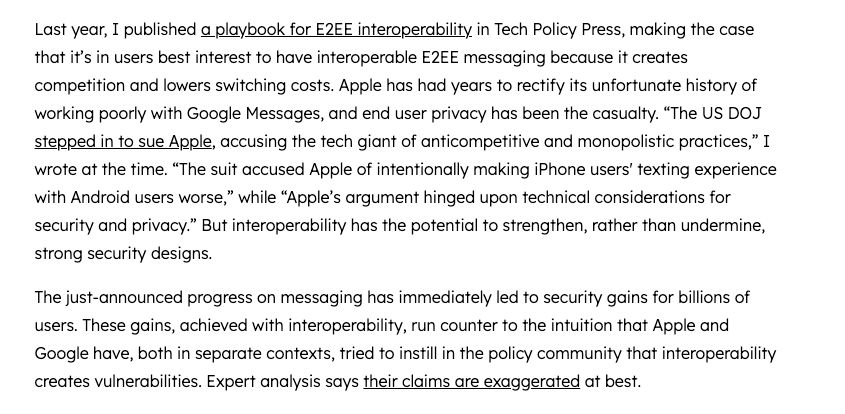
For years, Apple argued—wrongly—that interoperable messaging between iPhone and Android would undermine security.
As the DoJ alleges, Apple has intentionally made the iPhone-Android texting experience worse. Finally, in adopting RCS, security and the experience will improve.
In Virginia, a utility is apparently violating an FCC order by attempting to charge a broadband provider for pre-existing safety violations on utility poles.
As Michael Santorelli writes, the dispute could be a test case for how these issues get sorted nationally.