A big milestone for @RapteeEnergy ! ⚡
From building high-voltage EV technology in Chennai to securing ₹25 Cr in government investment, incredible progress!
Good to see @CatalystByZoho powering the cloud backend behind their EV technology.
Congratulations to the entire Raptee team! 🚀
See how they built it 👇
https://t.co/oDV4OQjrUr
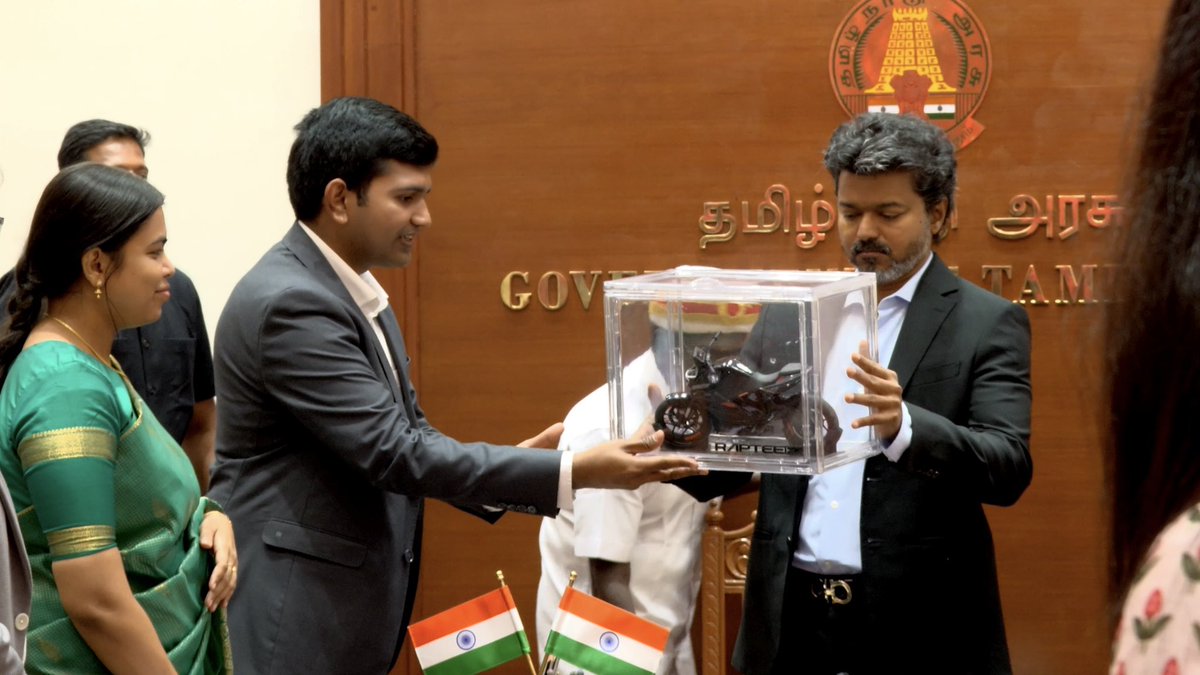
Pleased to join Hon’ble Chief Minister Thiru C. Joseph Vijay at the Secretariat for the inauguration of Raptee Energy’s first Mega Experiential Center on Old Mahabalipuram Road, Chennai, and to witness the ceremonial signing off of the company’s 100th motorcycle.
Founded by four engineers from Tamil Nadu, Raptee is building indigenous electric mobility technology. Its T30 is India’s first high-voltage electric motorcycle.
With TIDCO’s strategic investment, Raptee represents the growing ambition of Tamil Nadu’s home-grown deep-tech ecosystem.
From developing critical technologies to building manufacturing capabilities in Tamil Nadu, this is the kind of innovation-led growth we are committed to nurturing.
Wishing the entire Raptee team continued success as they take their journey forward!
#CMJosephVijay #TamilNadu
Everyone is chasing bigger and smarter AI models.
But what if the real bottleneck isn’t the model, but how well it understands your platform?
In our Catalyst experiments, a smaller model equipped with Agent Skills completed 92% of a full-stack development task, compared to 25% without platform context.
The next leap in AI coding might not come from better models alone, but from giving them the right context and tools.
Here’s what we learned 👇
https://t.co/Cwrc21bDr6
What I find most interesting is the shift happening in developer infrastructure itself.
A few years ago, the default was: pick a hyperscaler and assemble everything on top.
Now developers increasingly want a simpler stack - database, compute, storage, auth, AI and deployment working together from day one.
That’s the problem we’re trying to solve with Catalyst.
I don’t see Catalyst as an attempt to become another AWS or GCP.
For me, the more interesting goal is this: take the infrastructure Zoho has built over the years, open it up piece by piece, and make the overall developer experience feel much simpler than traditional cloud.
If developers can spend more time building and less time thinking about infrastructure, we’re moving in the right direction.
That’s very much the direction we’re thinking about.
We already have Catalyst QuickML capabilities like RAG and LLM Serving, and we’re making Catalyst easier to use from AI coding environments through integrations for Claude, Codex and other developer tools.
The next step is going beyond individual AI features - things like an AI Gateway and making more of the platform itself agent-ready.
My personal view:
If I were starting a company today, I wouldn’t begin by building my own infrastructure.
I’d use the cloud and spend my time building the product.
Owning infrastructure starts making sense when you reach a scale where cost, control, performance and long-term independence justify that investment.
Zoho could take this path because we were building for the long term and reached that scale over decades.
For most startups, the interesting question isn’t “build or cloud?” It’s how long you can keep infrastructure from becoming a distraction while still retaining enough control as you grow.
One thing I strongly agree with here is that cloud knowledge should not stop at learning product names and managed services.
The more developers understand what sits underneath - compute, networking, databases, runtimes, scheduling, observability - the better decisions they make even when using highly managed platforms.
That is also something we think about a lot with Catalyst. Abstract the operational complexity, but don’t take away the developer’s understanding or control.
A useful way to think about Catalyst:
Developers today often assemble their stack across multiple platforms.
Vercel for frontend, Supabase for backend and database, Render or Railway for compute, and other services for storage, cron jobs and observability.
Catalyst brings many of those application infrastructure capabilities together in one integrated platform.
Compute, databases, storage, authentication, APIs, caching, search, scheduled jobs, remote headless browser, LLM serving, event-driven workflows, frontend hosting and observability - all without having to stitch together a dozen different services.
And what we expose today is still only a subset of the infrastructure Zoho has built internally.
There’s a lot more we plan to bring to developers.
Catalyst by Zoho gives you:
▶️ Agent-ready full-stack cloud
▶️ Free collaborators
▶️ Free bandwidth
Take your application from local to live. Your entire workflow, simplified into one intuitive platform.
If you're a student, build and ship for free 👉 https://t.co/TfFAk0KCZv
#catalystbyzoho #catalyst3poin0 #agentready #fullstack #catalystforstudents #studentdevelopers #developers @Zoho
What India needs urgently is self-reliance when it comes to cloud hosting of indigenous applications. The work @svembu sir and team are doing is a phenomenal investment in that direction.
Most people may not even understand the significance of this work right now, because the results will be visible only in a few years.
This is the kind of investment Indian IT giants should have been doing for the last 10 years, and in that aspect, I am terribly disappointed with the top Indian IT service companies.
We’ve seen the value of that investment firsthand, @MVhandle. Our team recently took a customer’s order management system from workshops to go-live in three months on @CatalystByZoho, including testing and user training.
Having core services like authentication, storage and compute available gives us more time to work through the customer’s processes and get the application right.
The years of engineering @svembu describes give teams like ours a head start. The benefit reaches customers through faster delivery and more time spent on their specific requirements. That’s what excites us about building more customer solutions on Catalyst.
There’s one more thing about @CatalystByZoho that I want to make explicit:
We don’t charge for cloud ingress or egress.
If you’ve built and scaled applications on other cloud platforms, you probably know how significant those costs can become.
No bandwidth bill surprises. Your data comes in and goes out without an ingress/egress charge.
Sometimes the best pricing feature is the charge that simply doesn’t exist.
#IndianPaaS #NoEgressFee #Catalyst #Zoho #FreeForStudents
One of the early things we did at Zoho was build our own cloud infrastructure to run our applications. From databases, identity and messaging to search, storage and compute, we built it ourselves rather than depending on AWS or Google Cloud.
We have opened this infrastructure to developers as Catalyst, our serverless platform. What started as a way to extend Zoho is now being adopted by developers outside the Zoho ecosystem as well.
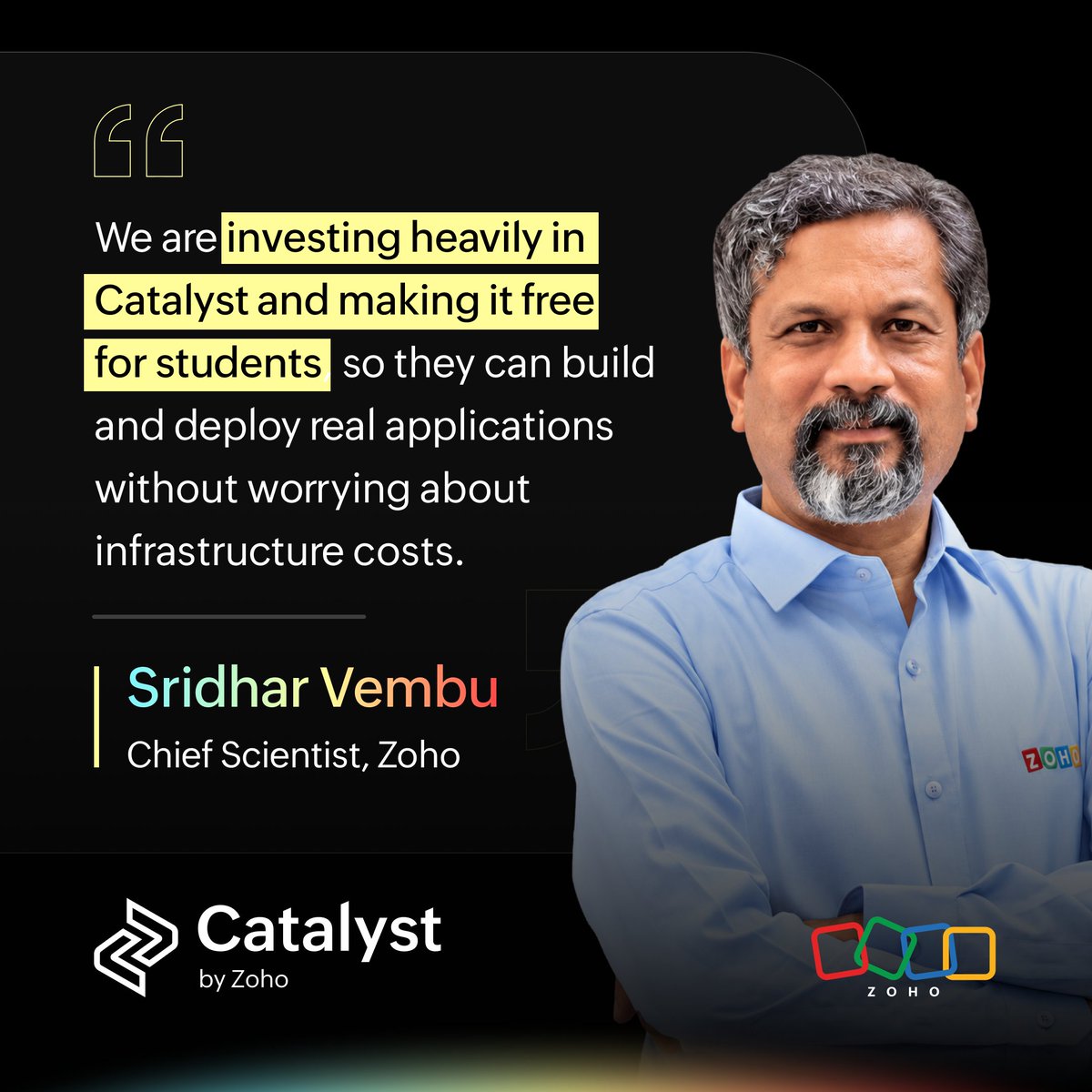
We are investing heavily in Catalyst and making it free for students, so they can build and deploy real applications without worrying about infrastructure costs.
Our goal is to give developers the infrastructure to turn their ideas into real products.
https://t.co/B3mBGZPc7S
this is going to be huge,
Zoho finally entered into the cloud game, what is mean for us, all the softwares are running in cloud and creating software is no longer an bottleneck, so i think Zoho is entered into hardware game....