After watching the sneak peak of Gunn's divisive version of Superman (https://t.co/3CwC5VTpT6), I'm curious whether the heroes we prefer on-screen help us understand our divisions as a society. Which Superman do you prefer, and which presidential candidate did you prefer in 2024?
After watching the sneak peak of Gunn's divisive version of Superman (https://t.co/3CwC5VTpT6), I'm curious whether the heroes we prefer on-screen help us understand our divisions as a society. Which Superman do you prefer, and which presidential candidate did you prefer in 2024?
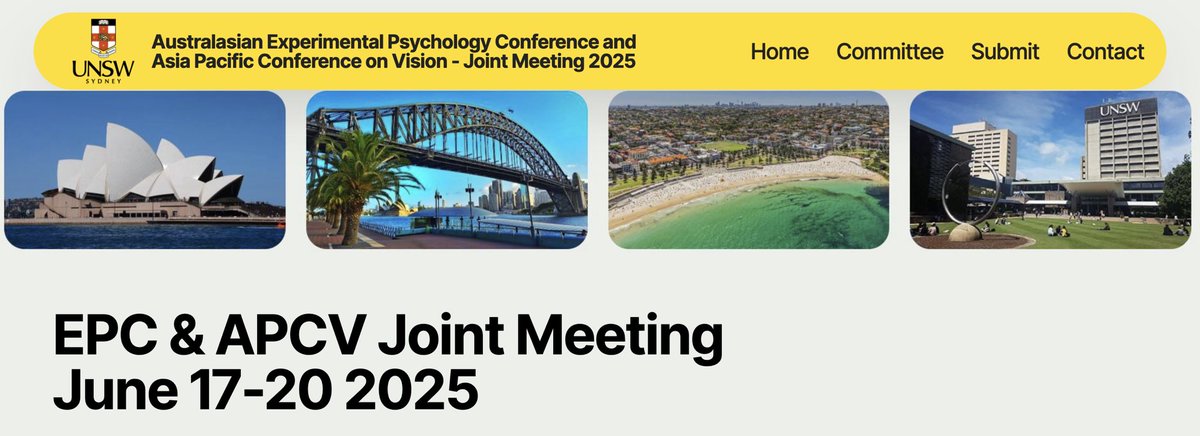
Hello, #psynom24! Come share your work in Australia. We’re holding the 2025 Australasian Experimental Psychology Conference in Sydney, jointly with the Asia-Pacific Conference on Vision. A week later, Human Brain Mapping (@OHBM) is in Brisbane. There's never been a better time!
The Australasian Experimental Psychology Conference (EPC) and Asia Pacific Conference on Vision (APCV) are holding a joint meeting in 2025, to be held at UNSW in Sydney, from June 17-20. Abstract and symposium submissions are open!
https://t.co/LcnvXY5zKY
A beautiful day’s walk across campus during @UNSW’s Open Day, while @BonJovi’s “Livin’ On a Prayer” blasts from the speaker system… For this NJ boy Down Under, a rare sense that the strands of my life are in harmony.
And it was fun giving the Open Day Psychology lecture too!
There’s great beauty in passing through an international airport and seeing people of all languages, cultures, and attires, all exasperated by their kids in the exact same way.
How do babies assess danger? ⚠️
The ability to detect threats to one’s safety is an important survival mechanism. And your baby begins learning to do so almost immediately after birth.
But when literally everything is new to them, how do infants determine what should make them wary?
While there is some research to suggest an instinctual basis for the fear of certain stimuli (including potential predators), the primary way your baby assesses threats is social:
They learn by watching you.
Infants are keen observers of your facial expressions, eyes, body language, and tone of voice - and continually use this data to monitor and assess their own safety.
When you’re comfortable in a situation your baby typically will be as well. But if you express apprehension or indicate stress, that can all turn on a dime.
As they become more mobile and independent, toddlers begin a whole new process of assessing potential threats in comparison to their own growing abilities.
And while they need lots of supervision (and can sometimes wildly overestimate their own levels of skill), it can also be fascinating to watch their cautious navigation of the world.
Check out this new walker’s reaction to a large crack in the pavement.
As she spots it, she stops dead in her tracks. Her hands jerk outward with surprise.
She cautiously steps to the left, presumably to assess whether there is a way around the problem. (But alas, there isn’t.)
Look what she does next.
She turns her head over her shoulder to check in with Mom.
It’s a shame that the original audio here has been replaced with music, but it’s not hard to imagine that Mom offers a bit of verbal reassurance in this moment.
We don’t know exactly what she says, but its underlying message was almost certainly, “You’re alright.”
And with this vote of confidence she begins the process of crossing the gap - first squatting to touch the level ground on the other side, then tenderly placing her foot onto the crack itself and shuffling over to the other side.
The whole scene is a lovely window on her thinking as she assesses a potential threat - and a great reminder of the importance of trusted adult coaches as toddlers navigate a strange new world.
This video was shared to IG by kg_0773.
My philosophy for connecting with students when teaching: 𝘌𝘮𝘣𝘳𝘢𝘤𝘦 𝘺𝘰𝘶𝘳 𝘪𝘯𝘯𝘦𝘳 𝘥𝘰𝘰𝘧𝘶𝘴
Looking forward to contributing lectures on emotion regulation to UNSW’s “Learn to Lead" online courses for alumni (https://t.co/Eflm9QFYB4).
https://t.co/B8e0HVQK57
Q: How much should you assist your toddler?
A: Only as much as they need to avoid frustration and find success.
After 8-12 months of near total dependence, toddlers unlock a whole new world in which they have the language, cognition, and motor skills to begin acting on their own desires.
We call this agency.
And while it can be a real shift for us as parents (after becoming accustomed to meeting infants’ every need), it’s important to honor your toddlers’ growing independence and allow them the time and space to develop skills of their own.
I’m such a fan of this independent little one, who is not only determined to free herself from her car seat - but supremely confident in her ability to do so.
Of course toddlers need plenty of adult supervision - to avoid not only physical danger but the very real frustration that comes along with the misalignment of their desires and abilities.
But toddlerhood is also a time to begin following your little one’s lead, allowing them the opportunity to work through challenges and, yes, occasionally “worrying about yourself” (as our hero so aptly puts it).
Think of it as becoming a trusted advisor, rather than the “do-er” of all things.
With exams around the corner for so many students, here's a short video to help students study better using insights from cognitive psychology (also viewable on YouTube: https://t.co/1O3r7Dpgob). Feel free to share!
https://t.co/qugBGnxZr7