⚠️ ALERT: Revolut falls for a FAKE government request, exposing sensitive personal information of customers in a disturbing data breach.
Revolut disclosed that it complied with a fraudulent government request using a spoofed official email and valid credentials, exposing PII belonging to a group of customers.
The leaked data reportedly includes passports/driving licences, verification selfies, names, DOBs, occupations, home addresses, emails, phone numbers, IBANs, account statements and full transaction histories, including Bitcoin activity.
No customer funds were reportedly lost and Revolut says its systems were not hacked.
The company has notified affected users and regulators and blocked the source.
Social-engineering attacks are on the rise, with attackers increasingly exploiting human trust and weak verification processes rather than technical vulnerabilities.
LATEST: 🇺🇸 SEC Chair Paul Atkins told Fox Business he "anticipates and hopes" the CLARITY Act will pass the Senate and reach President Trump's desk for signature.
What the G20 asked of the FSB: analyze the cross-border implications of global stablecoins — and the data gaps.
Issuer regulation is largely settled across major jurisdictions. The next battleground is who captures transfers that cross borders: connecting the Travel Rule with issuers' reporting obligations.
For JPY stablecoin design too, the question is no longer just domestic compliance — it's "what can this architecture report when the coin moves across borders?"
🚨HUGE: 19 of the G20's 20 members just united on a major global economic statement.
China was the ONLY holdout.
Here’s everything you need to know from the G20 Finance meeting, held in Asheville, North Carolina, on August 31–September 1:
1. China vs. the G20
19 members backed action against persistent global trade imbalances and “non-market” policies, including calls for surplus economies to rely less on exports and boost domestic demand.
China was the only one to object.
2. Crypto moved deeper into the G20 agenda
The G20 backed clearer pathways for digital-asset innovation while preserving financial stability.
It also called on FATF to prioritize enforcement of crypto standards in countries with significant virtual-asset activity.
3. Stablecoins are getting specific attention
The Financial Stability Board is preparing findings on the cross-border implications of global stablecoins, including gaps in stablecoin data.
4. Hormuz is now a global economic issue
The G20 warned that disruption to energy trade threatens growth and specifically stressed the need for free, safe and predictable navigation through the Strait of Hormuz.
5. The sovereign-debt problem isn't going away
Members pushed for faster and more predictable debt restructurings as high debt-service costs increasingly crowd out investment.
6. AI is now part of the economic-growth playbook
The G20 said investment in AI, computing and digital infrastructure could boost productivity, while also flagging financial-sector and cyber risks.
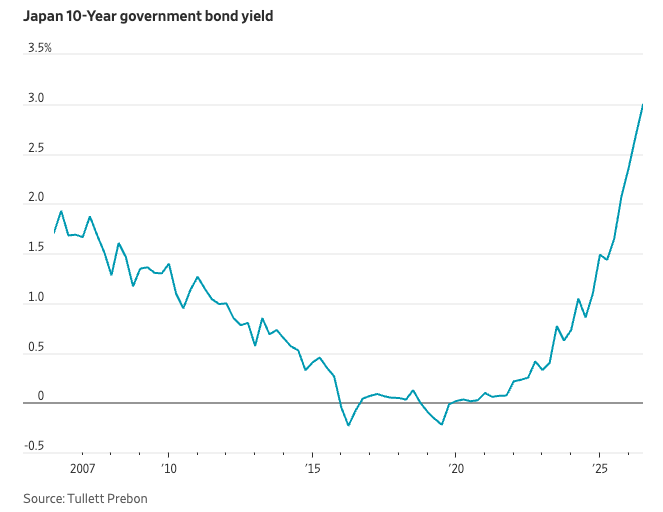
Everyone reads JGB 3% as a fiscal story. For stablecoins, it’s the opposite: the reserve-yield model that built Tether and Circle just became viable in yen for the first time in 30 years. Japan’s rate normalization is a stablecoin story.
MASSIVE:🇯🇵Japan’s 10-year bond yield SURGED to 3%, its highest level since 1996, as the global bond rout intensifies.
Japan faces two MAJOR pressures:
- Japan's next budget could be the largest ever, fueling debt concerns, per Nikkei
- Bessent’s call for Tokyo to “do the right thing” has strengthened expectations of a BOJ rate hike
The yield closed at 2.992%, its highest close since September 1996, per LSEG.
DTCC calling shared ledgers the "elusive golden record" is striking, because DTCC *is* the golden record for US securities. What was elusive was never the record itself but the tiers of custodial books layered on top of it, reconciled daily.
Shared infrastructure doesn't create a new record. It removes the layers. And the same gap exists on the cash side: deposits sit on each bank's ledger, reconciled through the central bank. Put securities on-chain without cash and DvP is still half-built. That's the actual case for stablecoins and deposit tokens.
LATEST: 🏦 DTCC's Nadine Chakar called blockchain's shared infrastructure the "elusive golden record that we've all been chasing for many, many years," speaking with Thinking Crypto.
Not a “tax exemption.” Japan’s FSA is asking to drop the trustee’s beneficiary-change reporting duties for trust-type stablecoins — the one legal artifact that still keeps JPYSC-type tokens inside a single exchange’s ledger. If adopted (Apr 2027 at the earliest), trust-type JPY stablecoins become freely transferable on-chain, and tax law concedes what payments law already did: these are money, not trusts.
LATEST: 🇯🇵 Japan's FSA has requested a tax-filing exemption for trust-type stablecoins starting April 2027, citing frequent use and no income generation for holders.
The detail that matters isn’t the infostealer. It’s the fake SKILL.md.
Malware that hides in an AI agent’s instruction files gets reinstalled every time the agent loads its own context. The victim’s backup was the persistence mechanism.
We’ve spent years securing code supply chains. Agent skill files are now a supply chain — executable trust, distributed as markdown, audited by no one.
If your AI reads instructions from disk, those instructions are part of your attack surface. Treat SKILL.md like you treat a dependency: pin it, hash it, review it.
Hot wallets were just the first casualty of an unsecured instruction layer.
🚨ALERT: If you use Claude, you could LOSE your crypto to malware without ever knowing you were hacked.
The campaigns targeting Claude users spread infostealers that silently grab passwords and browser data, putting exchange logins and hot wallets directly at risk.
One user got hacked through a download link served inside his own Claude chat, from a copycat site bundling malware.
Worse, his backup hid a fake SKILL.md file rigged to silently reinstall the malware EVERY time the AI loaded it.
These campaigns hit 29 organizations in just two days, per Huntress.
The Tectonic exploit is a textbook illiquid-collateral manipulation — pump TONIC ~100x, borrow $75M against phantom value. Nothing new there.
The real story is the halt. Cronos stopped the chain and trapped ~$69M of the $75M before it could exit. That’s an admission with consequences: a network that can freeze an attacker’s assets is a network that can comply with an asset-freezing order. You can’t invoke that power for security incidents and disclaim it before courts and regulators.
Two doctrinal implications:
1.Settlement finality is now conditional. If “final” transactions can be unwound by validator coordination, the legal characterization of onchain settlement — and everything built on it, including tokenized RWAs and stablecoin transfers — inherits that condition.
2.Control implies responsibility. Under most regulatory frameworks, the ability to intervene is what triggers duties to intervene. Every emergency halt narrows the argument that “no one controls the network.”
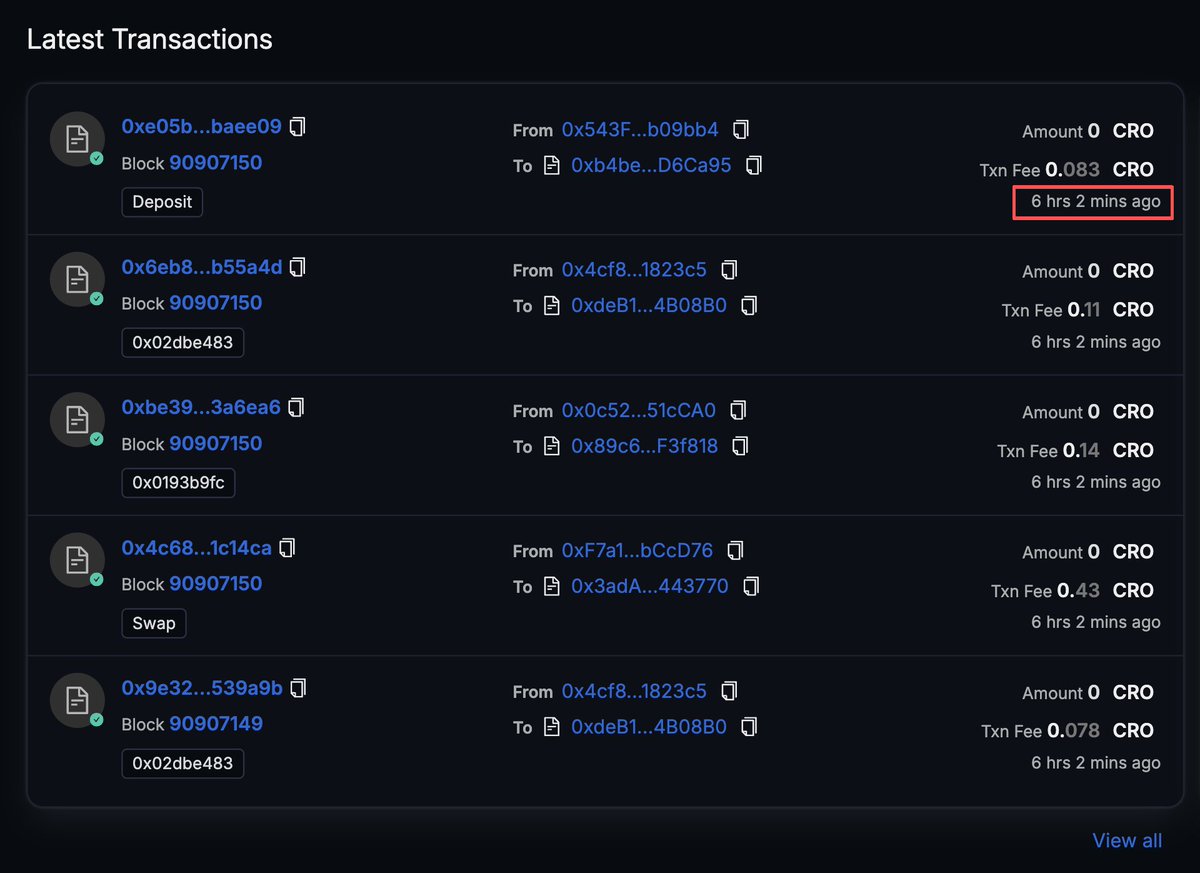
Cronos Halts After Tectonic Exploit; Attacker Estimated to Have Borrowed $75 Million
The CryptoCom-linked Cronos network halted after an exploit hit lending protocol Tectonic. Onchain researcher Weilin Li estimated that the attacker pumped the price of the illiquid TONIC token roughly 100-fold, then used the inflated collateral to borrow about $75 million in other assets. Only around $6 million was bridged to Ethereum before Cronos halted, preventing most of the assets from leaving the network. Tectonic has not confirmed the amount involved or the root cause. CryptoCom said its app and exchange were not compromised.
Effective Aug 7, Japan's FSA reorganizes and establishes its first-ever "Crypto Assets & Stablecoins Division" — upgraded from a councillor-level office to a full division (課).
In Kasumigaseki terms, this is significant: a 課 means permanent budget, headcount, and a dedicated director. Crypto is no longer an "emerging issue" parked in a policy bureau — it's a standing supervisory mandate.
Notably, the division sits alongside a new Payment Services Division under the same bureau. Stablecoins are being treated as core payments infrastructure, not a crypto sideshow.
The Coinbase Bitcoin Premium Index has now been negative for 78 straight days — the longest streak on record (latest: -0.1145%).
This index is a proxy for U.S. spot demand. ETF authorized participants source BTC largely through Coinbase, so a vanishing premium is consistent with slowing ETF inflows.
The regime where "institutional bid" was the market's baseline assumption may be quietly shifting.
Coinbase Bitcoin Premium Index Sets Longest-Ever Negative Streak at 78 Days
CoinGlass data shows the Coinbase Bitcoin Premium Index has remained negative for 78 consecutive days, the longest such streak on record, with its latest reading at -0.1145%. The index measures the BTC price gap between Coinbase and other major exchanges and is commonly used as a gauge of U.S. market demand. A persistently negative reading means Bitcoin is trading at a relative discount on Coinbase, potentially indicating weaker U.S. investor demand or comparatively stronger selling pressure.
Transaction revenue -21%, yet 88% of revenue now sits outside BTC spot trading. The exchange model is quietly converging with the stablecoin issuer model: monetize the float, not the trade. USDC at $20B on platform is the real balance sheet story
Coinbase Q2 Revenue Falls 14% as Prediction Markets Revenue Jumps 106%
Coinbase reported Q2 2026 total revenue of $1.22 billion, down 19% year over year and 14% quarter over quarter, while transaction revenue fell 21% to $599 million. The company recorded a net loss of $359 million and adjusted EBITDA of $208 million. Crypto spot trading volume declined 24% to $146.4 billion, but Coinbase’s share of total crypto trading volume rose from 9.1% to a record 10.3%.
Subscription and services revenue fell 5% to $555 million, representing 48% of net revenue, while revenue outside BTC spot trading accounted for 88%. Prediction markets revenue increased 106% quarter over quarter and exceeded $100 million on an annualized basis. Average USDC held in Coinbase products reached $20 billion.
A five-person company now has the reach of a fifty-person one.
It still has the accountability structure of a five-person one.
That gap is where the next decade of policy arguments happen.
At a small business, the person closest to a problem is often the one who has to solve it—even when it falls outside their job description.
We studied how AI is becoming powerful generalist tool for small teams, helping them work across functions.
✦ two different stories wearing the same costume ✦
Issuer revenue tracks the float. payment adoption tracks the volume. june was bad for the first and record-breaking for the second.
A shrinking market cap with rising turnover isn’t a contraction. it’s a change in what stablecoins are being held for
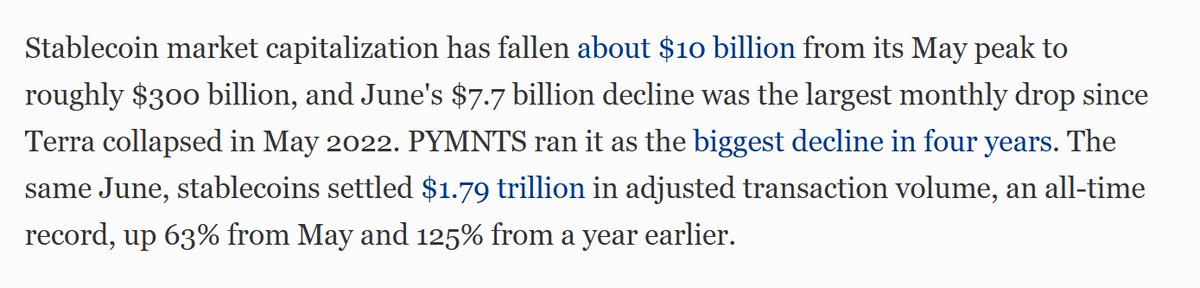
Stablecoin Market Shrinks $7.7 Billion in June, Biggest Drop Since Terra
The stablecoin market lost USD 7.7 billion in June, its largest monthly decline since the Terra-Luna collapse in May 2022, bringing total capitalization down roughly USD 10 billion from its May peak to about USD 300 billion.
Yet adjusted transaction volume reached a record USD 1.79 trillion, rising 63% from May and 125% from a year earlier, suggesting usage for transfers and settlement remained strong even as circulating supply contracted.
Reserve income used to be the issuer’s margin. Open USD reprices it as a distribution cost.
That’s the quiet admission behind the 140 logos: issuance was never the scarce resource. Distribution is.
Every issuer — USD or otherwise — now has to answer why partners should route.