You cannot out-biohack foundational biological dysfunction.
People assume longevity requires hyperbaric chambers, cold plunges, and $5,000 diagnostic stacks. As a physician, 95% of what actually moves the healthspan needle costs nothing.
If you're using a lack of expensive gadgets as an excuse, start here.
3 quiet daily habits that cancel out every longevity effort you make (and the signals to fix first): 🧵
(Habit 1):
Eating within 3 hours of sleep.
Late digestion forces your cardiovascular system to stay active all night instead of entering cellular repair and brain waste clearance (glymphatic wash).
• The signal: Delayed overnight resting HR dip (hits at 5 AM instead of 1 AM) • The fix: Strict 3-hour food cutoff before bed.
(Habit 2):
2. Indoor circadian inversion.
Staying in dim rooms all morning, then blasting blue-enriched screen light at midnight destroys melatonin release by up to 90 minutes.
• The signal: Suppressed deep sleep and elevated core body temp at bedtime • The fix: 10 mins of natural sunlight within 30 mins of waking; dim overheads at dusk.
(Habit 3):
3. Sedentary compression (the "active couch potato").
A 45-minute workout cannot undo 8 straight hours of physical stillness. Continuous sitting suppresses muscular glucose uptake and vascular elasticity.
• The signal: Exaggerated glucose spikes and higher daytime baseline HR • The fix: 2 minutes of walking or movement every 45–60 minutes.
Longevity isn't about collecting gadgets. It's about building physiological resilience and decoding human signals.
Master the biological zero-dollar fundamentals before you spend a dime on biohacking.
If you found this valuable:
Follow @SCHWA_APP for daily insights on biometrics, AI, and healthspan.
Repost the first tweet to help someone fix their foundation.
Most people track steps and calories.
Top performers track autonomic stability. As a physician, here are 5 subtle biometric signals that predict burnout weeks before you actually feel it (and how AI decodes them):
High-utility healthspan framework translating complex data into immediate lifestyle adjustments.
The most interesting implication is not that software engineers become irrelevant. It is that the definition of valuable engineering changes.
As AI absorbs more of the routine coding work, human advantage will shift toward problem framing, architecture, judgment, verification, security, and understanding what should be built in the first place.
We have seen this pattern before in aviation and medicine: better automation does not eliminate human expertise. It raises the level at which that expertise has to operate.
The people who adapt fastest will not simply learn to use AI tools. They will learn how to combine machine speed with human judgment.
There is real strength in becoming comfortable with quiet.
When we no longer need constant stimulation, validation, or activity, we create space to think more clearly, understand ourselves better, and choose our relationships and commitments more intentionally.
Solitude and isolation are not the same thing. One disconnects us from life. The other can reconnect us with ourselves.
Sometimes reducing the noise is what allows us to hear what actually matters.
There is something powerful about continuing when external validation has not yet arrived.
But I think the deeper lesson is this: doubt from others can be fuel, but it should never become the reason for the work. The strongest builders eventually stop trying to prove people wrong and start focusing on proving the idea right.
Persistence becomes far more durable when it is anchored in conviction, evidence, and the willingness to keep refining the path.
Sometimes the breakthrough is not that they were wrong about you.
It is that you stayed with the work long enough to become right.
I agree that thinking shapes behavior, but I would frame it slightly differently.
Our thoughts influence what we notice, how we interpret setbacks, how much effort we invest, and whether we persist long enough for circumstances to change. That is powerful—but the external world does not always “follow” simply because our mindset shifts.
What does change reliably is our response to the world.
In sport, medicine, leadership, and life, the strongest mindset is not believing we control every outcome. It is knowing we can control the quality of our decisions, our preparation, and the meaning we assign to what happens next.
Change the thinking, and you change the behavior. Change the behavior consistently enough, and you often change the trajectory.
@TheBillionaireU Tony Robbins argues that the reason most people fall short of their potential has nothing to do with a lack of talent or ability.
The real bottleneck is something far simpler and far more powerful.
He puts it this way: “The Holy Grail between somebody taking action or not is one word: certainty.”
You can possess massive potential and still freeze in place if you don’t truly believe your effort will deliver the outcome you want. The sequence is straightforward: potential feeds belief, belief drives action, action produces results, and those results either strengthen or weaken the original belief.
When certainty is missing, the cycle turns destructive. Doubt leads to half-hearted effort. Half hearted effort yields weak results. Those weak results then get interpreted as confirmation “See, I told you this was a waste of time. I told you this wouldn’t work.” Belief shrinks further, action shrinks further, and the downward spiral accelerates.
The same mechanism works in the opposite direction. When you generate genuine certainty that a way forward exists, your sense of what’s possible expands. You take more decisive action. Better results arrive. Those results reinforce the certainty. Momentum builds.
This is why Robbins insists certainty outranks motivation. Motivation can spark a single burst of effort. Certainty keeps you moving long after the initial excitement fades and before the proof has fully arrived.
He points to Roger Bannister as living evidence. For decades the four-minute mile was treated as a physiological barrier. The moment Bannister broke it, the barrier dissolved in people’s minds. Within two years, dozens of other runners did the same. Human physiology hadn’t suddenly improved. Only the shared belief about what was possible had changed.
That’s the real cost of treating something as impossible. You don’t merely forecast failure, you reduce the action you’re willing to take, and in doing so you manufacture the very outcome you feared.
We've reached the wearable plateau.
And it has nothing to do with the technology.
For a decade, we've asked our wrists a question they were never designed to answer.
Not "How healthy am I?" but "How well can a wrist understand a human being?"
In Issue No. 29 of SCHWA Signals, we explore why the next revolution in wearables won't be another sensor, another dashboard, or another readiness score. It will be another philosophy.
Inside the article:
🔹 Why a physician from 2006 would call today's smartwatch a miracle and why one from 2046 may be astonished by how little we understood despite all that data.
🔹 What the science actually says about sleep staging, HRV, and readiness scores (validation studies included).
🔹 What aviation, elite sport, hospitality, and leadership already learned about drowning in instrumentation and how they broke through.
🔹 Wearables 3.0: the shift from scores to stories, from surveillance to dialogue, from the individual to the ecosystem.
The first generation of wearables counted our movement.
The second interpreted our physiology.
The third may finally help us understand ourselves.
If tomorrow's technology could measure every heartbeat, every hormone, every molecule, and every movement, would our greatest challenge still be collecting data? Or would it finally become understanding ourselves well enough to change the future?
#SCHWASignals #Wearables #HealthTech #DigitalHealth #HumanPerformance #WearableTechnology #Longevity #PreventiveHealth
In 1911, two teams set out to achieve one of history's greatest feats:
becoming the first to reach the South Pole.
One was led by the Norwegian explorer Roald Amundsen.
The other by the British naval officer Robert Falcon Scott.
Both were courageous.
Both were intelligent.
Both wanted the same destination.
But they followed profoundly different philosophies.
Scott often pushed his team to exhaustion on good days and rested on bad ones.
Amundsen adopted a rule that seemed almost too ordinary to matter.
He insisted his team travel approximately the same distance every day.
Even when conditions were perfect.
Even when they felt capable of doing more.
Even when enthusiasm tempted them to press ahead.
His reasoning was simple:
"If we overextend today, we borrow strength from tomorrow."
The result?
Amundsen reached the South Pole first and returned safely.
Scott arrived weeks later.
His team never made it home.
History often remembers ambition.
It remembers records.
It remembers victories.
What it sometimes forgets is that the outcome was shaped by an invisible decision made hundreds of times before either team reached the Pole:
Whether to be faithful to a system rather than to a feeling.
We often believe success belongs to those who push the hardest.
Human Wealth suggests something different.
It belongs to those who become trustworthy to themselves.
Every morning we make small promises.
"I'll exercise."
"I'll make that difficult phone call."
"I'll finish what I started."
"I'll stop scrolling."
Most of these promises are never witnessed by another person.
But they are witnessed by someone whose opinion quietly shapes the rest of our lives.
Ourselves.
Every promise we keep sends a silent message:
I can rely on myself.
Every promise we repeatedly break sends another:
My intentions are negotiable.
This is what I call self-trust capital.
Like financial capital, it compounds.
Every kept promise is a small deposit.
Every broken promise is a small withdrawal.
Eventually, we discover that confidence was never a personality trait.
It was an account balance.
People with deep confidence have usually spent years making deposits no one else ever saw.
Perhaps that's why genuine confidence cannot be borrowed.
It must be earned.
One ordinary promise at a time.
This Week's Question
What promise to yourself have you been postponing, and what would happen if today became the first deposit into your Self-Trust Capital?
A Thought to Carry This Week
Character is how others learn to trust you.
Self-trust is how you learn to trust yourself.
#HumanWealthCode #Leadership #SelfTrust #Discipline #HumanWealth
In 1846, a young Hungarian physician named Ignaz Semmelweis noticed something that everyone else had accepted as normal.
Women giving birth in one maternity ward were dying from childbed fever at nearly three times the rate of those in another ward within the same hospital.
The buildings were nearly identical.
The patients were similar.
The physicians were highly trained.
Yet the outcomes were dramatically different.
Semmelweis became obsessed with one question.
What was different?
Then tragedy struck.
A close colleague died after accidentally cutting himself during an autopsy.
The symptoms looked hauntingly familiar.
They were almost identical to those of the mothers dying after childbirth.
A possibility emerged.
Doctors were moving directly from the autopsy room to the delivery room without washing their hands.
At the time, no one knew bacteria existed.
The idea sounded absurd.
Physicians were gentlemen.
Gentlemen could not be carrying death on their hands.
Semmelweis introduced one simple change.
A chlorine handwashing solution.
Within months, maternal mortality collapsed.
Thousands of lives could have been saved had the medical community embraced the evidence sooner.
Instead, many rejected it not because the data were weak, but because accepting it required admitting they had been wrong.
Semmelweis eventually died without seeing his idea fully accepted.
Today, every surgeon scrubbing before an operation is quietly continuing his work.
We often think intelligence is measured by how often we are right.
Human wealth suggests something far more valuable.
The willingness to let reality correct us.
Every one of us carries invisible assumptions.
About money.
About health.
About leadership.
About parenting.
About success.
About ourselves.
Most of them feel so obvious that we never think to question them.
That is precisely what makes them dangerous.
Progress rarely begins with a better answer.
It begins with a better question.
The greatest breakthroughs in history were often preceded by a moment of intellectual humility.
Someone looked at the same world everyone else was seeing and quietly asked,
"What if our certainty is the problem?"
This is what I call conviction debt.
Every time we cling to an idea after the evidence has changed, we borrow against our future.
Every time we allow evidence to reshape our thinking, we deposit our human wealth.
Because wisdom is not measured by the number of beliefs we defend.
It is measured by the number of truths we are willing to discover.
This Week's Question:
What belief have you held for years that deserves to be questioned, not because it is necessarily wrong, but because you have never asked whether it is still true?
A Thought to Carry This Week
An open mind is not a sign of uncertainty.
It is a sign of intellectual courage.
#HumanWealthCode #Leadership #CriticalThinking #Medicine #GrowthMindset
In 1982, seven people in the Chicago area died after taking cyanide-laced capsules of Extra-Strength Tylenol.
It was one of the most devastating product-tampering tragedies in modern history.
At the time, Tylenol accounted for nearly 37% of the U.S. pain-reliever market.
Many experts believed the brand would never recover.
Johnson & Johnson faced a decision that would define its future.
Protect profits.
Or protect people.
There was no law requiring the company to recall every bottle nationwide.
It chose to do so anyway.
More than 31 million bottles were removed from shelves at a cost exceeding $100 million, an extraordinary sum in 1982.
The company then introduced tamper-evident packaging, transforming not only its own products but eventually setting a new standard for the entire pharmaceutical industry.
The crisis did not destroy trust.
The response rebuilt it.
Today, tamper-evident packaging is so common that most of us barely notice it.
Yet every sealed medicine bottle quietly reminds us of a decision made more than forty years ago.
The Lesson:
Many people believe trust is earned through success.
I think success only creates visibility.
Trust is earned through decisions made when failure becomes possible.
Anyone can appear confident when circumstances are favorable.
Character is revealed when protecting your reputation conflicts with doing what is right.
Human Wealth teaches that every difficult decision creates one of two assets.
It either protects your image.
Or it strengthens your integrity.
Images impress people.
Integrity outlives them.
The same principle applies far beyond business.
In families.
In medicine.
In leadership.
In friendships.
In our own private lives.
Every difficult decision quietly asks the same question:
"What are you really trying to protect?"
The answer to that question determines something far more valuable than reputation.
It determines whether people and eventually you yourself will trust the person you are becoming.
That is what I call Integrity Capital.
It compounds exactly like trust.
Every difficult decision made for the right reason becomes another deposit.
Eventually, people stop believing your words.
They begin believing your character.
This Week's Question:
What decision are you avoiding because it feels easier to protect your image than your integrity?
Choose the one that your future self would respect.
A Thought to Carry This Week:
Reputation is what people think of you.
Integrity is what remains when no one is watching.
#HumanWealthCode #Leadership #Integrity #Trust #Character
“The harder you work, the luckier you get” is only half the story.
In the SCHWA lens, unstructured effort creates burnout.
Strategic, biologically aligned effort creates compounding advantage.
Real “luck” is built when:
🧠 Cognition is protected → clear decisions
😴 Sleep is optimized → recovery and learning
❤️ Heart resilience is trained → sustained capacity
⚖️ Weight & metabolism are stable → energy availability
🏃 Activity is periodized → performance without injury
High performers don’t win because they grind more.
They win because their systems recover faster than their competitors.
When physiology, behavior, and environment are aligned, opportunity becomes predictable.
That’s not luck.
That’s engineered healthspan.
What system are you building to support your next decade of performance?
Most people treat longevity like a shopping list.
More supplements.
More gadgets.
More hacks.
That’s why most longevity efforts fail.
Longevity doesn’t break down because people aren’t trying.
It breaks down because they’re adding inputs to a system they don’t understand.
You can stack the best supplements.
Track every wearable metric.
Follow every new protocol.
And still feel worse.
Because healthspan doesn’t improve by accumulation.
It improves through alignment.
Alignment between:
• sleep and recovery
• stress and capacity
• metabolism and environment
• effort and timing
• signals and interpretation
When systems are misaligned, more inputs create more noise.
More noise leads to more force.
More force accelerates decline.
The body isn’t asking for more tools.
It’s asking for clarity.
Clarity about what’s actually driving fatigue.
Clarity about why recovery is slowing.
Clarity about which signals matter and which are distractions.
Longevity isn’t a checklist.
It’s a conversation with your biology.
When sleep, cognition, heart, weight, and activity move in rhythm, the body adapts quietly without hacks, heroics, or overwhelm.
Healthspan doesn’t respond to more things.
It responds to understanding the system you’re working with.
That’s where real longevity begins.
Subscribe to my biweekly LinkedIn newsletter, SCHWA Healthspan Signals, where biology becomes clarity.
2026 will quietly redraw the map of healthspan.
Most people won’t notice until it’s too late.
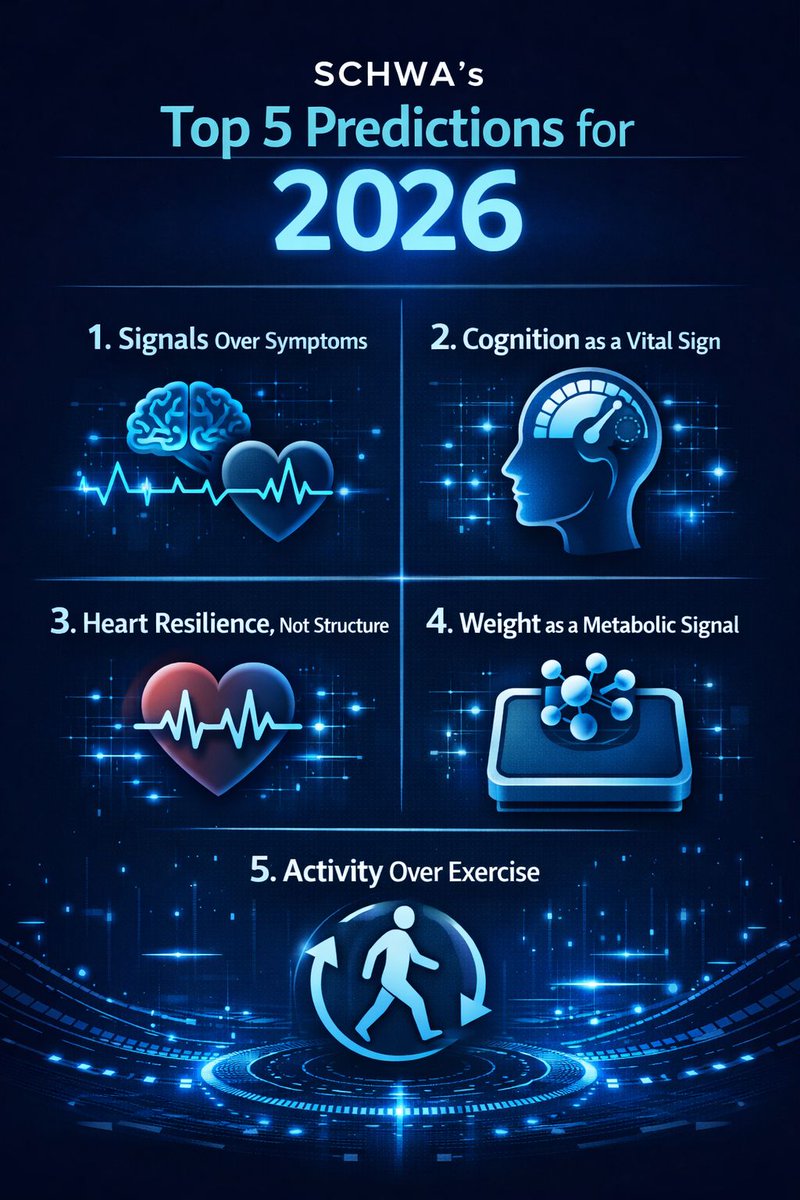
Here are SCHWA’s Top 5 Predictions for 2026 not trends, but structural shifts already underway 👇
🔮 SCHWA Prediction #1: Symptoms officially lose their authority
In 2026, symptoms become late-stage indicators, not starting points.
Health decisions will be driven by:
Sleep instability
HRV collapse
Cognitive friction
Weight volatility
Activity inconsistency
If you wait until pain, fatigue, or diagnosis…
You’re already behind.
Signals > symptoms.
🧠 Prediction #2: Cognition becomes the new vital sign
Blood pressure had its era.
Cholesterol had its reign.
Next up: cognitive performance.
Reaction time
Mental stamina
Decision latency
Focus decay
These will predict cardiometabolic and neurodegenerative decline years earlier than labs alone.
Clinics that don’t measure cognition in 2026 will feel outdated by 2027.
❤️ Prediction #3: Heart health shifts from structure to resilience
The ejection fraction won’t disappear but it won’t be enough.
The future focus:
Autonomic balance
Recovery curves
Stress adaptability
HRV trend integrity
The strongest hearts won’t be the “youngest-looking” ones…
They’ll be the most adaptive.
⚖️ Prediction #4: Weight becomes a signal, not a goal
By 2026, weight loss as a standalone objective quietly dies.
Weight will be interpreted as:
A metabolic signal
A sleep quality echo
A stress-response artifact
A hormonal proxy
Those still chasing numbers will plateau.
Those decoding patterns will progress.
🚶 Prediction #5: Activity replaces exercise as the longevity lever
Gyms won’t disappear.
But movement consistency will outperform intensity.
What matters:
Daily motion density
Recovery-to-effort ratios
Sedentary interruption patterns
Longevity won’t belong to the hardest trainers but to the most rhythmically active humans.
🔑 The 2026 takeaway
Healthspan is no longer reactive.
It’s observed, interpreted, and adjusted in real time.
That’s the operating system shift.
Not more data.
Not more devices.
More meaning.
If 2026 is the year you stop guessing
and start reading your signals you already know where to start.
👉 Enter SCHWA.
Healthspan, always on.
“The body is not a collection of separate parts; it’s an interconnected system.” @Mark Hyman, MD 🌍🧠
This single insight explains why so much of modern healthcare struggles and why the future of healthspan must be different.
When we isolate organs, symptoms, or lab values, we miss the signal.
But when we look at the body as a living system, patterns emerge:
🔹 metabolic dysfunction precedes disease
🔹 sleep disruption reshapes cognition and inflammation
🔹 stress biology rewires hormones and the heart
🔹 environment and behavior quietly dictate long-term outcomes
This is why functional medicine, systems biology, and data-driven wellness are no longer “alternative.”
They are inevitable.
Across the globe, the same question keeps coming up from patients, clinicians, employers, and even insurers:
Why are we still treating consequences instead of trajectories?
The answer is visibility.
When biomarkers, wearables, and AI finally allow us to see how systems interact in real time, health stops being reactive and becomes anticipatory.
That’s when prevention becomes precise.
That’s when care becomes humane again.
Healthspan doesn’t improve because we add more tools.
It improves when we understand the system we’re working with — the human body, in context.
And that systems-first lens is exactly where the next era of medicine is being built. 🔬✨
hashtag#FunctionalMedicine hashtag#SystemsBiology hashtag#MetabolicHealth hashtag#Healthspan hashtag#Longevity hashtag#PrecisionWellness hashtag#AIinHealth hashtag#Biometrics hashtag#FutureOfMedicine hashtag#PreventiveHealth hashtag#WholeBodyHealth hashtag#GlobalWellness
The next decade of medicine won’t be defined by new treatments, it will be defined by new feedback loops.
Not episodic snapshots, but continuous, intelligent, biologically accurate signals that help us adjust daily behaviors long before a diagnosis is ever needed. 🌍💡
Across my work in 67+ countries, from clinics to wellness resorts to longevity conferences, the same truth keeps emerging:
We don’t have a healthcare problem.
We have a visibility problem.
We’ve been treating the consequences of dysfunction because we’ve never had the tools to see it forming.
That is finally changing.
As innovators like Daniel Kraft, MD often show, the future of medicine is a continuous feedback loop in a living conversation between biology, behavior, and intelligent systems.
And when that loop becomes seamless, several shifts happen at once:
🔹 Biometrics evolve from “tracking” to “translation.”
We stop counting steps and start decoding physiology.
🔹 Clinicians stop guessing and start forecasting.
AI doesn’t replace judgment it amplifies it with pattern clarity.
🔹 Patients stop reacting and start self-correcting.
Insight becomes the most powerful therapeutic intervention.
🔹 Care delivery moves from the clinic to the rhythm of daily life.
Hotels, homes, workplaces, and wellness destinations become nodes in a global health ecosystem.
This is more than digital health.
It’s the harmonization of human biology and technology, designed to elevate connection, context, and capability.
The organizations, clinicians, and health systems that understand this shift will lead the next era of global wellness.
The ones that don’t will watch it happen from the sidelines.
Because the future isn’t high-tech…
It’s high-resolution and deeply human. 🔬✨