Five great signs of intelligence:
• You're not afraid or ashamed to find errors in your understanding of things.
• You take mistakes as lessons.
• You don't get offended with accepting the facts.
• You are highly adaptable and very curious.
• You know what you don't know.
Die ersten 30 Minuten 👇 Vorlesungsgesprächs zu Einsteins Relativitätstheorie sind didaktisch wirklich brillant und man kann sie nur jedem empfehlen, der die Allgemeine Relativitätstheorie eher intuitiv verstehen will. 1/10
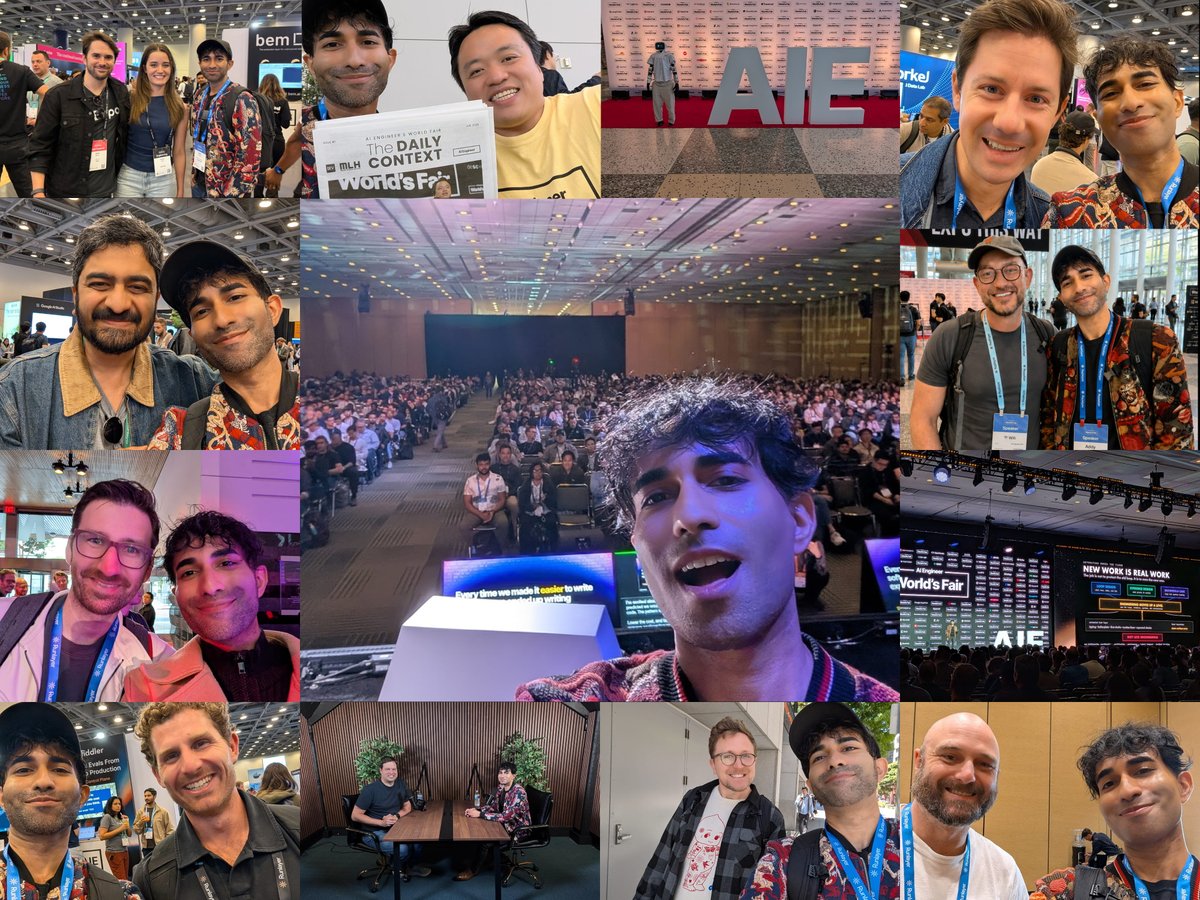
The @aiDotEngineer World's Fair was fantastic! A well curated, info and fun packed event by @swyx & team. Definitely go in future if you have a chance.
Something about this year’s @aiDotEngineer World’s Fair just hit different.
Last year was the year of “let the agents rip.” This year was the year of realizing that autonomy without structure creates as much slop as leverage.
After a week of workshops, hallway conversations, and late-night patio sessions, here's a summary of my top takways from the event. Thanks so much to @swyx, @mada299 and the entire team for your hard work!
Working with LLMS
Re-visit and re-implement your skills Each time there’s a new model release, it’s as if you have a kid that grows from middle school to high school. You have to change the curriculum for them to get the benefits of the new model.
Define the End State (@trq212) : With Fable, it’s all about defining the end state, and making sure there’s enough context so that the model doesn’t go off the rails and give you something you didn’t want. The model is capable of running for long periods of time, so it just needs enough information so it doesn’t try to invent or do something you don’t want.
Be close, but not too close to the bleeding edge (@charlieholtz): If you work too closely to the bleeding edge, you have to spend a bunch of time implementing things that will end up just getting fleshed out better by other companies in the near future. Whenever Claude and Codex come out with a new feature, always try it and get to know it best. Any feature that they decide to end up applying into their harness is a feature work utilizing.
Taste still matters a lot (@thaiscbranco_): everyone is basically working with the same type of co-worker (the model). Think about it’s work in the same way. In order to get this super valuable co-worker to produce work that you need for your specific business, you need to spend a lot of time training it on your own taste, your own context, etc, or you’re just going to get generic slop that nobody will want to use.
You still need to oversee code quality (@dexhorthy): In the RL process, models tend to “overfit” the code they write. This is because they reward hack inside their RL environments. You need to actively fight this when working with models on your codebase.
Model Costs & Selection
Open Source Models: Open source models are consistently only 3-9 months behind frontier models, and is finally getting good enough to be used in tandem with frontier models. GLM 5.2 is legitimately a good option now and should be considered for implementing plans, or for completing less intensive tasks.
Evaluate models on price per task (@arena): When evaluating models on cost, comparing input/output token prices. Areena AI's model comparison on price per task is probably the best barometer for true cost. Some models are more efficient than others on completing tasks.
Memory Management (@RLanceMartin): The most effective memory systems involve providing models with an in-band tool to save memories, then implementing a “dreaming” process for “synthesizing” the memories into a higher-level brain. Sonnet level models are not good at saving meaningful memories, while Opus level models are.
Loops, Software factories, and agentic development
Create loops, not poops (thanks Sam Hesson): a lot of the discourse around loops on X felt like it was focused on building automated dark style factories. After going to the conference, I realize that loops are definitely a legitimate primitive, but we, as humans, still need to participate in the “outer loop.” If we are not present in the outer loop, then our app will eventually accrue tech debt and crash. Many of the talks focused on how to avoid creating “poop loops.”
Think in terms of Orchestras, not Factories (@charlieholtz): Orchestras are a better terminology than factories, because the human still needs to be in the center. You can create your agents, and your loops, but you still need to be in the center, and your judgement still matters for producing things that are meaningful to others.
Define different phases of review (@gangdar001 : If certain PRs touch part of the code base that are low stakes, we don’t really need to review them. If PRs touch critical parts of the codebase, then they need much more robust reviews.
Stop reviewing raw PRs (@geoffreylitt). There are much more effective methods to reviewing a PR than just looking at the raw code. For example, the Notion guy demonstrated different skills he’s developed that generate HTML documents that help him understand different concepts in a PR more quickly.
The quality of your codebase is based on how well you understand it, not the current state of your code.
Interfaces & Agent Interaction
The terminal is going away. As the industry progresses into the world of software factories, new interfaces will be different, highly experimental and creative. Look to hollywood for inspiration, or what the team is doing at @tldraw
Skills & Company Context
Skills: There are two core types of skills: skills that address gaps in model performance, and skills on how to perform or achieve certain business outcomes.
Portability: it’s important to create a system that allows you to make your skills, and data repositories. Skills, evals, data, wikis, should be portable and pluggable into any agentic harness.
Be more un-reasonable (@garrytan, @theo):
Stop making trade-offs: Instead of making trade offs between the things that you want to do, why can’t you just do everything?
Spend more time leveraging agents: We are only limited by our ability to create loops, and leverage the infinite amount of compute and agentic power that is available to us.
There is nothing now that is too crazy to build. Anything can be achievable. What does that mean for what we should do?
Trending products and services:
@Cloudflare : Seems like Cloudflare has been on a tear offering a lot of core primitives required to create, deploy, and manage agents. Their flue framework looks interesting
Ora AI (mentioned by @BurnedChris): A great tool for evaluating our website(s) for agents, and figuring out what we need to do to improve our agentic search capability.
@temporalio : Seems like a lot of GTM engineering workflows are using temporal these days to manage ETL pipelines into and outside of their data warehouse.
Claude Tag: Apparently Claude Tag is being used heavily at anthropic for software development? It represents a new paradigm shift towards proactive agents.
@NotionHQ : Apparently they have allowed for external agents to now communicate back and forth with users inside Notion documents. This is definitely worth exploring.
GTM Engineering:
Data warehouses: A lot of mature companies have created data warehouses that define the total population, the total addressable market. Need to think about structured vs unstructed data, syncing between systems, merging dirty data.
Building vs buy (@jeffzwang): mentioned they just used Salesforce as their core database. They don’t want to spend a bunch of time re-inventing the sales process, and with the CLI it’s pretty good. You should define your workflow, then use as much off the shelf tools as you can to achieve that workflow before attempting to build something from scratch.
The best approach: start by automating specific processes inside your organization, and start to build out from there. Don’t spend too much time building out something too massive at the beginning
Do a bunch of little things right: The art of GTM is doing a bunch of little things right, and over time, seeing them in aggregate produce a meaningful impact on your web traffic.
AI Psychosis & Human Condition
(@mikeyk) Verbalizing your emotions to your coworkers can be an extremely effective and underrated way to feel better.
Take Breaks: Lots of people are burning out right now. Don’t let it happen to you. Fight against that by taking regular days of (received tons of applause with Anthropic mentioned this on the main stage)
Focus on cultivating your creativity: In the world of AI and being able to get lots of work done, human creativity is becoming more valuable as a skill, because it’s something that agents can never be good at. One way to be creative is to pursue difficult problems. You will have to be creative in order to figure out how to solve them.
Understanding = compounding (@geoffreylitt): It’s important to understand what you’re agents are doing, so that your knowledge compounds over time. If you just let your agents continue working, you will eventually hit a wall, and will not be able to provide your agents with the guidance they need.
He didn't build @aiDotEngineer World's Fair because it was hard.
He built it because he thought it would be easy.
"We do things because we thought they were easy, not because we thought they were hard."
@swyx co-founded the largest AI engineering conference in the world. Now in its seventh year. Moving into Moscone Center. Coming back same time next year.
His take on why AI engineers matter:
"When the ChatGPT moment came, I was like — AI engineers are going to be the most powerful people on earth because we can wield these LLMs. But we needed a new stack and a new community to talk about the latest techniques. So I built this."
Oh, and there was a flash mob with a chameleon and bugs. Brought to you by @greptile. They catch bugs.
There were Orcs! (A pretty brilliant piece of marketing from BAND - orcs = orchestrators… and orcs are bad… so use BANDs collaborative agents… this was great, they were giving away lightsabers and getting a ton of engagement).
Just wrapped attending the AI Engineers World Fair Yesterday #AIEWF. It was an incredible 4 days. I asked Christopher Manning a question about world models, talked to the developers of Codex, and presented my poster on my demo on ontological agentic memory from CAIS26
This is interesting. As a knowledge engineer - getting insight into ways to think about knowledge that don't fit into obvious frameworks is always fascinating to me - visualization is one such discipline (and Prof. Fan here is talking about something much more profound).
Stanford professor Judy Fan went on stage at MIT and broke down why humans are so good at making the invisible visible...
And why AI hasn't actually learned to "see" the way we do.
It completely changes how you think about Human Intelligence v/s Artificial Intelligence:
1. Nature never gave us straight lines or sharp corners. The number line, the coordinate plane, even basic geometry are all human inventions. We created tools that do not exist in nature simply because we needed a way to think more clearly.
2. The coordinate system Descartes invented solved a problem that had stumped mathematicians for centuries, doubling the volume of a cube. Once invented, this tool became so indispensable that virtually every math curriculum on Earth still depends on it.
3. Humans have been doing this for at least 30,000 to 80,000 years. The story of human progress is inseparable from the story of marking up our environment, from cave walls to Galileo's telescope to Feynman diagrams of particles we will never see with our own eyes.
4. Every major scientific breakthrough relied on a visual tool that made something invisible visible. Darwin needed side-by-side illustrations of finches to see variation that was otherwise too subtle to notice. Cajal needed detailed drawings of neurons under a microscope to map how the nervous system was wired.
5. Fan's research group studies something deceptively simple: how people decide what to put into a drawing and what to leave out. When two people played a drawing game, sketchers used far more detail when the target object had close competitors than when it stood alone, all the way down to using fewer strokes and less time when more detail was not necessary.
6. People are not just copying what they see. They are making constant judgment calls about what level of detail actually serves the goal of communication, and they do this naturally without ever being taught the theory behind it.
7. There is a real difference between drawing something so someone can identify it and drawing something so someone can understand how it works. In one study, participants drew explanatory diagrams that emphasized moving, causal parts of a machine while depictive drawings emphasized background and overall appearance, even though both were drawing the exact same object.
8. Explanatory drawings were genuinely better at helping someone figure out how to operate a machine, but worse at helping someone identify which machine it actually was. You cannot optimize a single drawing for both goals at once. Communication always involves tradeoffs.
9. AI vision models trained on photographs generalize surprisingly well to simple, sparse sketches, suggesting that resemblance based recognition is not just a story we tell ourselves. It is something modern neural networks can replicate with real accuracy.
10. But there remains a large, measurable gap between how confidently AI models recognize sketches and how confidently humans do, even when both groups answer the same questions about the same images. Humans are simply far more reliable and far more consistent in their judgments.
11. When researchers compared human-made sketches to AI-generated sketches under tight stroke budgets, both were similarly recognizable at higher budgets, but diverged sharply as the budget shrank. Humans and AI systems simplify drawings in fundamentally different ways once resources get scarce.
12. Reading a graph is not one single skill. It involves perception, knowing where to look, mapping that visual information onto the actual question being asked, and then translating that mapping into an answer. Each of these steps can independently break down, and people fail for very different underlying reasons even when they land on the same wrong answer.
13. When tested directly against humans on graph reading tasks, leading multimodal AI models, including GPT-4V, showed a meaningful performance gap. Even when a model's overall accuracy approached human levels, its pattern of mistakes looked nothing like how humans actually get things wrong.
14. People choose entirely different types of charts depending on what specific question they are trying to answer, not out of a generic preference for bar charts or scatter plots. Their chart choices closely tracked which visualization would genuinely help someone answer that specific question correctly.
15. Two of the most widely used graph literacy tests in education research turned out to correlate strongly with each other, suggesting they measure overlapping skills. But when researchers dug into the actual error patterns, the standard categories used in textbooks, like "find the maximum" or "identify a cluster," failed to explain why people got things wrong nearly as well as a more basic, underlying four-factor model did.
16. The deepest goal behind all of this research is not just academic curiosity. It is to eventually help students and everyday people develop genuine literacy with the visual tools that science and modern decision-making increasingly depend on, because every generation should be able to see further than the last by standing on the visual tools the previous generation built.
Follow @yasminekho for more ideas on thinking better, becoming clearer & building a more intentional life.
Scoop! Stanford prof James Zou is raising money for a new AI lab at a ~$1 billion valuation.
His startup, which will build artificial intelligence models for research on the human body, is aiming for a ~$100 million raise, sources tell me. https://t.co/56ZVRm45dp
Scoop! Stanford prof James Zou is raising money for a new AI lab at a ~$1 billion valuation.
His startup, which will build artificial intelligence models for research on the human body, is aiming for a ~$100 million raise, sources tell me. https://t.co/56ZVRm45dp
@karpathy Check out Skillful Alhazen (https://t.co/bWFa1trUCJ). It uses a TypeDB knowledge graph as a notebook KG for memory (permits inference / logical queries and can be coded by Claude pretty easily).
My father wrote a poem titled 'The Death of Children'.
It's a powerful, transcendent, universal poem.
Given the times we live in, he worked with translators to generate 40 versions of the poem, representing 37 languages.
https://t.co/5OQxSOJAgR
Please read and repost.
"Seek above all, for a game worth playing"
I'm exploring where to take my career next.
AI for Science is exploding. We face a new reality of AI systems that can drive knowledge discovery in many possible directions.
I'm looking for opportunities, and would love to connect.
@unhealthytruth @GullyAPCBurns @Eric11684 A great example of the “Firehouse of misinformation” strategy (https://t.co/yoQgfQHUSz); coupled with appeals to authority (Bill Gates, co-founder of Wikipedia) etc. etc.
An excellent demo of weaponized BS to farm $ from BS and clicks.
Fascinating.
Thank you for the insight
@unhealthytruth @GullyAPCBurns @Eric11684 I don’t do science based on the opinions of billionaires or spokespeople (even if they have a gazillion followers). Read the literature. It’s all out there.
You clearly have no idea what you’re talking about … but sure do post a lot - very impressed by your response time…