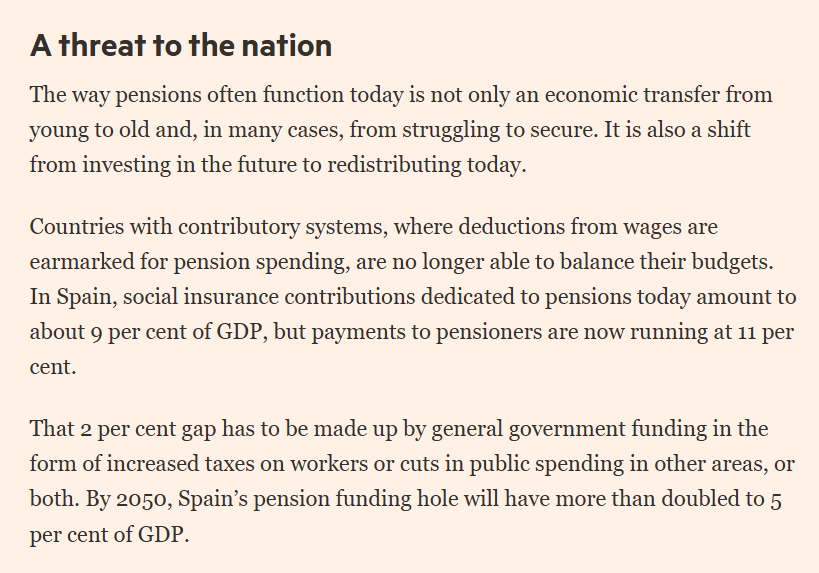
Pese a esta masacre del FT sobre cómo el mundo occidental ha destruido su futuro a costa de transferencias de rentas a los viejos y abandonando la inversión por el asistencialismo—ni hablar ya de un Estado promotor como el de @extramuros_esp —, ayer vimos en prime time a dos tipos peleándose para ver quién daba más a los que ya han recibido todo lo posible en lugar de quién tiene todo por vivir.
La batalla real es esta y la inmigración, dos caras de la misma moneda donde se juega la supervivencia de la nación.
A THREAT TO THE NATION
¿Hablan de Putin? ¿De Trump? ¿De los tecno-oligarcas?
No. Hablan del sistema público de pensiones, tal y como hoy está diseñado.
esto de Óscar López es lo que más me revienta del gobierno actual
me revienta cómo han normalizado copar puestos críticos del estado con apparatchiks del partido que no tienen ni la más remota idea del área que gestionan
pero lo peor no es ya que no sepan, es que se la suda completamente
lo vemos en transformación digital, lo vemos en transportes, lo vemos en red eléctrica y como es de esperar... esas areas están hechas unos zorros
aquí siempre salta el midwit de turno con lo de: "bueno mihura, un ministro es un gestor político, no tiene por qué ser ingeniero ni saber los detalles técnicos, para eso están los asesores"
pues no, eso no es así. Si tu conocimiento sobre la materia que diriges es nulo, careces del criterio más básico para distinguir si el asesor que te está hablando es un técnico competente o un vendehumos profesional
al final, como el gestor es quien elige a quién escucha, lo que ocurre es que un ignorante al mando siempre acaba rodeado de palmeros, parásitos y grifters que le dicen lo que suena bonito mientras le cuelan proyectos de mierda
por eso terminamos financiando con dinero público churros cuánticos, modelos soberanos que nacen muertos o prometiendo "gemelos digitales con IA" para evitar que dos trenes no se choquen en una vía de una dimensión
en el momento de mayor disrupción tecnológica de la historia tenemos los mandos del país entregados a gente cuyo único mérito es llevar veinte años lamiendo culos dentro del partido
es una negligencia criminal que nos está costando el futuro del país y lo peor es que parece que ya nos hemos acostumbrado
I believe the @nvidia board is not acting in the best interest of shareholders nor in a manner consistent with their fiduciary duties.
What we know is that the board fired Jensen or forced his resignation for violating company policy and/or in response to the accusation of an affair with a spy.
They did so without careful consideration of the impact on the company, its customers, its shareholders or other stakeholders.
They rushed to judgment without the benefit of careful due diligence or even with a basic understanding of the facts.
How do we know this?
We know this by how quickly Jensen was fired and how little was known at the time of his firing.
It takes time to convene a board meeting. There was time, maybe, for one Zoom.
And this is a decision that should have been made by a board sitting in person and carefully deliberating the facts once they are known.
And they should have slept on the decision and met again the day after to discuss the facts, the risks and the other implications of their decision.
The timing and lack of information did not allow for careful board deliberation.
While boards can fire a CEO for an inappropriate relationship with a subordinate, it should not be an automatic decision. That is why we have boards comprised of humans and not agents.
A board should consider whether or not such a relationship was consensual or whether it was an abuse of power dynamics. And a board has to consider what the impact of the firing is on all stakeholders.
If I were in this board, I would not have rushed to judgment based on articles in the media. I would have made sure the board had all of the facts so it could make a careful and informed decision.
Boards of Delaware companies have a duty of care which means they must make informed, prudent and good faith decisions. This clearly did not happen here.
What law firm is advising this board?
Or is the board even taken good legal advice?
It doesn’t look like it.
And now the board is compounding its failures by insisting that there is no possibility for Jensen’s return as CEO.
Why is it in the best interest of the company to foreclose the possibility of Jensen’s return and to do so before all of the facts are known? This is yet another breach of their duty of care.
Furthermore, the board has launched an investigation whose scope is unknown. Investigations can be extremely damaging to a company and should be carefully targeted to address whatever facts need to be known rather than be overly broad in scope.
In short, this looks like a series of major governance failures by directors that panicked due to headlines in the media. They likely felt compelled to do something because they were afraid of looking bad in the media, not because it was the right thing for them company.
They couldn’t stand the heat.
The board’s conduct here is shocking for a company of this scale and importance to our country and the world at large, particularly at this moment in history.
report from the permanent underclass - 17.11.2026
- I still believe openai is ahead on the frontier, but they're getting cooked from the inside and the disease is googlification. it was already showing during the last DevDay, and after today's Astra 6.2 and Sol 6.2 drop it's undeniable. Their products are actively getting worse, and if you look at their recent hiring spree it honestly looks like meta 2020. who tf had the brilliant idea of hiding the codex remote control button inside the chatgpt app? it sounds like a stupid detail, but these little friction points tell you everything about the internal decay of an org. They have insane resources and clearly the smartest internal models (navier-stokes, the slopdrop, etc...), yet they are fumbling the product when product is supposed to be their whole thing. Dots is terrible, they are clearly struggling with inference compute, and the whole org looks like a bloated mess. Bearish bc this is a very disease that is very hard to cure
- Anthropic is looking way healthier heading into the IPO this week. We all know their goal is a monopoly on intelligence and a monopsony on compute, and they're executing well on that trajectory. I don't think their internal models are ahead of openai's in raw capability, but their models are way more aligned to useful work. This is probably a reflection of having employees who are also cultishly aligned to the company's mission
- Google is starting to catch up on paper, but i'm still bearish. You simply don't have cracked researchers who don't care about money and can work literally anywhere jumping ship to join rival labs or start their own thing if you're actually on the verge of bootstrapping RSI internally
- China is in a rough spot. western labs are getting much better at blocking distillation, and the compute squeeze is getting painful. The US is getting harsh with anti-smuggling enforcement. Jensen getting ousted from the big N is just a symptom that the china hawks are taking full control. I'm also bearish on domestic chinese EUV in the short term; export controls on lithography are much easier to enforce than on chips, and you don't replicate that supply chain overnight. I expect the gap between US frontier and chinese open-weights to widen over the next 1-2 years, which is an eternity in this transition. Anyway, china has lots of smart and relatively cheap workforce, which is still relevant specially when it comes to creating training envs for models, so we might see some surprises
- Elon is the wildcard here. with the latest starship landing, Spacex starts looking on track to become the ultimate compute provider. It sets up an interesting collision with Anthropic: what matters more in the endgame, a monopoly on intelligence (and a monopsony on compute), or monopoly on the compute and energy?
- Europe is dead in terms of compute. However, as software gets solved, the bottleneck shifts to the physical world. physics and hardware have much slower feedback loops than software, so catching up there via RL is way harder. Central Europe still holds the best western know-how in high-precision manufacturing, optics, and robotics. I expect the technocapital machine to aggressively target and acquire european industrial talent and infrastructure over the next two years
idk, times are interesting, but the outlook for open intelligence doesn't look so great right now
anyway, this is just starting, brace yourselves