Go to a small town. The baseball field is named after some local business owner. New track and field house at the high school. Same. Should be no different with data centers. Put a couple of million into small towns across America and watch this drama end overnight.
One year of making DC safe and beautiful again.
Across our nation’s capital, iconic spaces are getting the care and attention they deserve.
The fountains are flowing, and DC is shining again.
> Finishing the border wall
> 0 border crossings for a year
> Highest arrests of illegal immigrants in recorded history
> Forcing immigration courts to do "mega rulings" rapidly expanding the deportation bottleneck of court precedings
> Record funding for ICE so that it can operate during government shutdowns
> Mass deregulation of nuclear energy development
> Mass deregulation of federal housing codes to build more housing
> Deregulation of the car market to bring back cheaper cars
> Lower taxes for you and working Americans
> Like 1/2 million federal worker layoffs
> Roe V Wade overturn
> Cancellation of DEI SBA loans
> Prosecutions of race based admissions in colleges
> Cancelling medicaid funding for transgender cosmetic surgeries
> Ending USAID
> Largest reduction in pharma drug prices ever in American history through TrumpRX
> End of TPS for haitians
> 175,000 rescinded Visas
This is just off the dome.
Blackpill all you want but there are thousands of people working day and night in the admin to deliver for the American people and they really are.
If you’re confused why communists hate Thanksgiving, fireworks, and football, it’s because you don’t understand the religion you’re dealing with.
They are destroyers. They want to burn down everything around them. Certainly everything good.
Think of them like hungry predators.
The Metro Richmond Flying Squad is asking the community for help restocking essential supplies as extreme heat and a surge in emergency calls have stretched the all-volunteer organization thin. https://t.co/OZjL7ahcxq
Today, on the 250th birthday of The United States of America, a thread of the extant homes of the signers of the Declaration of Independence.
1. Richard Henry Lee and Francis Lightfoot Lee
- Stratford Hall
The communist doesn’t think to increase the quality of the grid. The communist demands that you decrease the quality of your life.
They make you ration the things that every other American gets to enjoy. Every single time.
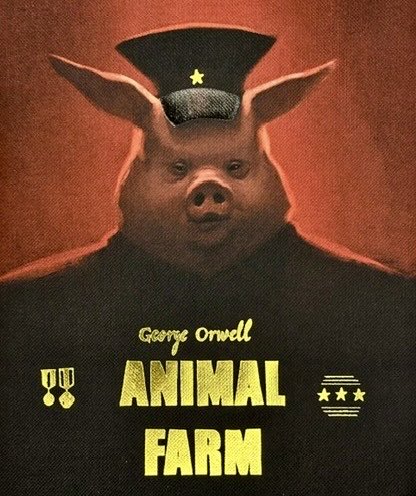
Animal Farm by George Orwell, in short:
1. Old Major, the fattest pig on the farm, delivers a sermon about "liberation." He has never missed a meal in his life – but he is the most envious of the Man – the producer, the entrepreneur…
2. “Whatever goes upon two legs is an enemy” – the ideology is manufactured from the start, designed not to free the animals but to direct their resentment away from the pigs and toward a useful target. Every revolution needs an enemy. The pigs chose the farmer.
3. The revolution’s commandments were never a constitution. They were a management tool – sacred enough to motivate, vague enough to rewrite, and controlled from the beginning by the only ones who could read – the pigs.
4. Boxer the horse, the most honest creature on the farm, decent, loyal yet naive, totally devoted, responds to every setback with the same answer: “I will work harder!” He means it completely. He works himself half to death. It is the most heartbreaking sentence in the book – because the new system is perfectly designed to absorb exactly that kind of devotion and give nothing back.
When he finally collapses from exhaustion, he is sold to the knacker. For cash. The pigs buy more whisky with the proceeds.
The other animals are told he died in a hospital receiving the best care. The most useful animal on the farm is the one who never once suspects he is the product.
5. The commandments get rewritten at night not because power corrupted the revolution – the rewriting was always the plan. Language was the weapon from the first speech Old Major ever gave.
6. “All animals are equal, but some animals are more equal than others” – this is not the system’s failure. It is the system’s true face, finally visible once the animals are too exhausted and confused to object.
7. Orwell’s message: the lie came first. And the "liberation" it promised delivered something far worse than what came before – because the fattest pig was merely selfish at the start, but by the end is selfish and fluent in the language of "justice." He took all the eggs. He took everything. And made the hens thank him for it.
The fattest pig knew what he was doing all along…
As we approach our 250th anniversary, I believe it's worth noting that our government is only actually 165 years old.
The American Republic established in 1776 ended in 1861.
The Civil War cost almost a million lives: one out of every five white men of military age in the South and one out of every ten in the North. It destroyed virtually all of the wealth in the South — a 90% reduction to per capita GDP. The South would not recover economically until 1950.
But the real cost of the war wasn't economic. It was political.
The Civil War destroyed the Federalist system that our founders built to ensure the central government's power remained genuinely limited. Not limited by the goodwill of its legislators, which is no limit at all, but limited by the existence of rival sovereign States, which could restrain the central government and each other through competition.
After 1865 the only real limit to federal power was the self-restraint of the men in office. And that didn't last for long...
But, before we look at the long-term impact of America's first war of aggression, let us dispel a critical myth: that the Civil War ended slavery. Slavery was ending because of technology and economics. And it would have ended just as surely if no war had ever been fought between the States.
Britain abolished slavery, without a war, throughout its empire in 1833, freeing some 700,000 people in the West Indies alone. France abolished slavery in its colonies in 1848. Russia — the most backward great power in Europe — emancipated some twenty-three million serfs in 1861, the very year of Sumter. The Netherlands freed the slaves of Surinam and Curaçao in 1863. Across the entire industrializing world, unfree labor was abandoned within a single compressed generation. And, in no other great nation, was war required.
In America, slavery did not end because of General Grant and the boys in blue. It did not end because of a moral awakening. The cause was economic.
Chattel slavery extracts muscle power from human beings. Therefore, slavery only makes economic sense if muscle power is the binding constraint on production. Once machines had multiplied the labor output of muscle by hundreds of times, slavery was not only immoral but inefficient. In an industrial economy a slave costs more than he yields. As a result, capital flees from slavery into factories. All over the world. And even in the South.
Slavery ended everywhere at roughly the same time for the same reason: innovation and economics. It would have ended in the American South regardless of who won at Gettysburg. Even Brazil, the last holdout in the Western hemisphere, freed its 725,000 slaves with the Golden Law of 1888. No war was required: slavery was no longer productive.
With apologies to the celebrants of Juneteenth, slavery was not legally abolished in the United States until the Thirteenth Amendment was ratified in December 1865. The institution died, not because of the war, but because the world had entered the machine age.
The unnecessary destruction of half of our country and almost a million people wasn't the greatest tragedy of the Civil War. The greatest tragedy was the loss of Federalism and the hard-won liberty Americans won in the Revolution.
The Civil War destroyed the federal structure of the American republic, in which the several States were sovereign in their own spheres, with genuinely different legal systems, cultures, and traditions. The national government was beholden to the States, with only limited and enumerated powers.
The clearest proof of this change lies in our language. Before 1861, the United States was a plural noun. Men said the United States "are." After 1865 our country became singular. The United States "is."
The doctrine that a state could check the central government — by interposition, by nullification, in the last resort by departure — died at Appomattox, and with it the last structural brake on the power of the federal government died too.
The framers had not relied on parchment to limit the government they created. They relied on competition. So long as the States were genuinely sovereign — so long as a man oppressed in one State could remove to another, so long as the national government had to reckon with twenty or thirty rival centers of authority each jealous of its own jurisdiction — the central government could not easily grow into a Leviathan. The States were not administrative subdivisions. They were the Constitution's immune system.
What followed the Civil War was America's first empire -- in the South. And Empire's require a strong central government. Thus began a long erosion of the line between the citizen and the State, and between private institutions and public power.
Twelve years after the war, the Supreme Court considered whether a State could fix by law the prices a private grain warehouse charged its customers. The owners argued it was a taking of their property without due process — that what a man does with his own property, and what he charges for its use, is rightfully his own affair. The Court disagreed. Chief Justice Waite ruled that when private property is "affected with a public interest, it ceases to be juris privati only," and may be regulated by the government for the common good (Munn v. Illinois, 1877).
That was the end of private property in America. After all, if the national legislature may decide which property is "affected with a public interest," and may then dictate its prices and uses, there is in principle no property the government may not control.
Justice Stephen Field saw it and dissented with prophetic fury. The doctrine, he warned, "is nothing less than a bold assertion of absolute power by the State to control at its discretion the property and business of the citizen." A legislature that could fix the uses and prices of property "against the consent of the owner" could "deprive him of the property as completely as by a special act for its confiscation or destruction."
New York City's landlords are finding out the truth of this reality. They believe they own their properties. But they are about to find out otherwise, as rents will now be controlled by the mayor, who is a communist. This will spread. A communist ruling over all of America is only a matter of time. Why? Because the law provides an unlimited incentive for such power. There is nothing in America the government cannot take from you. Nothing.
The proof of the unlimited central authority was established in blood. The courts followed where the armies led. And the first American Empire — the North's conquest of the South — led to more such military adventures, which continue to this day.
In its first century, the United States heeded its founders' warnings against entangling alliances, a large standing army, and foreign military adventures. But the creation of the massive Northern army created its own momentum. Only 20 years after Reconstruction, the country clamored for another Empire and war against Spain. America became an imperial power, with possessions from the Caribbean to the far Pacific — Cuba, Puerto Rico, Guam, the Philippines.
The consolidated nation that emerged from the Civil War was the precondition for the American Empire that emerged in 1898. Power flows to the center, and the center's reach has no natural boundary.
The Leviathan must be fed.
In 1913, every American became a direct serf to the national government: The Sixteenth Amendment gave the federal government the power to tax incomes directly. The size of a government is set, in the end, by the size of its revenues. The income tax removed the ceiling.
The Seventeenth Amendment, ratified the same year, provided for the direct election of United States senators. Under the original Constitution, senators were chosen by the state legislatures. This was the last vestige of State sovereignty. It could not be allowed to stand. The Senate stopped being the guardian of federalism.
And… then… with these Constitutional impediments finally vanquished, you saw Leviathan act to ensure its permanent dominance: it would control the money supply.
In December of 1913, Congress created the Federal Reserve System. The power over money, which the Constitution had strictly withheld from the central government, was enshrined into law. Income tax, a central bank, and the removal of the states from the Senate — all in one year.
The Revolution that began in 1861 was complete. America's Empire had begun.
Munn established that the government may dictate the use of private property. 1898 established that the consolidated nation would project power without limit beyond its borders. 1913 established the revenue, the money power, and the removal of the states from their guard post. The 1964 Civil Rights Act expanded this dictatorial power into every private transaction in America.
Government of the people, for the people, and by the people has been destroyed.
We now live in an Empire, not a Republic.
The Civil War didn't free any slaves; it enslaved all of us.
240 years ago today, the most underrated general in American history died. From a sunburn.
Nathanael Greene was never supposed to be a soldier. He was a Quaker from Rhode Island who ran his family's iron forge. He had asthma, a stiff leg that gave him a permanent limp, and zero combat experience. His own church suspended him just for going to watch a military parade.
So how did he end up commanding the entire Southern army? He read. He bought every book on warfare he could find and taught himself strategy from scratch. Washington noticed, and trusted him more than almost anyone.
By 1780 the war in the South was a disaster. The previous American general got beaten so badly he fled 200 miles on horseback. Congress let Washington pick the replacement, and he picked Greene without hesitation.
Greene's plan was insane. He looked at his small, starving, half-naked army and decided he could not win, so he would lose correctly. He ran Cornwallis all over the Carolinas until the British were exhausted, far from supply, and bleeding men they could not replace. "We fight, get beat, rise, and fight again."
At Guilford Courthouse, Cornwallis technically won the battle and lost a quarter of his army doing it. That was the whole point. Greene lost almost every fight on paper and won the entire South. Cornwallis limped off to a little tobacco port to rest and refit. The port was called Yorktown.
Here's the part that should make you angry. To feed and clothe his men, Greene personally co-signed for war supplies because the government wouldn't pay. When the bills came due, Congress refused to honor them. The man who saved the South came home buried in debt that wasn't his.
Georgia gave him a plantation near Savannah as thanks. He finally had peace. Then one hot afternoon in June 1786 he spent the day walking a neighbor's rice fields with no hat. He collapsed from sunstroke and a week later he was dead at 43.
One last twist. After he died, his widow Catharine took in a broke young houseguest tinkering with an idea. His name was Eli Whitney, and the cotton gin was invented at the dead general's home.
June 19, 1786. Remember the name. Nathanael Greene.
I’m fighting for a western civilization where none of them had to die.
We’re not fighting red vs. blue.
We’re fighting good vs. evil.
Darkness vs. light.
We must win.
The aristocratic urge to fight for one’s home, hearth, people and culture against the tyrannical overreach of the central government and its quest to stop our local sovereignty
My friends, from the globalist perspective you must always accept their #1 priority is information control.
It doesn't matter what the tool or technique of the day being discussed it, the #1 issue -for them- is to control information.
Look at everything, including and importantly the current AI discussions and debate, through the prism of information control.
COVID-19 taught you the lesson. Information control is the objective. Social media restrictions, internet restrictions, the terms 'mis-dis-mal-information' etc., the AI race, election systems they can manage, demonetizing or deboosting, CISA, the payment to "influencers", media bans, all of it, the sum of every effort, tool and technique is about controlling information.