COP31 has ended without a deal.
It’s the first time since 2009 that a COP failed to agree to a cover decision and it happened on Australia’s watch.
A consensus on nuclear in global decarbonisation plans would have been more meaningful.
But anti nuclear ideology meant one of the world’s largest sources of clean energy didn’t even make it into the final draft.
If COPs want to make a difference to the climate perhaps they should start with why countries like Australia still object to sources of clean energy…
some Sunday speculation around the IESO's ridiculous capacity valuation of winter solar - featuring an update of my BI reporting of generating contracts and sites in ON (with the IESO Q3 contract listing and my mostly OPG additions).
the IESO delusion could be driving contracting
hey @IESO_Tweets , this looks frivolous.
Most of Canada realizes the trivial capacity value of solar in winter. How come you feel that resource is more reliable in winter here than anywhere north of Mexico?
Maybe NERC misunderstood your information.
https://t.co/YA7epSVr1l
solar has value in displacing fuel/gas.
pretending it has a winter capacity value in Ontario is irresponsible - and stupid.
I hope the IESO's procurement design is smarter than their NERC submission.
hey @IESO_Tweets , this looks frivolous.
Most of Canada realizes the trivial capacity value of solar in winter. How come you feel that resource is more reliable in winter here than anywhere north of Mexico?
Maybe NERC misunderstood your information.
https://t.co/YA7epSVr1l
Your actual immediate situation (from NERC).
the IESO claimed the emergency capacity arrangement with US company (OIL fueled) is a late outage - I'll guess from Bruce Power who has grown a preference for winter outages.
Oil because the natural gas pipes are full at energy peaks.
I appreciate ON's Energy Minister noting the long-term outlook here.
A couple of things...
1. it's a bad, petty bitching, column from Yakabuski, which ought not have been amplified.
2. NERC...
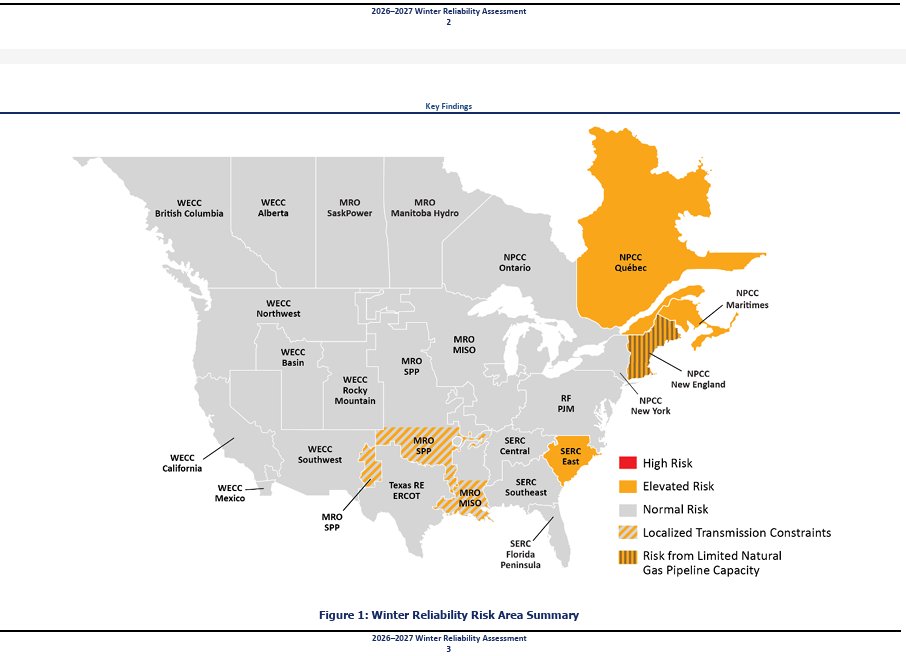
This map from the North American Electric Reliability Corporation (NERC) tells a story about energy reliability. It is predicated on the capacity of provinces to generate power to meet demand.
What stands out to you?
Ontario stands alone in northeastern North America with a stable long-term reliability outlook.
The facts speak for themselves.
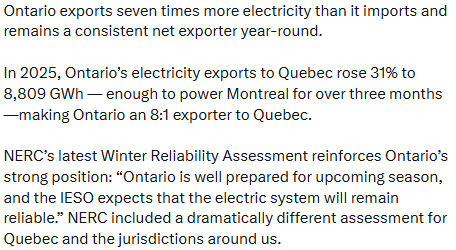
Ontario exports seven times more electricity than it imports and remains a consistent net exporter year-round.
In 2025, Ontario’s electricity exports to Quebec rose 31% to 8,809 GWh — enough to power Montreal for over three months —making Ontario an 8:1 exporter to Quebec.
NERC’s latest Winter Reliability Assessment reinforces Ontario’s strong position: “Ontario is well prepared for upcoming season, and the IESO expects that the electric system will remain reliable.” NERC included a dramatically different assessment for Quebec and the jurisdictions around us.
This is no accident. It is the result of proactive planning and historic investments in Ontario’s electricity future.
Ontario and the IESO launched LT2 — the largest competitive procurement in Canadian history, targeting 7,500 MW of new supply. We've already secured 1,755 MW, with another window opening in early 2027 for renewables, batteries and natural gas.
More than 1,000 MW of new, cost-competitive natural gas generation is expected to enter Ontario's grid by 2028.
We've launched the largest energy efficiency program in Canadian history, already reducing demand by 11% — part of our plan to save 3,000 MW by 2036.
We're also advancing North America's largest nuclear expansion and refurbishing Pickering, which will secure 2,200 MW of reliable power for an additional 38 years.
We're advancing new hydroelectric power in the North while re-contracting 26 of Ontario's large hydro assets, representing more than 1,000 MW, at rates 20% below previous contracts.
Our all-of-the-above approach has positioned Ontario as the ONLY jurisdiction across the region with a stable outlook. NERC has recognized Ontario and the IESO for their proactive planning and layered approach to short- and long-term reliability.
That work will continue. Ce travail continuera.
Your actual immediate situation (from NERC).
the IESO claimed the emergency capacity arrangement with US company (OIL fueled) is a late outage - I'll guess from Bruce Power who has grown a preference for winter outages.
Oil because the natural gas pipes are full at energy peaks.
if it was moving outage tasks into this year's $120/MWh rate period from next year's $200/MWh one (requested), management must be having quite a laugh at the expense of all of us (a.k.a. their stakeholders).
@kyoto_bear I can see that argument in some situations (without agreeing) - but not where the argument is about getting remote communities less dependent on diesel.
100% agreed.
The idea that the more they spend (on wires) the more you save is as suspect as it ought to sound.
I don't have a problem with connecting local grids in the Yukon and NWT, but it ought to be part of a QC-style "plan Nord" - not some sham claim about consumer benefit
⚡️Utility bills may be insulated but federal taxes will not be
⚡️We don’t have excess hydro and nuclear right now
⚡️Cold snaps tend to be regional and neighbours all face supply issues at the same time
I think fundamentally we should be focused on increasing generation instead of building interties. But let’s at least be specific about which interties have a benefit > cost
𝗣𝗵𝗼𝗻𝘇𝘆 𝘇𝘂𝗿𝘂̈𝗰𝗸 𝗮𝘂𝗳 𝗱𝗲𝗺 𝗥𝗮𝘀𝗲𝗻 ⚡
Nach seiner Verletzung trainierte Phonzy heute erstmals wieder individuell. Zusammen mit Serge absolvierte er Läufe und erste Übungen mit Ball. 💪