Yesterday, I watched Naza.
I did not go to learn what had happened in Gaza. I am from there. I am one of the victims of this war, one of its witnesses, and one of those who have paid a price that will not end when the war does.
I did not need a film to tell me how entire neighborhoods were wiped away, how residential buildings were bombed with the people still inside them, or how families were forced to leave their homes without knowing where they were supposed to go.
Nor did I need anyone to tell me about the famine. I lived through it twice, with all its humiliations, down to the smallest detail. Or about the starving people who were killed while trying to reach what were so absurdly called “food distribution centers.”
I know all of this.
I was there.
Read the whole Thread below :
#Naza @yuval_abraham
Heil Austria 🧵
Mustafa Ayyash cresce nel campo profughi di Nuseirat a Gaza, a quindici anni crea il forum online "Gaza Now" che riscuote un successo clamoroso. Raggiunto il sogno di fare il giornalista, fonda "Gaza Now news" che in pochi anni diventa uno dei media più popolari della regione.
Nel 2017 riesce a raggiungere l'Austria da dove pensa di raccontare liberamente i crimini di Israele senza il pensiero di ricevere in regalo un missile in camera da letto.
A differenza di quei cialtroni dei media mainstream europei, ignoranti e felici di raccontare Gaza attraverso le veline degli invasori, Ayyash racconta la sua città, la sua gente, e non si può parlare di Gaza omettendo i combattenti della Resistenza.
Ayyash pubblica tutto, senza censura. Pubblica i video di Hamas ma anche quelli di altre fazioni e personalità politiche che si oppongono ad Hamas.
Con l'inizio dello sterminio, Israele vieta ai media di entrare a Gaza, il mondo deve sapere solo attraverso i portavoce dell'esercito sterminatore.
"Gaza Now" è una spina nel fianco della narrazione israeliana, diventa la principale fonte di informazione su Gaza per i giornalisti internazionali, pubblica in continuazione video dall'inferno di Gaza che ottengono milioni di visualizzazioni.
Su Telegram, "Gaza Now" raggiunge due milioni di iscritti.
Tutto questo per Israele è intollerabile, e contrattacca con i suoi noti metodi democratici.
A novembre del 2023, un missile colpisce l'abitazione di Ayyash a Gaza e uccide la madre, il padre e venti parenti tra i quali bambini e una neonata.
Gli Stati Uniti sanzionano "Gaza Now" e il giornalista Ayyash in quanto "presunto facilitatore finanziario chiave" (?) di Hamas.
(Classica pagliacciata tipicamente americana: "Gaza Now" pubblica migliaia richieste di donazioni provenienti da Gaza ma i canali che effettuano il passaggio di denaro sono americani o europei).
Nell'aprile del 2024 la polizia austriaca irrompe all'alba in casa di Ayyash e lo arresta insieme alla moglie.
Sequestrano tutti i dispositivi elettronici.
Dopo un luogo interrogatorio, vengono rilasciati.
Ayyash ha paura, capisce che questo è solo l'inizio, ma continua i suoi viaggi nelle città europee per raccontare la distruzione di Gaza.
Nell'agosto del 2024 l'Austria spicca un mandato di arresto europeo per Ayyash, la polizia olandese esegue e lo arresta.
Israele chiede l'estradizione, Ayyash entra in sciopero della fame, gli olandesi scendono nelle piazze per manifestare contro la detenzione del giornalista.
Dopo due mesi rinchiuso in carcere, l'Olanda consegna Ayyash alle autorità austriache.
Da novembre del 2025, il giornalista Ayyash è rinchiuso in attesa di processo in cella di isolamento per 24 ore al giorno, vietata l'ora d'aria, vietato avere colloqui con altri detenuti.
Le accuse della giustizia austriaca a carico del giornalista palestinese sono un'offesa al diritto, l'ennesimo passo verso l'israelizzazione delle società europee.
Ayyash, assente da Gaza da nove anni, è accusato di finanziare e APPARTENERE contemporaneamente ad Hamas, Fronte Popolare per la Liberazione della Palestina, Jihad Islamica, Brigate dei Martiri di al-Aqsa e pure la libanese Hezbollah.
(Un record da Guinness dei primati!)
Il processo dovrebbe iniziare a dicembre, gran parte delle accuse si basano su informazioni e prove SEGRETE fornite dai servizi di intelligence israeliani.
Ed essendo segrete, l'imputato e l'avvocato difensore non possono prenderne visione.
Questa non è più una questione palestinese, qui siamo davanti all'abbattimento delle colonne portanti delle nostre democrazie.
Dovrebbe interessare tutti.
Israeli occupation authorities have placed Palestinian writer, journalist and political analyst Rasem Obeidat, 67, under six months of administrative detention without formal charges or a public trial.
Obeidat was arrested during a raid on his home in Jabal al-Mukabber, occupied Jerusalem, in the early hours of September 27, 2026, and interrogated at the Moscovia detention center.
On September 29, occupation authorities issued the six-month detention order based on what they described as a “secret file.”
They wanted to burn her, but didn't want to waste gasoline. How Israeli soldiers gangraped and murdered a girl
For 54 years the fate of a young Bedouin girl who disappeared in the Negev desert was relegated to rumour and a single entry in the diary of David Ben-Gurion, the prime minister of the fledgling Israeli state.
"It was decided and carried out: they washed her, cut her hair, raped her and killed her," he wrote.
After that the case became one of the state's earliest secrets, and no more than hearsay passed between soldiers.
Now the Israeli newspaper Ha'aretz has used previously classified army documents to reveal the full story of what Mr Ben-Gurion called a "horrific atrocity".
In August 1949, an army unit stationed at Nirim in the Negev shot an Arab man and captured a Bedouin girl with him. Her name and age remain unknown, but she was probably in her mid-teens.
In the following hours she was taken from the hut and forced to shower naked in full view of the soldiers. Three of the men then raped her.
After the Sabbath meal the platoon commander, identified by Ha'aretz as a man called Moshe who had served in the British army during the second world war, proposed a vote on what should be done with her.
One option was to put her to work in the outpost's kitchen.
Most of the 20 or so soldiers present voted for the alternative by chanting: "We want to fuck". The commander organised a rota for groups of his men to gang rape the girl over the next three days. Moshe and one of his sergeants went first, leaving the girl unconscious. Next morning, she complicated matters by protesting about her treatment. Moshe told one of his sergeants to kill her.
She was forced into a patrol vehicle with several soldiers, two carrying shovels, and they drove off into the dunes. When the girl realised what was about to happen she tried to run, but only made it a few paces before she was shot by a Sergeant Michael.
Her body was buried in a grave less than a foot deep.
A few days later the battalion commander, Yehuda Drexler, asked Moshe if he had carried out an order to return the girl to her village.
He was ordered to write a report. Ha'aretz has obtained a copy.
It said: "In my patrol on 12.8.49 I encountered Arabs in the territory under my command, one of them armed. I killed the armed Arab on the spot and took his weapon. I took the Arab female captive. On the first night the soldiers abused her and the next day I saw fit to remove her from the world."
He and most of the soldiers at the outpost were tried in secret. Some said they were carrying out their commander's orders. The military judges rejected that line of defence. Moshe denied rape. "Morally speaking, it was impossible to sleep with such a dirty girl," he told the court.
He was acquitted of rape but convicted of murder and sentenced to 15 years in prison. The judges likened his stated willingness "to murder even women and children in cold blood" to "Hitler's methods in France".
Nineteen other soldiers received light sentences of between one and three years, mostly for "negligence in preventing a crime".
The appeal court reduced their sentences, saying: "At the time there was a general feeling of contempt for the life of Arabs ... and sometimes wanton events occurred in this sphere. All this helped create an atmosphere of 'anything goes'.
"We are convinced that this atmosphere existed at the Nirim outpost, too."
But the government and army understood the shame that would fall on the armed forces if the girl's fate became known to wider Israeli society, so the murder and trial were classified as secret.
The case was briefly resurrected at the trial in 1956 of Israeli soldiers and police officers who murdered 43 Arab civilians in Kafr Qassem, to help establish the precedent that there is no defence in obeying illegal orders.
Then it disappeared from view again.
Several years later members of a kibbutz near the Nirim base noticed that the wind had uncovered a small hand.
Source: https://t.co/lDIBJ07gCz
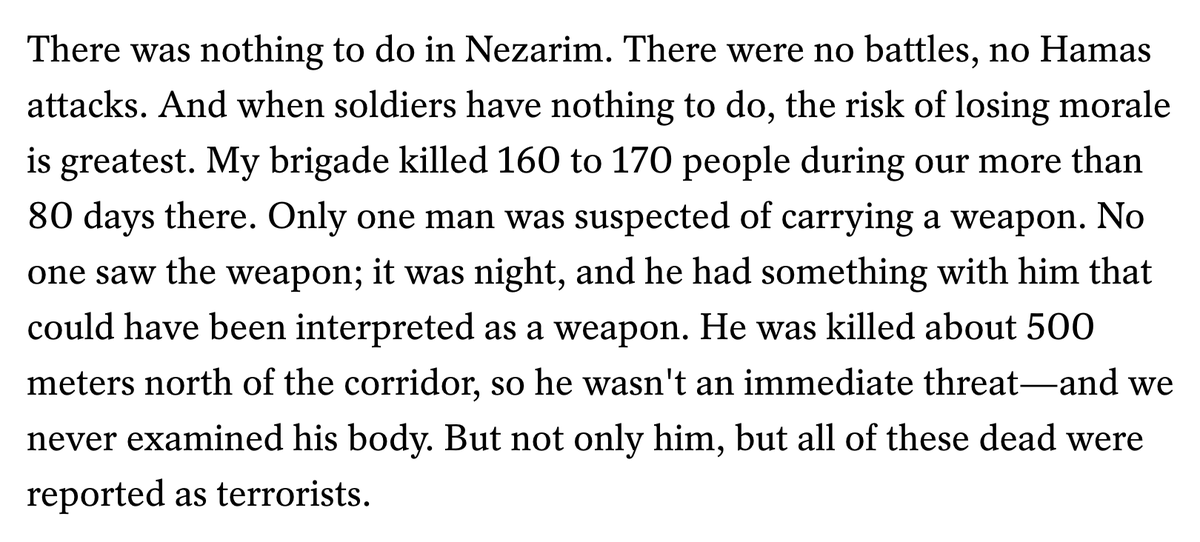
"My brigade killed 160 to 170 people . Only one man was suspected of carrying a weapon. No one saw the weapon; it was night, and he had something with him that could have been interpreted as a weapon. all of these dead were reported as terrorists."
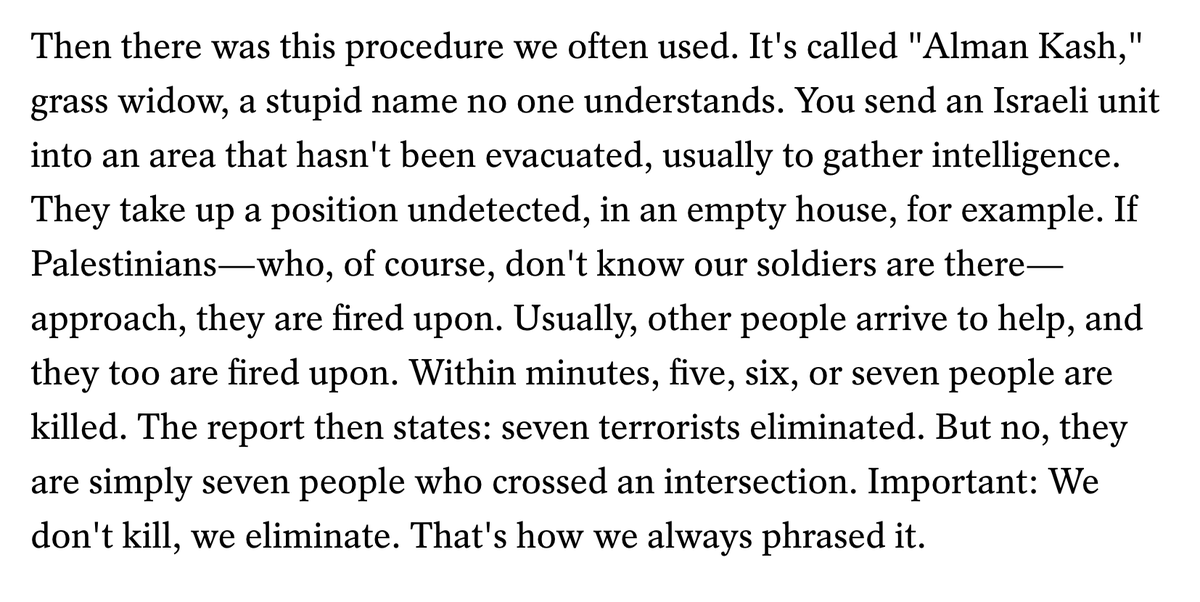
10 IDF soldier testimonies: