musician, programmer and card-carrying autist, trying to answer questions about digital art (got any?)
currently reading: Gideon the Ninth by Tamsyn Muir
It's surreal, but - Order of the Sinking Star, a very special puzzle game that I've been working as a puzzle designer on for 3 years, has a DEMO OUT NOW for Steam Next Fest!!!
The team is so talented, and we've put so much work into this game. Check out the demo!! :) Excited!!
The free demo for Order of the Sinking Star has been going great -- people really like it! We will upload Part 2 for you on Friday morning, but if you haven't tried it yet, you may want to get in there and play before the new puzzles drop!
https://t.co/z4KE9ENEEc
We live in a weird time of overhyping slop that will be forgotten about in weeks. Linux and Python are both from 1991. LLVM started as research project in 2000.
We want to build the foundations of silicon life. Software that lives for 50 years. There's time to make it perfect.
New video with Marc "Mahk" LeBlanc is up! On the heels of our ECS interview, Mahk is back with a much more intuitive construction for the typical "random selection from a series of unknown size" problem often faced in game development:
https://t.co/hhx9kArOC4
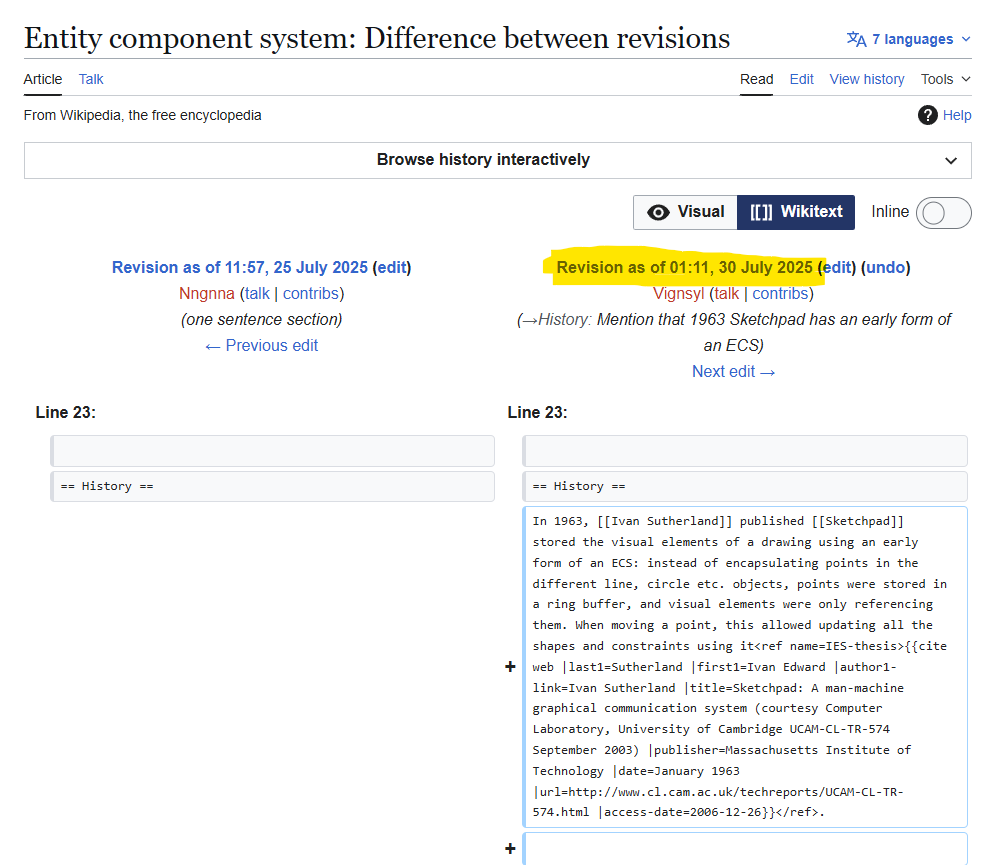
I wonder where Wikipedia suddenly got the idea that SketchPad used a proto-ECS? Surely it was by spontaneously reading his thesis, as the reference in the article would imply, and definitely not by watching my historical analysis of the topic which was posted 13 days prior.
@cmuratori@ahmedsabrylilah@PeaboffRatsman in practice fast math isn't even that much faster (ryg found the difference to be around 2 percent or less when he tested it)
PSA since this was going around: this is incorrect on modern desk/laptop CPUs. The only part that's vaguely correct if you squint at it is "multiplication is 4" if you pretend it's talking about latency, which is irrelevant for these loops, since they aren't serially dependent.
Graphics API should NOT know my data. My CPU code writes it directly to GPU memory. My shaders read it. I use whatever data layout I please. API should not care!
Windows/posix thread launch doesn't ask me to describe the data either. A void ptr is enough! That's good design!
As the family IT guy its so disappointing how bad of an experience technology is for non-technical people.
I had the distinct pleasure of building educational software for kids full time for a summer while in college (s/o to @WilliamsonMark), and I remember they did weekly/biweekly user testing where a group of toddlers would come in and we'd record them using the software in various states and then adjust accordingly.
Every single session was SHOCKINGLY illuminating. Like, I expected after a number of these I'd empathize more and build better toddler software one-shot right? Hell fucking no. Every user study was so educational. I learned I simply can't enter the mind of a toddler.
Do TV companies, Netflix/Roku/etc. do user studies with elderly people? Do they realize how dogshit and impossible to navigate their interfaces are?
Asking some elderly family members to "sign up and schedule an Uber to pick you up for the airport" is like mission impossible. I thought they were exaggerating, then I tried the experience and holy shit man. Try cold finding, installing, signing up, and scheduling an Uber on a 5 year old iPhone with max font size. Its insane.
I strongly believe there are entire companies right now under heavy AI psychosis and its impossible to have rational conversations about it with them. I can't name any specific people because they include personal friends I deeply respect, but I worry about how this plays out.
I lived through the great MTBF vs MTTR (mean-time-between-failure vs. mean-time-to-recovery) reckoning of infrastructure during the transition to cloud and cloud automation. All those arguments are rearing their ugly heads again but now its... the whole software development industry (maybe the whole world, really).
It's frightening, because the psychosis folks operate under an almost absolute "MTTR is all you need" mentality: "its fine to ship bugs because the agents will fix them so quickly and at a scale humans can't do!" We learned in infrastructure that MTTR is great but you can't yeet resilient systems entirely.
The main issue is I don't even know how to bring this up to people I know personally, because bringing this topic up leads to immediately dismissals like "no no, it has full test coverage" or "bug reports are going down" or something, which just don't paint the whole picture.
We already learned this lesson once in infrastructure: you can automate yourself into a very resilient catastrophe machine. Systems can appear healthy by local metrics while globally becoming incomprehensible. Bug reports can go down while latent risk explodes. Test coverage can rise while semantic understanding falls. Changes happens so fast that nobody notices the underlying architecture decaying.
I worry.
One of the absolute killers of productivity in programming (and most other disciplines) is too much overlap between people's work. The highest velocity teams are doing mostly independent streams of work with infrequent, well defined points to combine the results.