Is it even Corpus Christi if you don’t hear this sung beautifully in Latin?
Rufina Lefiguier is helping instruct the faithful in beautiful liturgical hymns online and is leading an ancient parish on the outskirts of Paris in song every Sunday.
Sublimely beautiful!
Ray’s Rock - Omaha Beach
On the morning of June 6, 1944, 23 year old Staff Sergeant Arnold “Ray” Lambert came ashore with the first wave of the 1st Infantry Division on the eastern side of Omaha Beach. At this small patch of concrete he saved nearly 20 lives:
The division came under intense fire from several German bunkers surrounding the entrance to the Colville Draw (one of two exits off Omaha Beach). Ray, a medic, immediately went to work.
He was shot in the arm. Moments later he was hit by shrapnel in the leg, but Ray kept pulling men to safety. He pulled nearly 20 wounded soldiers to cover behind this 8ft wide obstacle, treating each soldier before going out in search of others.
After several hours under fire, while pulling a wounded soldier from the ocean, he was struck by a landing craft. It dropped its ramp on top of him, breaking his back. He fell face down in the water, drowning. The craft backed up and nearby soldiers pulled an unconscious Ray to safety, eventually evacuating him off the beach.
Remarkably, Ray had already earned two Silver Stars and three Purple Hearts in Sicily and North Africa, prior to landing in France. But here in Normandy his war would end.
He awoke in a hospital back in England a day later. In the next bed over was his brother, who had also been wounded at Omaha.
When asked about his work on D-Day, Ray simply said, “I did what I was called to do.”
Ray Lambert passed in 2021 at 100 years old. He exemplified the best of American grit and why remembering this day is so important.
They had been married for only 20 days.
Most newlyweds dream of a long life together.
A home.
Children.
Years of shared memories.
But for Saints Timothy and Maura, their marriage would end on a cross.
And it would become one of the most extraordinary love stories in Christian history.
Timothy was a young lector in the Church, responsible for safeguarding and reading the Sacred Scriptures. Maura was his newlywed wife.
They had been married for less than a month when persecution broke out in Egypt during the reign of Emperor Diocletian.
Timothy was arrested and ordered to surrender the Christian books in his care.
He refused.
The authorities tortured him mercilessly, demanding that he reveal where the Scriptures were hidden.
Still, he would not betray Christ.
When the governor learned that Timothy had recently married, he ordered Maura to be brought before him.
Perhaps, he thought, she could persuade her husband to give in.
Instead, she strengthened him.
Standing before the governor, Maura boldly professed her faith in Jesus Christ.
The enraged officials turned their cruelty upon her as well.
For days, the young couple endured horrific tortures.
Their bodies were broken.
Their wounds multiplied.
Yet neither abandoned Christ.
Ancient accounts tell us that during their suffering, Timothy and Maura encouraged one another to remain faithful.
Rather than despair, they spoke of Heaven.
Rather than fear death, they fixed their eyes on eternity.
Finally, the governor sentenced them both to crucifixion.
Two crosses were erected facing one another.
For nine long days, the young husband and wife hung there in agony.
Yet rather than despair, they encouraged one another.
They prayed together. They sang hymns. They reminded each other of Christ's suffering and the promise of eternal life.
When one grew weak, the other strengthened them.
Their final days were not filled with bitterness.
They were filled with faith.
Together, they endured.
Together, they hoped.
Together they carried their final cross.
Around the year 286 AD, Timothy and Maura surrendered their souls to God and entered Heaven as martyrs.
Their story reminds us that the strongest marriages are not built merely on human love, but on a shared love for God.
Timothy and Maura were married for only a few weeks on earth.
But their union lasts forever in Heaven.
Saints Timothy and Maura, pray for us.
In the name of the Father, and of the Son, and of the Holy Spirit. Amen.
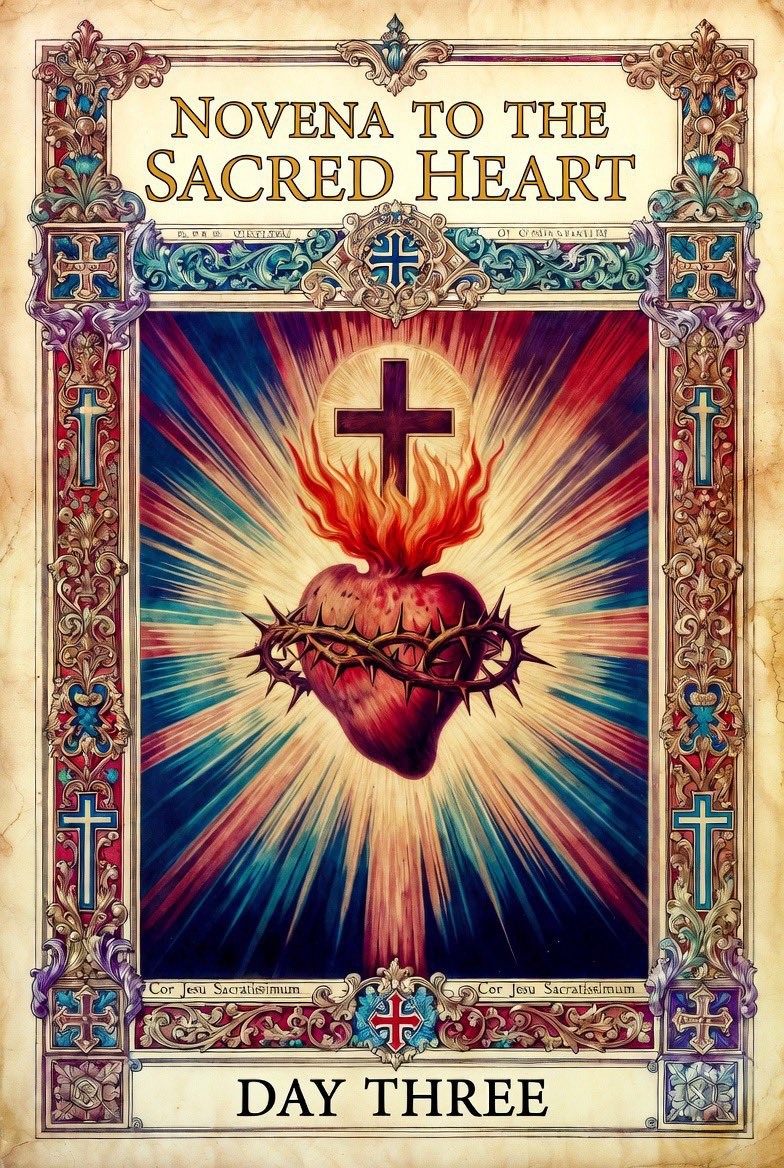
O my Jesus, You have said: “Truly I say to you, ask and you will receive, seek and you will find, knock and it will be opened to you.”
Behold I knock, I seek and ask for the grace of…
(Mention your Intention Here)
Sacred Heart of Jesus, I place all my trust in you.
O my Jesus, You have said: “Truly I say to you, if you ask anything of the Father in My name, He will give it to you.” Behold, in Your name, I ask the Father for the grace of…
(Mention your Intention Here)
Sacred Heart of Jesus, I place all my trust in you.
O my Jesus, You have said: “Truly I say to you, heaven and earth will pass away but My words will not pass away.” Encouraged by Your infallible words I now ask for the grace of…
(Mention your Intention Here)
Sacred Heart of Jesus, I place all my trust in you.
O Sacred Heart of Jesus, for whom it is impossible not to have compassion on the afflicted, have pity on us miserable sinners and grant us the grace which we ask of You, through the Sorrowful and Immaculate Heart of Mary, Your tender Mother and ours. Amen.
In the name of the Father, and of the Son, and of the Holy Spirit. Amen.
When you fight for the life of your dog…
… But murder your baby out of convenience.
“Wherever there is animal worship, there is human sacrifice.” — G.K. Chesterton
Yesterday Charlotte ordained 10 men to the priesthood, a record high in the diocese’s 54 year history. Interestingly, 8 of the 10 ordained came from parishes directly impacted by Bishop Martin’s restrictions against the TLM and/or altar rail ban. Meanwhile, two of the mega parishes in Charlotte, both of which fit the liturgical style +Martin favors-including one with over 12,000 registered families-haven’t produced a priestly vocation since well before COVID. Will this vocations boom continue in the coming years under Bishop Martin?
[Photo credit: Catholic News Herald]
Let every knee bend before Thee, O greatness of my God, so supremely humbled in the Sacred Host. May every heart love Thee, every spirit adore Thee and every will be subject to Thee!”
To make a good confession is to approach the Sacrament of Penance and the Rite of Reconciliation with honesty, humility, and a sincere desire to be reconciled with God and the Church. It begins long before one enters the confessional. The first essential step is a thorough examination of conscience. One sits quietly, prays for the light of the Holy Spirit, and reviews the commandments of God and the precepts of the Church. This is not a hurried scan for dramatic sins but a careful reckoning with the ways one has failed in love of God and neighbor. Failures in prayer, unkind words, neglect of duties, or harboring resentment all come into focus. The goal is clarity, not self-justification.
Next comes true contrition. It is not enough to feel embarrassed or afraid of consequences. Genuine sorrow flows from recognizing that sin offends a loving God who has given everything. This sorrow may be imperfect, arising partly from fear of punishment, yet it must include a willingness to turn away from evil. From contrition springs the firm purpose of amendment, a concrete decision to avoid sin and the occasions that lead to it. Without this resolve, confession risks becoming mere ritual rather than genuine conversion.
Then one goes to the priest for the actual confession of sins. Confession itself demands candor and brevity. One begins with the traditional words, states how long it has been since the last confession, and names sins clearly without excuses, unnecessary detail, or, God forbid, story-telling. The priest is not there to be shocked but to absolve in the name of Christ. If clarifications are needed, the priest will ask. Otherwise, assume the priest understands the nature of the sins confessed. After the sins are spoken, one listens carefully to the counsel offered. The priest assigns a penance, usually a prayer or act of charity suited to repair the harm caused by sin.
Finally comes absolution. As the priest speaks the words of forgiveness, the penitent makes an act of contrition, often the traditional prayer expressing sorrow and the promise to sin no more. Once absolved, one leaves the confessional resolved to perform the penance promptly and to begin anew. A good confession restores grace, heals the soul, and strengthens the will against future temptation. It is not merely the end of guilt but the beginning of renewed or a deepened friendship with God. Regular, honest use of this sacrament keeps the soul pleasing before God and the heart open to divine mercy.
Under Bishop Earl Fernandes, the Diocese of Columbus in Ohio is witnessing remarkable Catholic growth
The Catholic population has doubled in the diocese past three and a half years
Hundreds people became Catholic in the diocese at this year’s Easter vigil
The number of seminarians surged from 17 to over 40
First new Catholic school to open in the diocese in 30 years
Many students entered into full communion with the Church at the Newman Center near Ohio State University this year
Follow @HCatholictimes for great updates from the diocese. Her coverage is excellent.
Image: Diocese of Columbus






![LiturgyGuy's tweet photo. Yesterday Charlotte ordained 10 men to the priesthood, a record high in the diocese’s 54 year history. Interestingly, 8 of the 10 ordained came from parishes directly impacted by Bishop Martin’s restrictions against the TLM and/or altar rail ban. Meanwhile, two of the mega parishes in Charlotte, both of which fit the liturgical style +Martin favors-including one with over 12,000 registered families-haven’t produced a priestly vocation since well before COVID. Will this vocations boom continue in the coming years under Bishop Martin?
[Photo credit: Catholic News Herald]](https://pbs.twimg.com/media/HJqazAMXMAEdNEW.jpg)


