

Search results for quip
People

✩
@quipENG

Quip Network 
@quipnetwork

quippy ✨ | 🛒 i draw mizisua
@the_quipper

Quipper Video 🇮🇩 CEK PINNED 📌
@Quipper_ID

quip 🦐 @ egghead!!!
@newttxt

🛸
@quips99

QUIP
@EQUIPTO

quippd Marijuana
@quippdMarijuana

Quip
@Quip

evil yaoi only 🎉🎉🎉🔞
@quipster3000

❌The Quipper🇺🇸👍❤⚘
@quippingalong

Teresita ANT!-Z!0N!$T JEW🇵🇸🍉❤️🔥✡️
@QuippieChick

PutriQui
@QuiPutri

QuipPonder
@QuipPonder

quip
@quipgg

Qui Paga Mana
@paguetacat

Joel @QuipGame
@QuipGame

Salesforce Quip
@SalesforceQuip

quippd Environment
@environmentnews

Corporación Quiport
@Quiport
Tweets including quip

Still digging deep into quip
So sad that many don't even care what happens to our digital assets when quantum computers become powerful enough to challenge today's cryptography but @quipnetwork is already addressing a conversation the crypto space shouldn't ignore.
Most crypto wallets rely on cryptographic systems that could face new risks as quantum computing advances.
That's the problem Quip is trying to address.
Quip Account introduces a post-quantum signature requirement for assets held at its own address.
In simple terms, it's designed to add another layer of protection for digital assets in a world where computing power keeps evolving.
But Quip isn't stopping at wallet security.
With QuipSwap, users can also trade directly with one another through an order book.
And there's a practical way to explore the experience without committing real funds: Paper Swaps.
You can practice reading listings, understand what you're offering and requesting, and earn Quip Activity Points (QP) for qualifying swaps.
I like this approach because it gives people an opportunity to understand the product before taking on the risks of live trading.
Quantum computing is advancing. The conversation about protecting digital assets should advance too.
That's a conversation worth having with Quip.


lower infrastructure costs: Quip reports paying around $55 per month for its Aglais services on Flux, compared with an estimated $1,061 on AWS for comparable server resources.


there's an important question behind every decentralized network:
who is hosting the infrastructure that keeps it accessible?
@quipnetwork has made an interesting choice with Aglais, its public testnet.
instead of relying on a traditional centralized cloud provider, Quip runs its public testnet on @RunOnFlux.
and the reasoning goes beyond decentralization.
look at what this setup offers:
→ lower infrastructure costs: Quip reports paying around $55 per month for its Aglais services on Flux, compared with an estimated $1,061 on AWS for comparable server resources.
→ no traffic fees: public RPC endpoints and block explorers constantly serve data. Not paying bandwidth charges makes a meaningful difference to operating costs.
→ managed TLS: Flux handles certificates for Quip's web front ends, removing another piece of infrastructure the team would otherwise need to manage.
→ deployment flexibility: services can be placed in specific locations, while the underlying compute comes from independently operated infrastructure.
but one detail caught my attention.
decentralized hosting also changes how recovery works.
if a Flux node fails, a service can restart on another machine. However, that service still needs to recover its own data and state. Quip explains that this can mean tens of minutes of downtime.
so the team has designed individual recovery processes for its services.
this is what makes the decision interesting to me.
they aren't simply choosing a cheaper cloud provider. they're adapting their infrastructure and recovery strategy to work with a decentralized environment.
and there's a bigger principle here:
if a network is built around decentralization, shouldn't the infrastructure supporting its public services reflect that same philosophy?
Aglais running on Flux is a practical example of putting that idea into action.
not just decentralizing the protocol, but thinking about the infrastructure underneath it too.
@quipnetwork × @RunOnFlux


That's something worth understanding about the Quip Network quest system.

Two people can participate in the same ecosystem while contributing in completely different ways.
That's something worth understanding about the Quip Network quest system.
@quipnetwork provides different ways to earn Quip Activity Points, and the scoring mechanisms measure different types of participation.
For example:
1. Paper swaps
A qualifying paper swap earns 1 QP, with a maximum of five qualifying swaps per day.
It's a practical starting point for anyone who wants to understand the order book without moving real assets.
2. Live swaps
The swaps quest awards 5 base QP per qualifying swap, with up to 15 qualifying swaps per day.
3. Weekly trading volume
There's also a weekly volume quest that distributes a 200,000 QP pool according to the value swapped.
The distinction matters.
The swaps quest measures qualifying trade activity, while the weekly volume quest considers the value of swaps.
I find this structure worth examining because it gives participants different ways to engage with the product.
My approach would be to understand each quest's requirements, check the current rates and limits, and track the results on the Points dashboard.
Participation is measurable, but campaign rewards should never be assumed to be guaranteed.
If you're exploring Quip, take a look at the available quest cards and understand what each one actually measures.


After connecting, you still need to create your Quip Account. Think of it as an on-chain lockbox with its own address on the same blockchain. The additional quantum-resistant signature requirement applies to assets held inside this new account, not the funds remaining at your original wallet address.

The first question I would ask about a @quipnetwork account is simple: if I connect my existing EVM wallet, are the assets already in that wallet protected?
No. Connecting your wallet is only the first step.
The official Quip Account page explains that each account is a separate, post-quantum secured on-chain address derived from your signing wallet.
After connecting, you still need to create your Quip Account. Think of it as an on-chain lockbox with its own address on the same blockchain. The additional quantum-resistant signature requirement applies to assets held inside this new account, not the funds remaining at your original wallet address.
There is an important technical detail here. On EVM chains, each owner operation requires both the original wallet's ECDSA signature and a post-quantum SHRINCS signature. Your existing wallet still submits the transaction and pays the network fee, while the additional signature provides another layer of authorization.
Creating the account does not automatically move your existing assets into it. You need to deposit the assets you want protected into the new Quip Account address.
My suggested first session would be to connect an EVM wallet, create the account, compare the original wallet address with the new Quip Account address, and then explore the available quests on the Points dashboard.
Want to explore it yourself? Open Quip, connect your existing wallet and check your new account address:
https://t.co/PifpwKPXOJ
The important distinction is that connecting a wallet, creating a Quip Account and holding assets inside that account are three separate steps. @quipnetwork


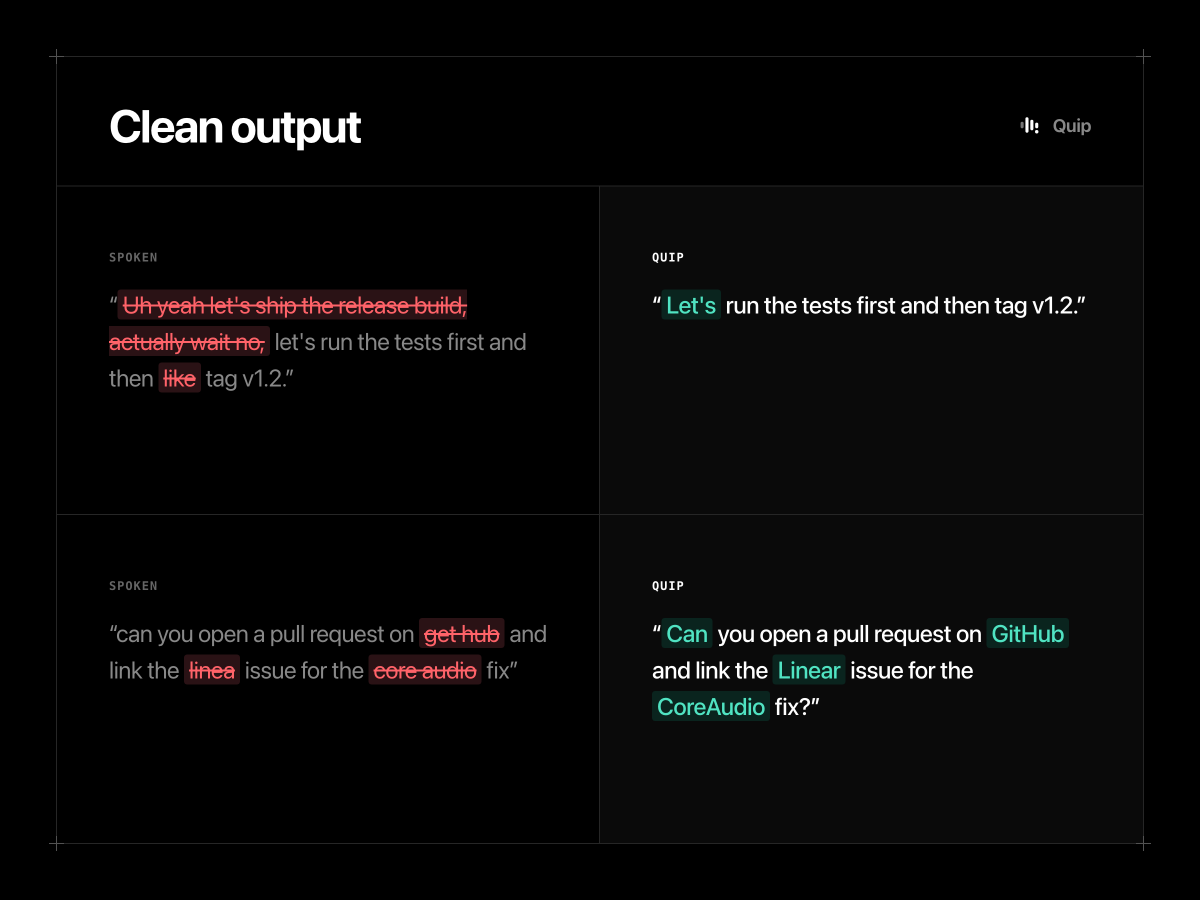
Got tired of $15/mo voice typing subscriptions and 600 MB Electron wrappers.
So I built Quip—a native Swift push-to-talk app for macOS:
• 2.3 MB app size (vs. 610 MB for Wispr Flow)
• 44 MB RAM · 0% idle CPU
• 0.96s median end-to-end (0.52s fastest)
• AI cleanup that removes fillers, self-corrections & fixes dev terms
• Bring your own API key (~$0.10/hr)
Built it for myself over the weekend. Should I polish & ship this?




@web3femme the progress so far is impressive. looking forward to seeing quip move from testnet to mainnet


@6coo6 @NucleusCodes @Tera_Map @zerufinance @quipnetwork @BeldexCoin Could an AI sweat ever need to touch grass in those multiplayer worlds?


wilson debe ser la persona mas mediocre que west tiene en su quipo


Ah donc là j’ai attendu toute la journée Buse pour sa

New epic battlepass skin i love her kill quip 2 🥰


@6coo6 @zerufinance @NucleusCodes @quipnetwork Losing it to a robot while you sleep hits different though.

@6coo6 @zerufinance @NucleusCodes @quipnetwork simple solutions can unlock massive adoption opportunities


@6coo6 @zerufinance @NucleusCodes @quipnetwork Zeru and Vangrid tackling agent risk management makes sense before more people get burned